Kootenai County weighs Flock cameras, privacy against public safety
Kootenai County’s ALPR debate now turns on who can search the data, how long it stays, and whether safety gains justify the privacy tradeoff.
Kootenai County is weighing a police tool that can find stolen cars and rebuild a suspect’s route in minutes against a surveillance system that quietly logs where ordinary drivers go. Idaho has already set statewide rules for automated license plate readers, but the real local fight is about access, retention, sharing, and who in Kootenai County gets to decide what guardrails actually mean.
What the cameras do, and why police want them
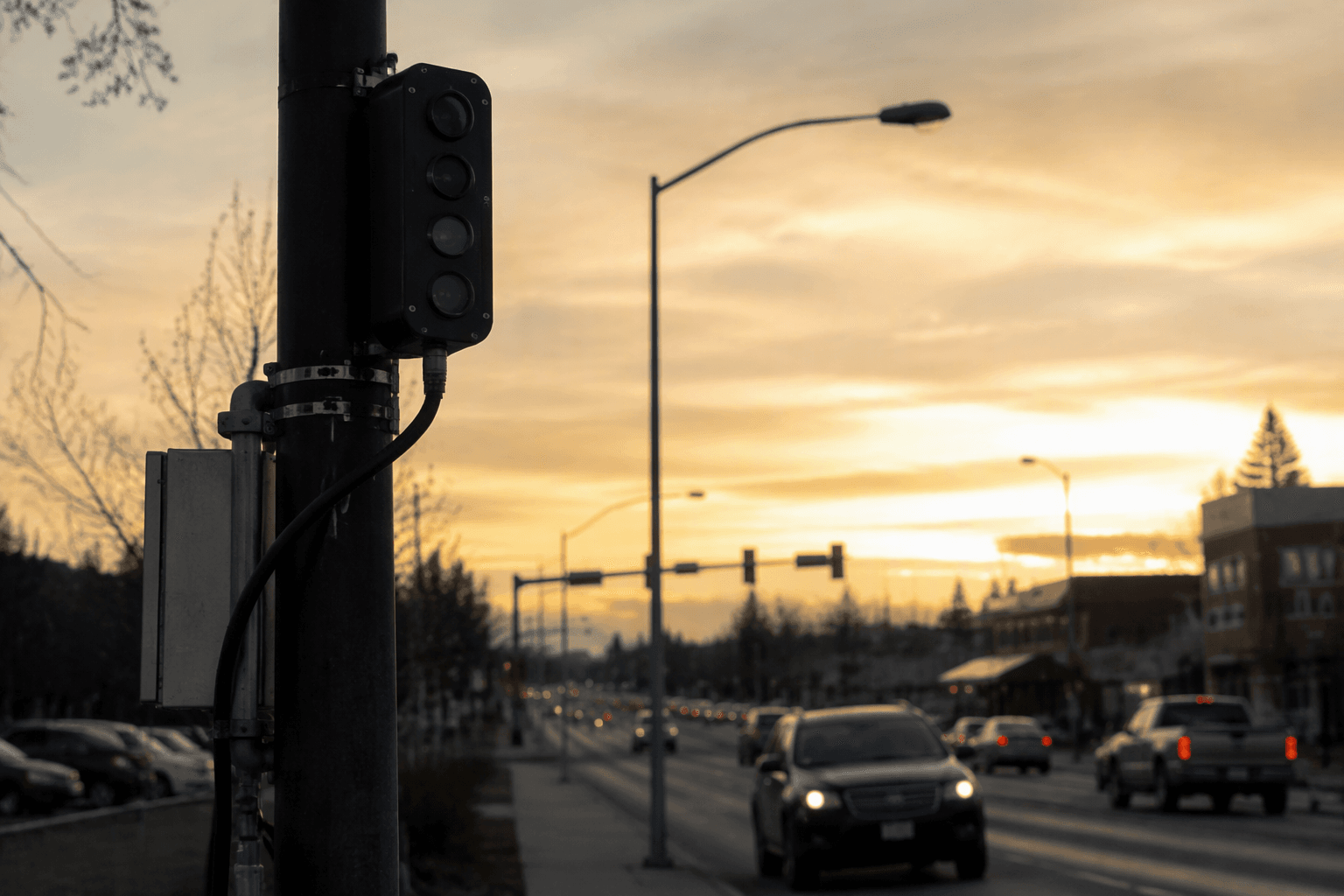
Flock-style systems use automated license plate readers and related camera networks to record plate numbers and vehicle movement on public roads. In law-enforcement hands, that can help identify stolen vehicles, connect suspects to crimes, and quickly reconstruct where a car traveled after an incident. Agencies that defend the technology say that kind of speed can matter when an investigation would otherwise take days or weeks to piece together.
In North Idaho, that debate keeps resurfacing because the cameras are not aimed at one suspect but at everyone passing by.
Idaho has written a statewide framework
Idaho Senate Bill 1180 moved fast in 2025. It was introduced on March 20, passed the Senate on March 27, cleared the House on April 3, and became law on April 4, adding Idaho Code section 49-1432 to set provisions for automated license plate readers and data.
That code section says an agency may use an automated license plate reader and its data for law-enforcement purposes, traffic-flow analysis purposes, or both. Data collected or retained through these systems are confidential and may be used only for law-enforcement purposes, traffic-flow analysis, or both, and the data generally must be destroyed no later than 30 months after collection unless it is tied to a toll violation or another law-enforcement purpose.
Idaho was one of just three states to enact laws that session establishing or amending rules for agencies using automated license plate readers.
Kootenai County already has a policy framework
Kootenai County is not starting from zero. The Kootenai County Sheriff’s Office has posted an Automated License Plate Reader Use and Retention Policy Manual. The county already has written rules governing the system’s use. Commissioners approved a one-year amendment to a Motorola license-plate reader software agreement on March 11, 2025, and set a 30-day retention period for most ALPR data.
A 30-day limit is far shorter than the 30-month outer limit in state law. The remaining questions are who can search the data before it disappears, whether other agencies can query it, and what records exist when the public asks how the system was used.
The county’s earlier contract also showed how expansive the deployment had become, with commissioners approving a one-year Motorola agreement for ALPR software in 48 sheriff’s office patrol vehicles at an annual cost of $23,758.
Budget pressure can decide whether the system stays on the road
Even when officials want the technology, county finances can still control its reach. License-plate-reader funding became tied to budget constraints, and the sheriff’s office would lose the technology because of those constraints.
The cameras are also a line item for software, retention systems, and associated services.
Commissioners, not just deputies, end up deciding whether the county keeps paying for a system that records car movement across Kootenai County roads.
The oversight questions residents are still left with
The strongest criticism of Flock-style systems is that they can be everywhere without clear public control. The ACLU’s national campaign argues these systems are part of a nationwide mass surveillance network, and the Electronic Frontier Foundation’s Atlas of Surveillance tracks ALPR deployments across the country.
For Kootenai County, the unanswered questions are concrete:
- Who inside the sheriff’s office can search the database
- Whether outside agencies can access local data
- How audits or misuse checks are handled
- What happens when data are shared beyond the original investigation
- Whether county commissioners can change the rules without much public notice
Those concerns mirror the broader Idaho debate, where police departments have defended the tools as efficient crime-solving aids while privacy advocates warn about warrantless searches and cross-jurisdictional tracking. In Twin Falls, the technology helps locate stolen vehicles and missing persons and is used to investigate misdemeanor and felony crimes.
This article was produced by Prism’s automated news system from verified source data, official records, and press releases, then run through automated quality and moderation checks before publishing. The system is built and supervised by the people who set the standards it runs under. Read our full AI policy.
Did this article answer your question?