Little touts session wins in Hayden, including Kootenai road funding
Little used his Hayden stop to argue Kootenai County is getting real dollars, led by $20 million for road work as growth and congestion strain local systems.
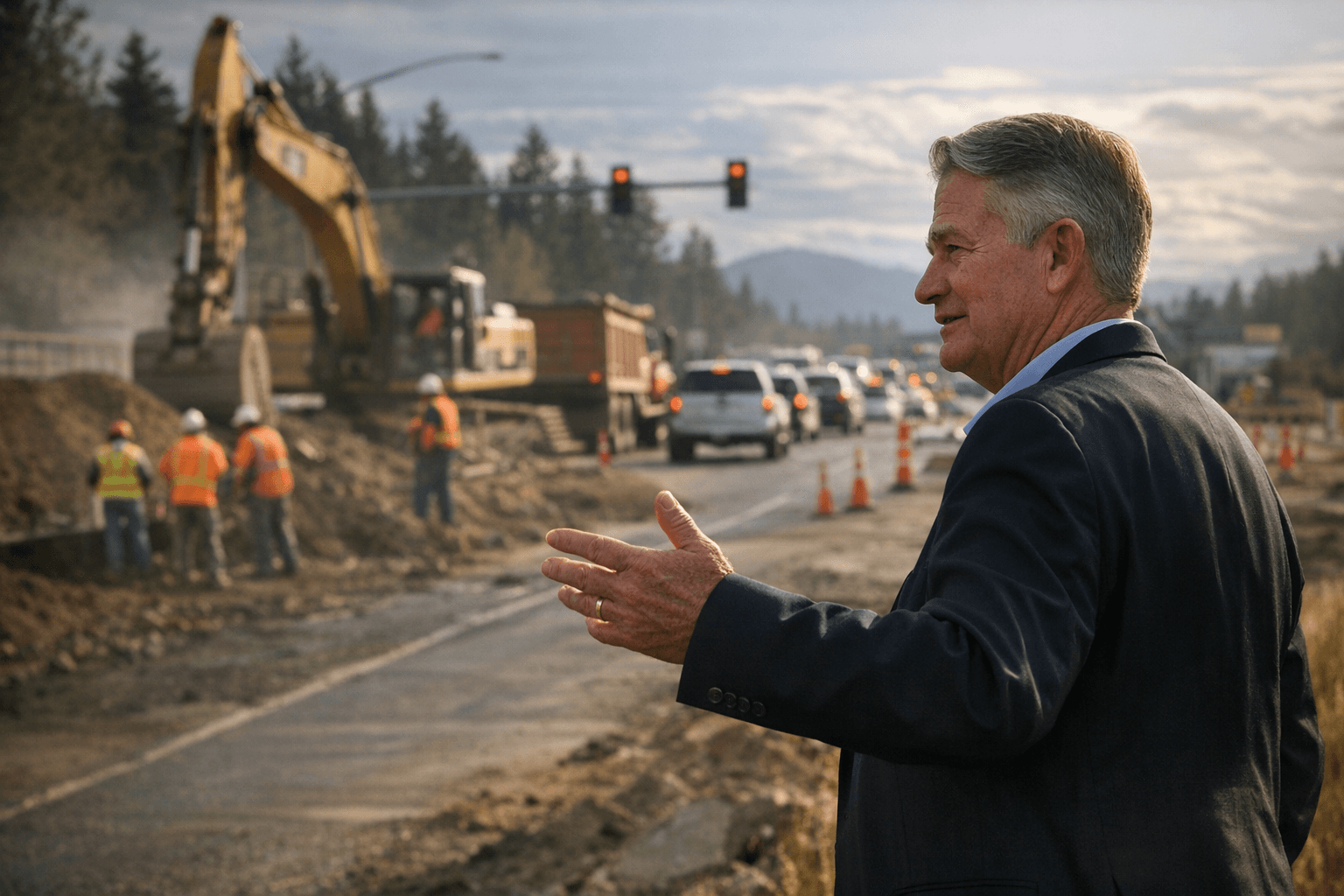
Gov. Brad Little came to Hayden on Tuesday with a concrete sales pitch for North Idaho: $20 million more for major road projects, including work in Kootenai County, and a defense of a session he said protected long-term stability under his Enduring Idaho Plan.
Little framed the Legislature’s work as a choice to keep Idaho on firm financial footing rather than chase short-term gains. He said the state lived within its means, did not raise taxes and aligned spending with what he described as the priorities of Idaho residents. In Hayden, that message was aimed at a county where growth has outpaced old assumptions and where state decisions now reach directly into daily life.
Kootenai County’s population was estimated at 188,323 for July 1, 2024 and 191,864 for July 1, 2025, a pace of growth that has pushed roads, public services and schools harder every year. County officials say the population has climbed 14% in the last five years. The pressure is already visible on Interstate 90, where the Idaho Transportation Department says the five miles from State Highway 41 to U.S. Highway 95 are the most heavily traveled and congested part of the corridor. Construction on the widening project began Aug. 11, 2025, and is expected to run through 2029.
That makes the governor’s road announcement more than a budget talking point. The Kootenai Metropolitan Planning Organization’s transportation improvement program covers all of Kootenai County, and local road agencies continue to line up work of their own, including 2026 improvement projects in Hayden Lake. For Coeur d’Alene, Hayden and Post Falls, the practical question is whether the new state money helps relieve bottlenecks soon enough to matter.
Little also pointed to public safety and health care as core pieces of the session. Idaho State Police are short roughly 30 to 40 troopers, a gap that has forced the agency to compete with better-paying departments. In North Idaho, that shortage lands on residents as slower response capacity and more strain on an already stretched system.
On health care, Little defended his veto of House Bill 978 on April 10, which restored graduate medical education funding for eight current medical residents after he said the earlier cut would have harmed doctor recruitment. He also signed House Bill 913 the same day, establishing Medicaid work requirements and requiring three months of compliance before enrollment. That move drew criticism from the Idaho Education Association, which warned that tax cuts and budget pressure would force hard choices that hurt vulnerable families.
Little also backed the bathroom bill signed into law in late March, set to take effect July 1. The ACLU of Idaho says the measure would make it a crime for a transgender person to use a public bathroom matching their gender identity.
Wildfire readiness remained another point of emphasis. State budget writers considered restoring about $125,000 one year and $140,500 the next for wildfire protection, but those partial fixes were rejected. In Hayden, Little’s message was that Idaho should keep money available for emergencies, even as North Idaho presses for more roads, more doctors and more law enforcement.
This article was produced by Prism’s automated news system from verified source data, official records, and press releases, then run through automated quality and moderation checks before publishing. The system is built and supervised by the people who set the standards it runs under. Read our full AI policy.
Did this article answer your question?