North Idaho April Skywatching Guide Features Pink Moon, Comet Viewing Window
April 8 opens a rare 8-night window to spot a potentially naked-eye comet from Kootenai County's dark ridges; here's exactly when and where to go before dawn.
John Taylor of the Rimrock Observatory has quietly published what may be North Idaho's most useful night-sky briefing of the spring: a month-by-month guide to April's celestial events that places a potentially naked-eye comet squarely on the calendar for Kootenai County observers between April 8 and 16.
The Pink Moon and What Just Happened
The Full "Pink" Moon crested at 7:12 p.m. PDT on Tuesday, April 1, spilling light across Lake Coeur d'Alene and the surrounding ridgelines in what has become one of spring's most anticipated lunar moments. The name carries no color: it honors the seasonal bloom of moss pink, a creeping ground phlox that carpets North Idaho meadows in April, and it has marked the start of spring skywatching season for generations of local observers. The following evening, April 2, the moon drifted to within a few degrees of Spica, the brightest star in Virgo; anyone who looked low in the southeast around 10 p.m. caught a tight pairing that rewarded the late effort.
That full moon also carried an immediate civic consequence. Easter on April 5 traces directly to the same astronomical formula that ancient church councils formalized: the first Sunday after the first full moon following the vernal equinox. The April 1 moon triggered the calculation, placing Easter on the closest available Sunday. The sky has set the date of Easter every year since the Council of Nicaea in 325 A.D., making this one of the oldest active astronomical rules still in daily use.
The Main Event: Comet C/2025 R3, April 8-16
Everything that came before in April's sky calendar is a warm-up. C/2025 R3 (PanSTARRS) is already visible through telescopes from the Northern Hemisphere and may become visible to the naked eye after passing perihelion on April 19, 2026. The comet was discovered by PanSTARRS in images obtained on September 8, 2025. By March 20, 2026, it became visible in 10x50 binoculars. In the most likely scenario, it could brighten to about magnitude 2.9, though some estimates push as high as magnitude 2.5.
Taylor identifies the window of April 8 through 16 as the optimal local observing period. The comet's closest Earth approach falls on April 26, but by then its geometry relative to the Sun's glare makes it difficult to detect from North Idaho. The better strategy is the second week of April, when the comet rides higher relative to the solar interference. Taylor recommends scanning low in the eastern sky around 4:45 a.m. and using binoculars to boost contrast against the brightening pre-dawn sky. To find the right patch of sky, locate the Great Square of Pegasus and work downward along the eastern horizon; the comet will appear as a slightly smudged or fuzzy point distinguishable from the crisp pinpoints of background stars.
Estimates of its brightness range from magnitude 7 all the way up to 3. A magnitude-3 comet would be visible to the unaided eye. That is roughly comparable to the faint corner stars of the Great Square of Pegasus, reachable without optics under genuinely dark conditions and much easier to resolve through binoculars.
Where to Go in Kootenai County
Coeur d'Alene's urban light dome eliminates backyard viewing for most of the comet window. A short drive changes the equation significantly.
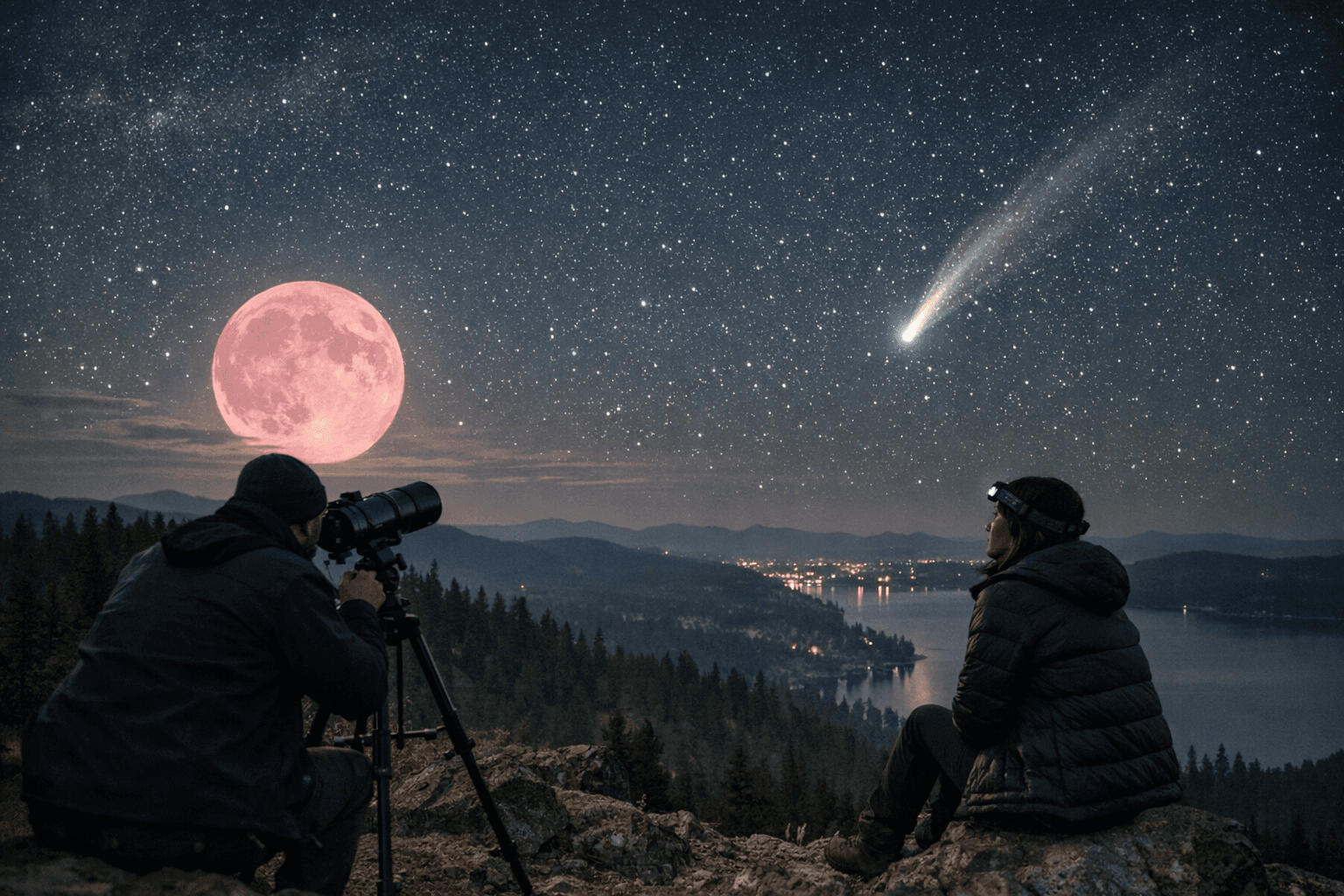
Farragut State Park, reached from Athol by heading west on Idaho State Highway 54, offers wide open fields on the elevated grounds of the former Farragut Naval Training Station. The park's eastern horizon is broad and relatively unobstructed, and ambient light at that hour is minimal. Plan to arrive no later than 4:15 a.m. to allow 20 to 30 minutes of dark adaptation before the optimal 4:45 a.m. window.
Mineral Ridge Scenic Area, perched above Lake Coeur d'Alene's eastern shore, provides ridge elevation that clears the treeline toward the east and reduces the atmospheric haze that can blur faint targets near the horizon. Local astronomy groups regularly host stargazing events at locations including the Mineral Ridge Scenic Area and Farragut State Park, and both sites are familiar stopping points for organized observing nights.
Rimrock Observatory serves as Taylor's home base for North Idaho amateur astronomy, and his April guide functions as the most precise local targeting reference available. Observers with questions about locating the comet can treat the guide as a field companion.
How to See It: Binoculars and Phone Checklist
The comet window is accessible to beginners with basic gear. Set a 4:15 a.m. alarm on any clear morning between April 8 and 16, give yourself at least 20 minutes of screen-free darkness before looking, and keep your phone face-down until after you've scanned the sky. Binoculars in the 7x50 or 10x50 range are ideal, though standard 8x42 birding optics will work. For phone astrophotography, prop the device on a stable surface or tripod, switch to Night or Pro mode, and dial in ISO 1600 to 3200 with an exposure of 8 to 15 seconds. A red-beam flashlight preserves night vision better than a white one if you need to check a star chart.
One Surprising Fact Worth Texting to Someone
Here is the detail that tends to stop people mid-scroll: every Easter Sunday on the calendar, including this Saturday's April 5 observance, is chosen by the same lunar arithmetic that governed the sky when the Pink Moon rose over Lake Coeur d'Alene on Tuesday night. The rule is unchanged from 325 A.D., which means the most common date most people check on their calendar each spring is still being set by the moon's orbit.
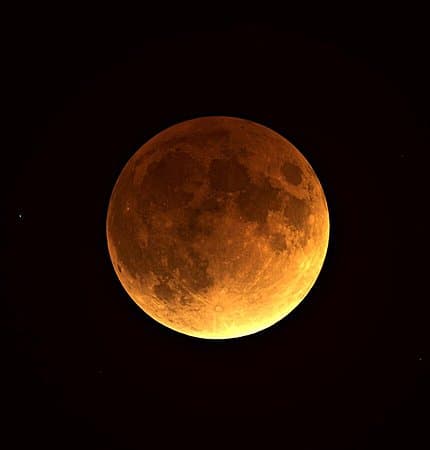
Kootenai County's stretch of clear spring nights has already delivered one spectacular event this season: the total lunar eclipse of March 3. If April's skies cooperate between the 8th and the 16th, the comet window could make this a genuinely memorable two-punch spring for North Idaho observers willing to set an early alarm.
This article was produced by Prism’s automated news system from verified source data, official records, and press releases, then run through automated quality and moderation checks before publishing. The system is built and supervised by the people who set the standards it runs under. Read our full AI policy.
Did this article answer your question?