Post Falls workshop teaches residents how to spot suicide warning signs
A free Post Falls workshop gave neighbors six questions and a clear response plan for suicide warning signs, with 24/7 Idaho help close by.
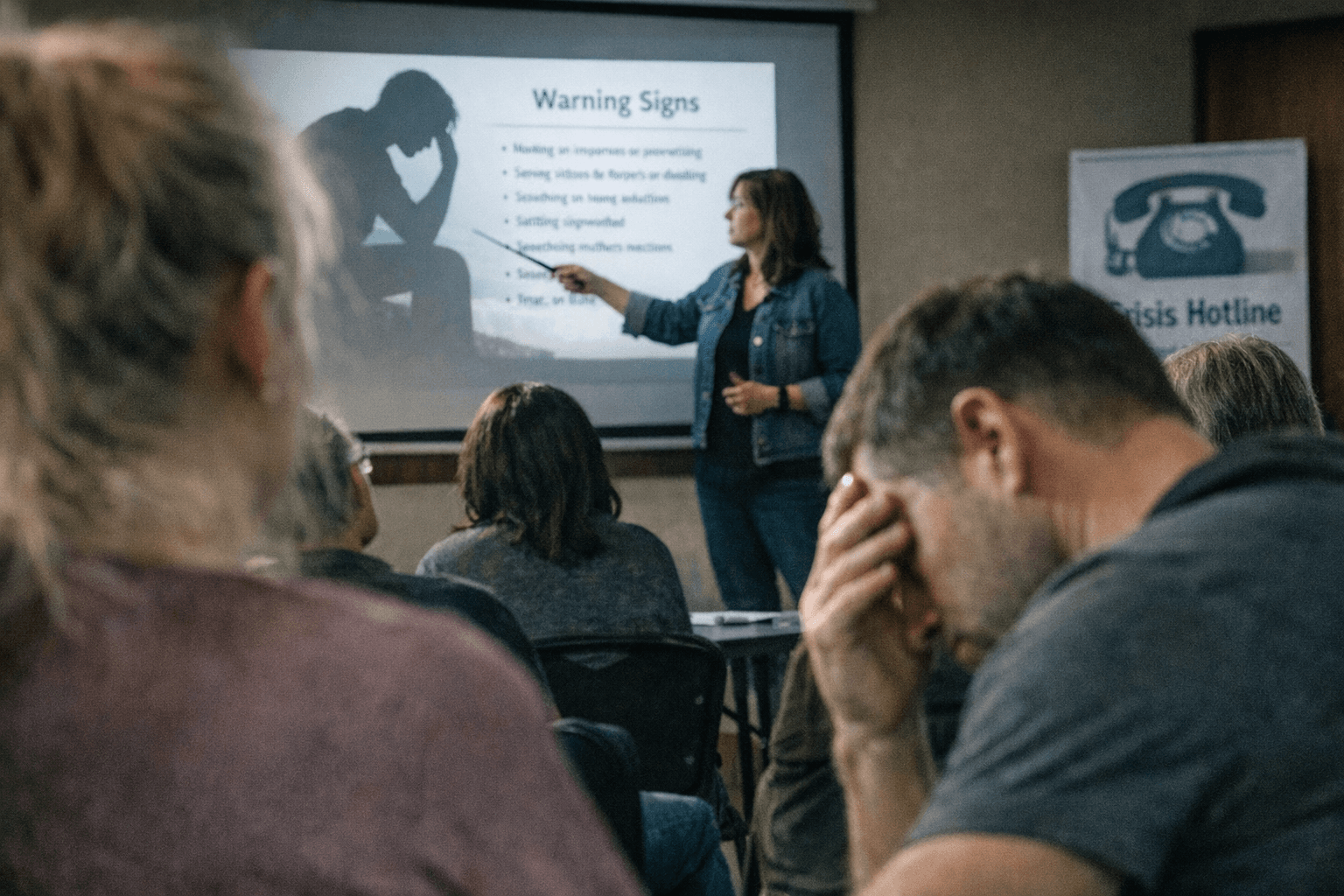
A simple tool for an urgent problem
At American Legion Post 143 in Post Falls, a free one-hour session gave residents a concrete way to step in when someone may be headed toward suicide. The Columbia Protocol, also known as the Columbia-Suicide Severity Rating Scale, is built around six questions that help assess suicidal thinking and guide the next move toward support and safety. The need is painfully clear in Idaho, where the state had the 4th-highest suicide rate in the nation in 2023, and in the wider United States, where the CDC counted 49,316 suicide deaths in 2023, about one every 11 minutes.
Why the training is meant for everyday people
The Columbia Lighthouse Project says the protocol and the training are free to use in community and healthcare settings. Training is not required, and people do not need mental health experience to use it, but the project says training is helpful; it also offers free options in 30 languages. That matters in Kootenai County because this is not a specialist-only tool. It is meant to give ordinary adults a shared way to notice risk and move quickly toward help.
The protocol is designed to do more than identify danger. According to the Columbia Lighthouse Project, the answers can help guide decisions about counseling, referrals, safety monitoring and emergency care, which makes the tool useful in a post hall, a clinic, a school or a living room. A companion smartphone app can also walk users through the protocol and tailor resources based on the answers, giving people another practical route from concern to action.
What warning signs to watch for
Idaho public-health guidance says to take warning signs seriously when someone is talking or writing about suicide, withdrawing from family or friends, acting agitated or sleepless, sounding hopeless or trapped, using alcohol or drugs more often, taking reckless risks, or showing sudden changes in eating, sleep or personal care. The state also notes that warning signs are often present close to the time of a suicide death, and that many people who die by suicide have a mental health or substance use disorder that can be treated. In other words, the training is not about guessing. It is about spotting a change early enough to matter.
How to respond if you are worried
When a friend, teen, veteran or neighbor is showing warning signs, be direct. The 988 Lifeline tells friends and family to ask plainly, say it is okay to talk about suicidal feelings, and listen without judgment. If the person threatens suicide while you are talking and has a weapon, Idaho officials say to call 911 immediately; if you cannot keep the person safe, go to the nearest emergency department or call 911.
For many people, the first call should be 988. In Idaho, the Idaho Crisis and Suicide Hotline is available all day, every day by call, text or chat, and calls from a 208 area code are routed to the Idaho hotline. Adults in Region 1 can also reach the Northern Idaho Crisis Center at 208-625-4884, a local option for in-person crisis support.
- Call or text 988 if the situation feels urgent but not yet life-threatening. The line is available 24/7, and Idaho’s hotline also offers online chat.
- If the person is a veteran, service member or military family member, call 988 and press 1, text 838255, or use Veterans Crisis Line chat. The service is free, confidential and available around the clock, even if the person is not enrolled in VA care.
- If no one can keep the person safe, do not wait for the situation to improve. Idaho’s guidance points people to 911 or the nearest emergency department when there is immediate danger.
Why veterans were at the center of the room
The Post 143 training put veterans front and center because military life can leave people navigating abrupt transitions, relationship strain, pain and a loss of purpose after service. CDC data say veterans experience higher suicide rates than the general population, and the Department of Veterans Affairs reported 6,407 veteran suicide deaths in 2022. Brad Lanta, the Columbia Lighthouse Project trainer, said the goal was to normalize help-seeking and make action feel ordinary, not shameful: “We want to normalize seeking help,” and “Seeking help should be seen as a sign of strength.”
That message fits the setting. American Legion Post 143 is already a place where veterans and neighbors gather, so a suicide-prevention class there carried a practical point: support does not have to start in a hospital or a formal therapy session. It can start with a conversation, a coffee meet-up, or a regular check-in that helps someone feel seen before isolation hardens into crisis.
Turning a workshop into everyday protection
The larger lesson for Post Falls and the rest of Kootenai County is that suicide prevention can live inside ordinary community life. A neighbor who asks a direct question, a family member who makes the 988 call, or a veteran friend who keeps showing up for coffee can become the bridge between danger and care. In a state with one of the highest suicide rates in the country, those everyday actions are not small. They are often the first step that keeps a crisis from becoming a loss.
This article was produced by Prism’s automated news system from verified source data, official records, and press releases, then run through automated quality and moderation checks before publishing. The system is built and supervised by the people who set the standards it runs under. Read our full AI policy.
Did this article answer your question?


