St. Thomas Cemetery tour turns Coeur d'Alene history into a classroom
At St. Thomas Cemetery, Hunter Kearns turns old graves into a walking lesson in how Coeur d’Alene was built, from Frank Genett to Ray Flaherty.
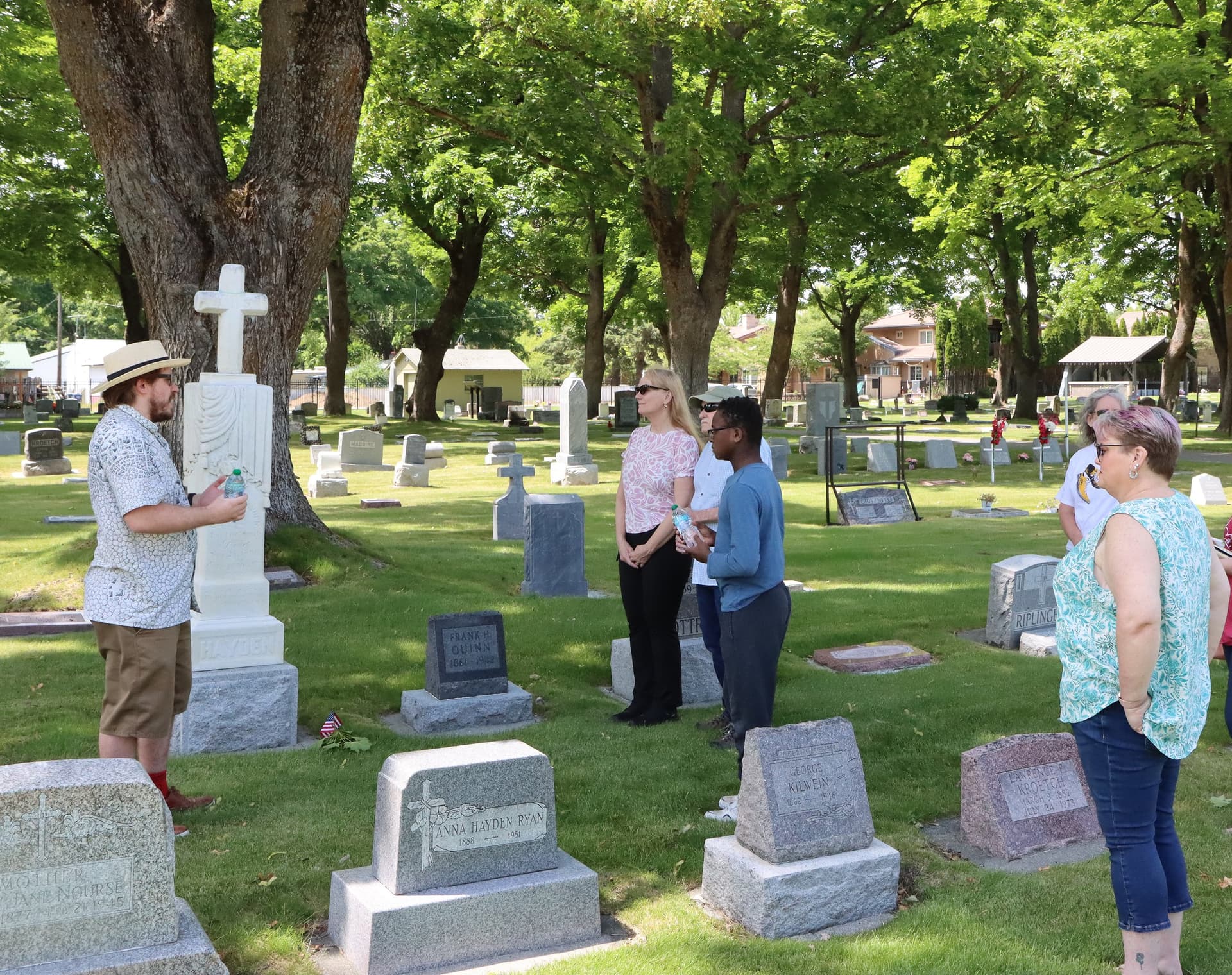
Coeur d’Alene’s history is easier to read when it is underfoot. On the Patriots and Pioneers walk at St. Thomas Cemetery, Museum of North Idaho guide Hunter Kearns turns a burial ground into a classroom, a memorial space and a living archive of the city’s earliest families, veterans and local figures.
A cemetery that carries the city’s oldest layers
St. Thomas Cemetery is commonly described as having been established in 1899, but parish and diocesan records trace its first burial to 1890 and say it has been in use since then. That early start is part of what makes the site so valuable to Kootenai County history: it sits on about three acres, holds more than 3,100 burials, and remains one of Idaho’s few Catholic cemeteries.
The Diocese of Boise says the cemetery primarily serves Catholics from St. Thomas the Apostle in Coeur d’Alene, St. Pius X in Coeur d’Alene, and St. Joan of Arc in Post Falls. The parish describes the grounds as part of the ministry of the Catholic Church and calls them “holy ground,” a place meant to honor previous generations who lived in faith. Taken together, those descriptions show why the cemetery is more than a burial site. It is a working record of how Catholic life took root in North Idaho and stayed woven into the region’s growth.
Why the Patriots and Pioneers tour resonates
Kearns leads the weekly Patriots and Pioneers tour for a small group of locals, and his approach is built on a simple but powerful idea: cemeteries hold people, not just names. That framing changes the pace of the walk. Instead of treating the graves as a list of dates, he moves through the cemetery as if he is introducing visitors to former neighbors whose lives still shape the city.
The Museum of North Idaho describes its cemetery tours as “living museums” where history and nature converge, and that is exactly how the tour functions. It is not a passive stop at a landmark. It is an interpretive walk that connects the city’s earliest settlers, ordinary residents and local celebrities in one place, so the story of Coeur d’Alene can be seen in a few rows of stones and markers.

The museum’s tour listing points visitors to the graves of James and Teresa Graham and football legend Ray Flaherty, giving the walk a concrete set of names to remember. Those stops help show how local history is built from both well-known figures and families whose names may not be widely recognized now, but whose presence helped make the town what it became.
The preservation work behind the setting
The cemetery’s current appearance is not accidental. A 2021 refurbishment added new fencing, benches and commemorative bricks for older gravesites whose markers had faded or been lost. Other material tied to the project says the makeover also included statues and was part of a fundraising effort that aimed to raise about $200,000 overall.
That preservation work matters because aging burial grounds often face the same pressures as other historic sites: weather, wear and the risk that names disappear before the stories do. At St. Thomas Cemetery, the updates were designed to protect the grounds while making it easier for people to spend time there, read the markers and understand the generations represented.
A separate effort from the Stars and Stripes Ministry at St. Thomas Catholic Church was raising $25,000 for a veterans monument at the cemetery. That emphasis on veterans remembrance gives the site another layer of public meaning, especially in a county where military service and family memory often overlap. The cemetery is not only a Catholic burial ground, but also a place where the community marks sacrifice in a visible way.
Names that make the past feel close
Few graves make the story of the cemetery more tangible than Frank Genett. Local reporting identifies him as a Civil War veteran born in 1812, who died in 1910 and is buried at St. Thomas Cemetery. His life spans an era far older than the modern city, and his presence there ties Coeur d’Alene’s local history to the national story of the Civil War and its long aftermath.
That is part of the power of the tour. A visitor can stand near a marker for Ray Flaherty, a football legend, and then move to a grave like Genett’s, where military history, settlement patterns and family memory intersect. The route also brings attention to founders and common residents, reminding people that a city is built as much by the lives of its everyday citizens as by its public names.
Sue Blais, one of the attendees, said it was “interesting and nice to learn the town’s history.” That reaction captures the appeal of the tour without turning it into nostalgia. The value is practical as well as emotional: it gives residents a way to understand where the town came from while the city around them keeps changing.
Why Coeur d’Alene should keep walking this ground
St. Thomas Cemetery offers a rare kind of local education because it compresses so much history into one walkable space. Its Catholic roots, veterans memorial work, early burials and preserved markers all sit together on a three-acre site that still serves families from Coeur d’Alene and Post Falls. For a fast-growing county, that kind of continuity is not decorative. It is part of the public memory that keeps growth from erasing the people who came first.
Kearns’s tour makes the case clearly: a cemetery is not only where people are buried, it is where a city can still meet its own past.
This article was produced by Prism’s automated news system from verified source data, official records, and press releases, then run through automated quality and moderation checks before publishing. The system is built and supervised by the people who set the standards it runs under. Read our full AI policy.
Did this article answer your question?