Trail of the Coeur d’Alenes blends tribal history and recreation
The Trail of the Coeur d’Alenes is a free 73-mile paved corridor where Kootenai County can bike, walk, or roll through tribal, rail, lake and mining history.

The Trail of the Coeur d’Alenes gives Kootenai County one of the easiest low-cost day trips in the region: a free, paved route that runs 73 miles between Mullan and Plummer and turns tribal history, railroad history and recreation into the same outing. Idaho State Parks describes it as a partnership-built corridor, and that mix shows up everywhere from the landscape to the way people use it.
Why this trail works for a local day trip
The appeal is practical as much as scenic. The trail has 20 developed trailheads and 20 scenic waysides, so you do not need to commit to the full length to make the outing worthwhile. A short ride, a family walk, or a longer all-day push all fit the same corridor, and the 15 mph speed limit helps keep the experience manageable for mixed-use traffic.
Class 1 and Class 2 e-bikes are allowed, which makes the route easier to share across different ages and fitness levels. Visit Post Falls notes that the waysides include tables for a picnic or a short rest, and that matters on a trail where potable water is not available throughout much of the route or at trailheads. If you want a simple day plan, bring your own water, choose a trailhead, and treat the waysides as your built-in pause points.
What the route actually feels like
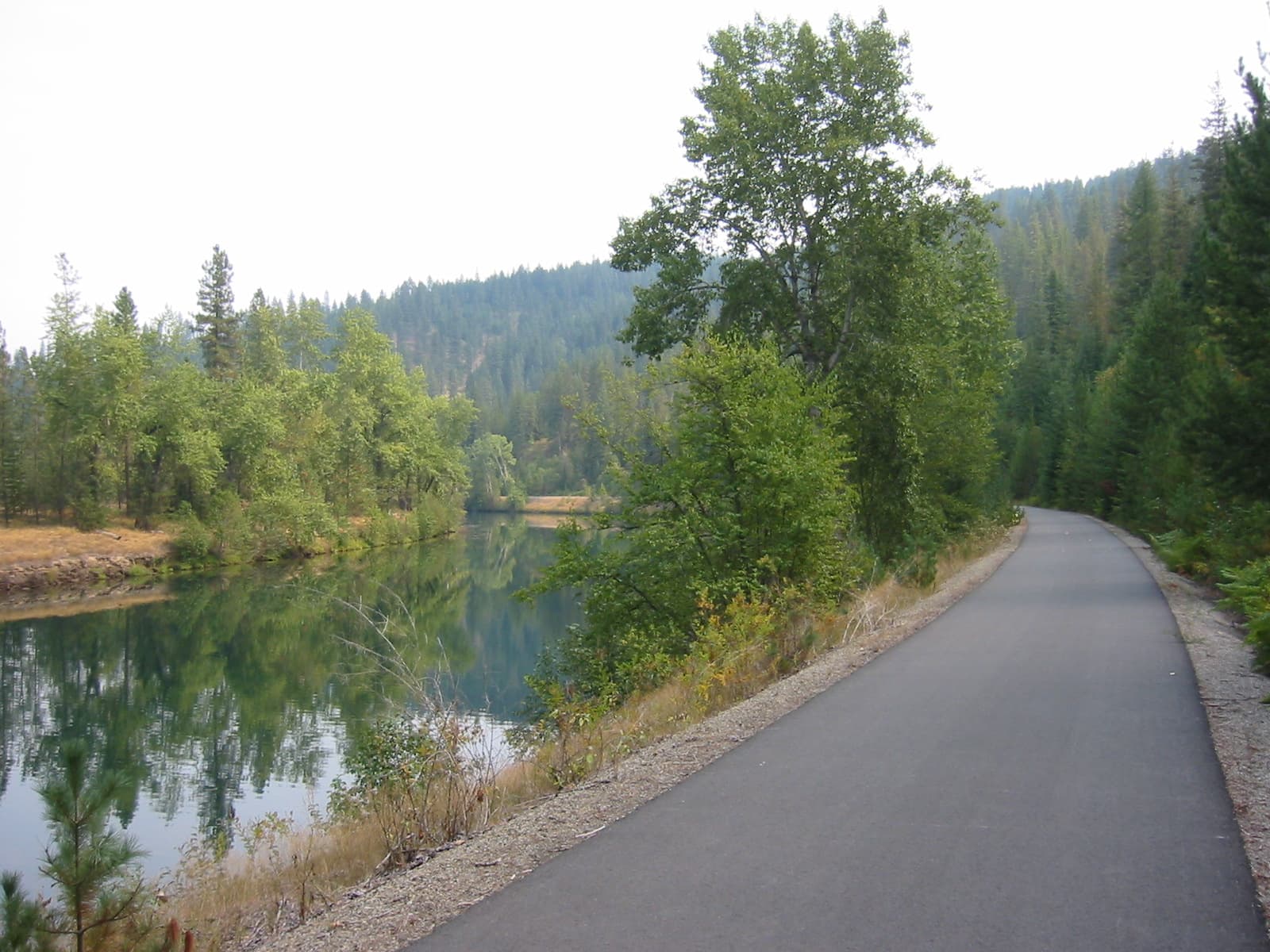
This is not a generic paved path that could be anywhere in Idaho. The trail runs through the historic Silver Valley, follows the Coeur d’Alene River, passes scenic Lake Coeur d’Alene, and then opens into rolling farmland on the way to Plummer. Rails-to-Trails Conservancy describes the route as 71.3 miles of paved rail-trail, while Idaho State Parks rounds it to 73 miles, but both descriptions capture the same long, continuous corridor.
That geography gives the trail a lot of variety without demanding a car shuttle. Trail users can move from mining country into lake views and then into open agricultural stretches, which is part of what makes the route so shareable for families, visitors, and longtime locals alike. For people who want a Kootenai County outing that feels bigger than a single park loop, this is one of the few places where the setting changes enough to keep a full day interesting.
Where to start, depending on the kind of outing you want
The trail’s 20 access points make it easy to tailor the trip. Mullan is the natural north-end starting point if you want to connect the outing to Silver Valley history, while Plummer gives you the south-end perspective and the farm-country feel. If you want a flexible midpoint option, the Harrison area is especially useful because the trail branches south from Harrison toward Plummer and east toward Mullan.
That branching pattern matters for planning. A rider with younger kids can choose a shorter out-and-back from one end, while a walker or wheelchair user can use one of the developed trailheads and stay close to a wayside for a break. The point is not to conquer the whole route in one shot; it is to use the corridor the way it was designed, as a series of manageable access points connected by a paved public path.

Who the trail suits best
Idaho State Parks says the Trail of the Coeur d’Alenes is suitable for cyclists, in-line skaters, walkers, wheelchair users, Nordic skiers, snowshoers, birders and wildlife enthusiasts. That broad use list makes the trail unusually inclusive, especially for households that need a route where one person can roll, another can walk, and everyone can still stay together. The paved surface also makes it easier to plan around weather and mobility needs than many backcountry options.
Wildlife watching is part of the draw too. Rails-to-Trails Conservancy’s 2025 trail feature says the wetlands and wildlife-rich corridor can bring moose sightings, which is the kind of detail that turns an ordinary outing into a memorable one. For local readers, that means the trail is not only a fitness asset but also a place to spot the landscape and wildlife that define this part of the Idaho panhandle.
The history beneath the pavement
The trail corridor was abandoned as railroad property in 1991, and a 1995 agreement among Union Pacific Railroad, the federal government, the State of Idaho and the Coeur d’Alene Tribe cleared the way for cleanup and development. The route officially opened in March 2004, after a collaboration that turned a former rail line into public recreation infrastructure. Idaho State Parks says the trail was created through a unique partnership among the Coeur d’Alene Tribe, Union Pacific Railroad, the U.S. Government and the State of Idaho.
That history gives the trail a larger meaning than a typical bike path. A recent Americana State Parks guide notes that the corridor passes through the former Bunker Hill Superfund area and that paving over contaminated soils was part of the trail’s design, so the route also functions as containment and remediation work. The result is a public asset built on cleanup, stewardship and shared governance rather than simple conversion.
A trail with national standing
The Trail of the Coeur d’Alenes has also earned recognition beyond Idaho. Idaho State Parks says Rails-to-Trails Conservancy named it one of the 25 top trails in the nation in 2010, and Rails-to-Trails Conservancy also inducted it into its Rail-Trail Hall of Fame that same year. Those honors still matter because they confirm what Kootenai County already knows: this is one of the region’s strongest outdoor assets, and it remains useful because it combines access, history and scenery in one place.
For a day trip, that combination is hard to beat. You get a paved, free route with multiple access points, a clear speed limit, family-friendly rest stops and a landscape shaped by mining, railroading, Native American history and environmental cleanup. In a county full of outdoor options, this trail stands out because it lets people experience all of that without a big budget or a complicated plan.
This article was produced by Prism’s automated news system from verified source data, official records, and press releases, then run through automated quality and moderation checks before publishing. The system is built and supervised by the people who set the standards it runs under. Read our full AI policy.
Did this article answer your question?