Avi Suquilla Airport manager brings military discipline to tribal aviation hub
Joshua Philipps runs Avi Suquilla Airport with military discipline, and Parker depends on the field for medical flights, aviation training, and round-the-clock access.
A military background meets a tribal aviation hub
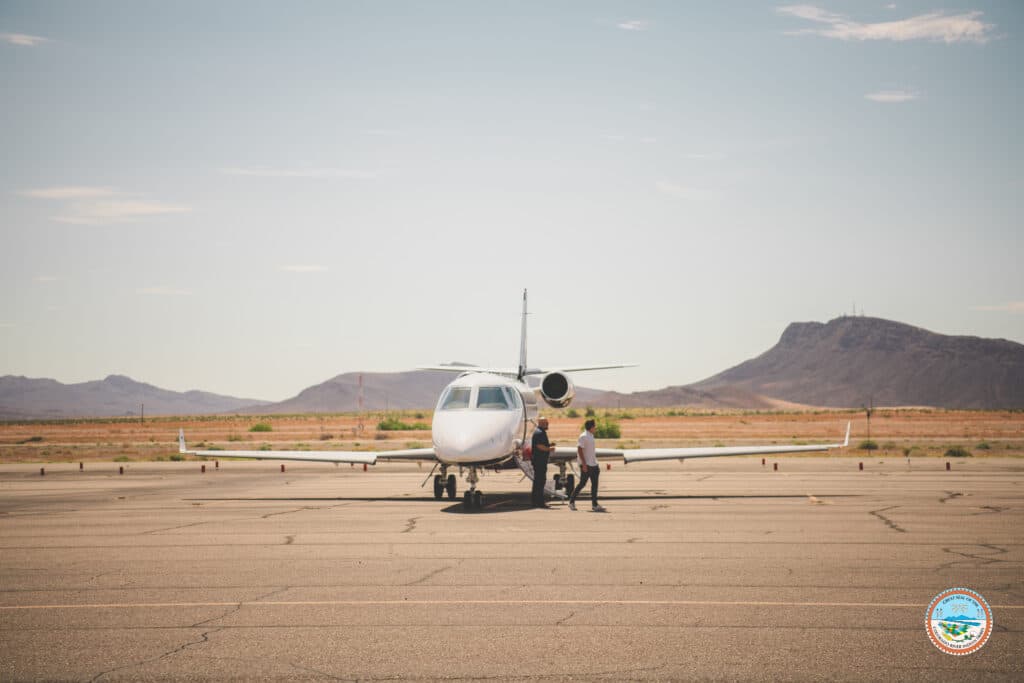
Joshua Philipps did not arrive at Avi Suquilla Airport as a typical small-airport manager. His career was shaped by service in the U.S. Marine Corps and later the U.S. Army, with deployments to Iraq, Afghanistan, and other locations, and that experience shows up in the way he talks about safety, readiness, and order. From his office, he looks out toward the runway and P Mountain, a view that captures what makes this place different from a generic airstrip: it sits at the center of Parker’s daily movement and emergency response.
That discipline matters because Avi Suquilla is not just a place where planes come and go. It is one of the few tribal airports in the country with a commercial side, and it handles a mix that includes military aircraft, private planes, parachuting, free-fall training, and mission work. In a town like Parker, that combination gives the airport a practical role in everything from transportation access to disaster readiness.
What the airport offers every day
Avi Suquilla Airport is built for constant use, not limited hours. CRIT Air says the airport is open for flight operations 24/7, with pilot-controlled lighting on CTAF 122.725. The pilot’s lounge is open daily from 8:30 a.m. to 5:00 p.m. MST, and airport administration keeps the same schedule Monday through Friday. Fueling is available seven days a week, secured vehicle parking has 24-hour access, and rental-car service is available through a third party.
The runway itself reflects that level of activity. Federal Aviation Administration data lists runway 02/20 as an asphalt strip measuring 6,250 feet by 100 feet, with 150-foot blast pads at both ends. The airport is attended from 1500 to 0000Z, and FAA remarks note intermittent high-altitude military parachute activity in the vicinity. For a facility serving both local flights and specialized aviation, those details are not background noise, they are part of how the airport actually operates.
Why Parker and La Paz County rely on it
The airport’s importance goes well beyond aviation enthusiasts or occasional travelers. Arizona Department of Transportation planning materials say the master plan was designed to meet the needs of the Colorado River Indian Tribes, the City of Parker, La Paz County, and the surrounding trade area over a 20-year period. Those same materials say closing the airport or moving its functions elsewhere would not meet the needs of CRIT, Parker, or the county.
That is the clearest sign that Avi Suquilla is a piece of public infrastructure, not a luxury. In a river community where distance matters and access can be limited, the airport supports business travel, tribal mobility, and emergency response in one location. Its long operating history backs that up: the field was activated in April 1940, and older FAA statistics showed about 10,200 aircraft operations and 29 based aircraft in 2007, evidence that it has remained a functioning part of the Parker area for decades.
Medical flights, training flights, and a broader public mission
The airport’s community value became easy to see during a May 1, 2024 field trip when Colorado River Indian Tribes Head Start students and staff visited the airport. They met Philipps and his team, saw single-propeller aircraft, jets, and medical helicopters, and watched an aerial demonstration by a World War II flying group. That kind of visit does more than entertain children. It introduces local families to the airport’s role in emergency care, aviation education, and the wider transportation system that serves Parker.
That public-service mission expanded again in January 2025, when Aerocare Global Medical Response Solutions and CRIT opened a new Education Center at Avi Suquilla Airport. The ribbon cutting brought together CRIT Tribal Councilmember Bill Beeson, Parker Mayor Randy Hartless, and Parker councilmembers Dusty Woodell, Erica Daniels, and Marion Shontz. The attendance alone showed that the airport now sits at the intersection of tribal government, city government, and regional medical response.
For a rural county, that matters in concrete terms. Medical helicopters need an accessible base. Training organizations need usable airspace and runway support. Local leaders need a site that can host public education, emergency coordination, and practical aviation activity without leaving the Parker area.
The people who keep it moving
Philipps’ leadership style is only part of the story. The airport’s day-to-day work also depends on the staff around him, the technicians who keep operations moving, and the community-facing workers who help the facility grow. The profile of Philipps emphasizes how his background in training and security, including active-shooter and safety work connected to CRIT departments, fits the operational demands of a place where safety has to be routine, not reactive.
He also stays active beyond the runway. The profile describes work with veterans, seniors, youth, and STEM outreach, including partnerships with the Veterans of Foreign Wars, Together with Veterans, and the Community Center for Parker. FAA scholarships and airport-hosted programs are aimed at encouraging the next generation of aviators, which gives the airport a local talent pipeline as well as a transportation function. In a community where young people often leave to find opportunities elsewhere, that kind of exposure can change how they see the future.
A facility with local identity, not just flight operations
Avi Suquilla Airport carries symbolic weight as well as practical value. It is tied to the Colorado River Indian Reservation, to Parker’s central business district, and to the wider river community that depends on a functioning regional hub. Philipps’ view of the runway and P Mountain is a fitting image for that relationship: the airport is rooted in the landscape, but it also connects Parker to people, services, and opportunities that reach beyond town limits.
The story of the airport is really a story about a place that does many jobs at once. It supports commercial activity, tribal priorities, medical access, training, security, and community outreach. In La Paz County, that makes Avi Suquilla less of a niche airfield and more of a daily asset, one that has served Parker for generations and still has room to matter in the years ahead.
This article was produced by Prism’s automated news system from verified source data, official records, and press releases, then run through automated quality and moderation checks before publishing. The system is built and supervised by the people who set the standards it runs under. Read our full AI policy.
Did this article answer your question?