Bouse, Arizona: History, Services, and Visitor Essentials for Desert Travelers
Bouse's nearest ER is 36 miles away in Parker, and its median resident age is 75.5 — nearly double Arizona's average. Here's what every visitor and newcomer needs to know.
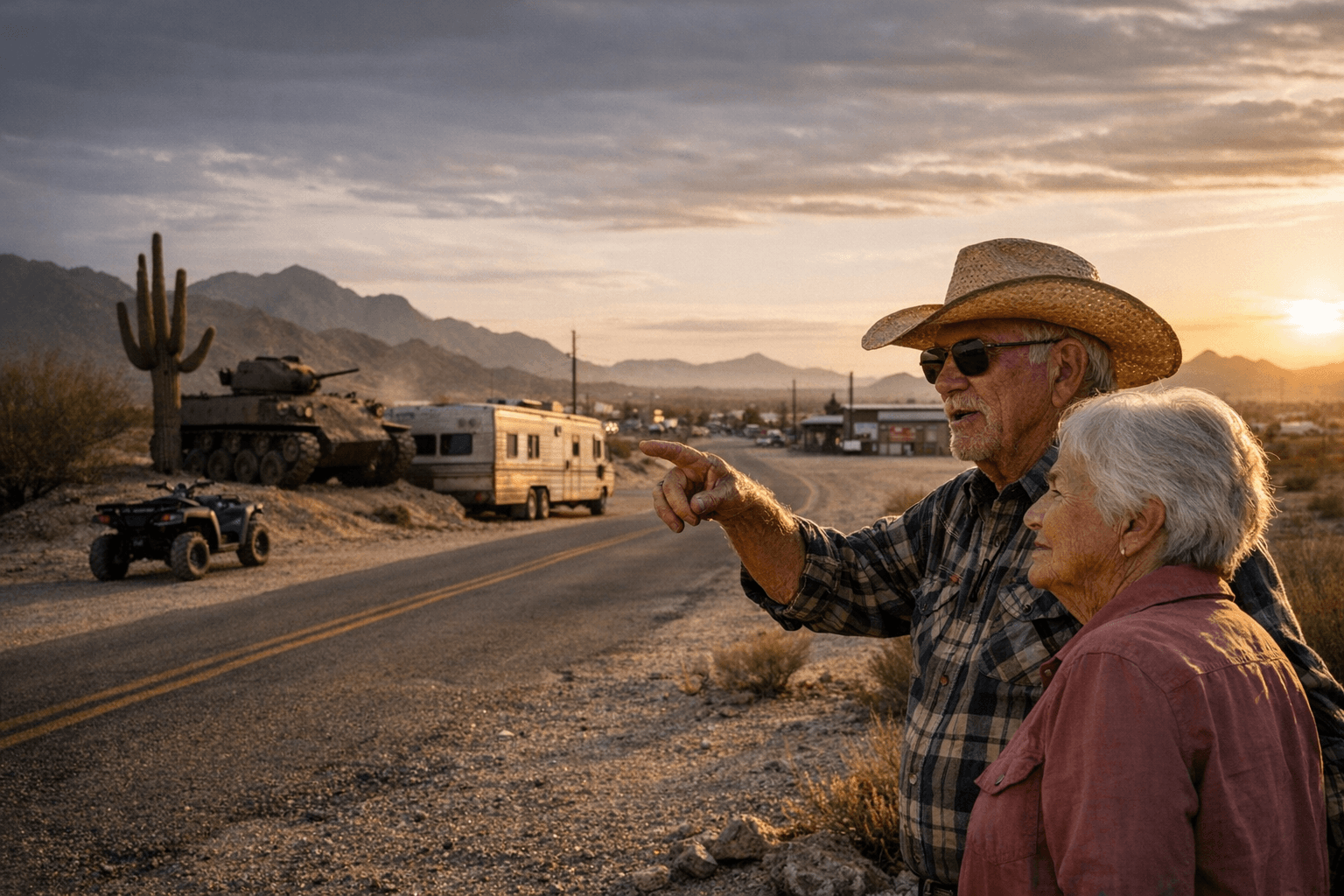
The number that should make any new visitor pause: Bouse is located along Arizona State Route 72, approximately midway between the towns of Parker and Quartzsite. That puts the nearest emergency room roughly 36 miles in either direction, at La Paz Regional Hospital in Parker. If that sounds like a manageable gap, consider this: Bouse had a median age of 75.5 in 2023, a figure that is about 25 percent higher than La Paz County's median of 59.7 and nearly double Arizona's statewide median of 38.8. This is a community where desert self-reliance is not a lifestyle choice — it is a daily operating condition.
From Mining Camp to Desert Community
Bouse was founded in 1908 as a mining camp. It was originally named Brayton, after store owner John Brayton Martin. The settlement first registered on a U.S. Census in 1920 and reported a population of 427 in the surrounding Bouse Precinct by 1930. The community contracted sharply through the mid-20th century before re-emerging as a ranching and agricultural waypoint, and eventually an economy based on tourism, agriculture, and retirees.
The area's most dramatic chapter came during World War II. General George Patton established Camp Bouse in 1943 in the Butler Valley as the site for training over 5,500 carefully screened and qualified volunteers. Camp Bouse was part of the larger Desert Training Center, which was built to prepare troops to do battle in North Africa against the Nazis. The camp also housed a secret program to test whether a very bright arc lamp could temporarily blind the enemy in battle at night. The training operation was conducted in absolute secrecy, mainly at night. Although the buildings are gone today, a few foundations remain, as do some of the tank tracks from World War II, and a historical monument in town commemorates the 526th Armored Infantry Battalion and the Canal Defense Light Project. Camp Bouse sits about 20 miles east in Butler Valley and is accessible by four-wheel drive or ATV via Swansea Road.
Population and Character
The U.S. Census Bureau recorded 615 residents in 2000, when Bouse was first designated a census-designated place. That number rose to 996 by 2010, reflecting influxes from seasonal and permanent residents, before dipping to 707 in 2020 amid broader rural depopulation patterns. The 2023 American Community Survey 5-year estimate places the population at 1,119, indicating a rebound. That rebound matters: it signals that Bouse is attracting new permanent and part-time residents even as many rural Arizona communities have stalled.
Bouse covers about 136.2 square miles at an elevation of 700 feet, with an annual average rainfall of just 5.89 inches. The Sonoran Desert landscape stretches in every direction, and the town is an unincorporated census-designated place with no municipal government of its own, falling instead under the La Paz County Board of Supervisors.
Medical Services: What's Here, What's Not
This is the section that matters most for anyone relocating or passing through. Bouse does have a local resource: the Bouse Medical Clinic, operated by La Paz Regional Hospital, is located at 44031 E. Plomosa Road and can be reached at (928) 851-2177. For anything requiring emergency or inpatient care, the destination is Parker. La Paz Regional Hospital is a not-for-profit, 25-bed Critical Access Hospital based in Parker, serving La Paz County and surrounding California communities including Big River and Earp. Its main line is (928) 669-9201. Parker Indian Health Center provides an additional care option in the county seat. There is no trauma center within Bouse itself, and EMS transport times across open desert roads reinforce the case for keeping a well-stocked first-aid kit in every vehicle.
Emergency and Fire Services
The Bouse Volunteer Fire District anchors local emergency response. Fire Chief Jason Weatherford leads the department, reachable at the district's main number, (928) 851-2648, with the station located at 44031 Plomosa Road. Board member Paul Martin joined the fire board at the start of 2025, continuing a transition of leadership within this all-volunteer organization. For law enforcement, the La Paz County Sheriff's Office handles non-emergency calls at (928) 669-6141. In any genuine emergency, call 911, which routes to La Paz County dispatch.
For electrical service and outage reporting, Arizona Public Service (APS) handles the grid in Bouse; the local service line is (928) 669-2248 and the outage reporting number is (800) 253-9405.
Practical Services: Fuel, Food, and Cell Coverage
Cell service is intermittent across stretches of desert between Bouse and the larger towns to the east and west. Travelers should download offline maps before departing I-10 or the Colorado River corridor and not rely on real-time navigation once in the backcountry. Fuel availability in Bouse itself is limited; the prudent approach is to fill up in Parker or Quartzsite before heading out on county roads or BLM routes. For major grocery shopping, Parker's Walmart on Riverside Drive is the practical anchor for the region.
The Bouse post office and Bouse Chamber of Commerce, both operating from the Plomosa Road corridor, serve as practical community hubs. The chamber website lists current local contacts, seasonal notices, and visitor resources that are updated more frequently than any printed guide.
Recreation on BLM Lands
The Bureau of Land Management's Lake Havasu Field Office oversees the public lands surrounding Bouse, which draw OHV riders, hunters, desert campers, and photographers in significant numbers. The Plomosa Road area north of Bouse offers open dispersed camping with no developed facilities, meaning visitors must pack in all water, food, and fuel. Hunting seasons bring an additional surge of visitors; Arizona Game and Fish regulations apply throughout, and licenses are not available locally.
For photographers and naturalists, the desert rewards early risers: the low-angle light at sunrise over the Plomosa Mountains and the wide-open silence of Butler Valley provide landscape conditions that are genuinely difficult to replicate elsewhere in western Arizona. The Camp Bouse site itself functions as an informal heritage trail, and the BLM information marker at the Bouse Y trailhead on Swansea Road serves as the practical starting point. Note that the final miles into Butler Valley involve deep sand; passenger vehicles have made it, but high-clearance is strongly recommended.
Seasonal Planning and Safety
Summer temperatures in Bouse regularly exceed 110°F, and the 5.89-inch annual rainfall arrives largely in monsoon bursts that can flash-flood washes with almost no warning. Between June and September, casual desert recreation becomes genuinely dangerous without deliberate preparation. The essentials:
- Carry at least one gallon of water per person per day when venturing onto unpaved roads
- Keep a full spare tire, jumper cables, and a tow strap in the vehicle
- File a trip plan with someone who knows when to call for help
- Check AZ511.gov for road closures after heavy rain before using county dirt roads
- Verify fuel levels before leaving Bouse on any route that does not loop back through Parker or Quartzsite
Winter brings a very different challenge: the population surge along the Quartzsite-Parker corridor, driven by the annual RV gathering at Quartzsite, pushes traffic and demand for services noticeably higher from January through March. Bouse sits squarely in the travel corridor between the two towns, and local roads, the post office, and the fire district all feel the additional load during those months. Events scheduled during the peak season often appear on the Parker Regional Chamber calendar or through La Paz County community notice boards.
Living Here Long-Term
The per capita income in Bouse stands at $26,536, roughly 80 percent of La Paz County's figure and about two-thirds of the Arizona statewide average. The median household income is $38,242. The cost of living index of 83.8 means expenses run below the national average, which partly explains the community's appeal to retirees on fixed incomes. The challenges are the mirror image of those advantages: limited local employment, a long drive for specialty medical care, and infrastructure that depends almost entirely on county funding and volunteer labor rather than municipal tax revenue.
What sustains Bouse through those structural pressures is the same thing it has always relied on: a dense web of volunteer organizations, long-standing families, and a shared understanding that in the western La Paz County desert, neighbors are infrastructure. The Bouse Volunteer Fire District, the chamber, and the informal networks that have held this community together since the ranching era remain its most durable civic assets.
This article was produced by Prism’s automated news system from verified source data, official records, and press releases, then run through automated quality and moderation checks before publishing. The system is built and supervised by the people who set the standards it runs under. Read our full AI policy.
Did this article answer your question?