Court Rules Arizona School Capital Funding Unconstitutional, Local Impact Immediate
A Maricopa County judge has found Arizona's school capital funding system unconstitutional, citing persistent facility neglect in evidence that included La Paz County's Quartzsite Elementary. The ruling requires the legislature to craft a funding system that meets constitutional standards, a change that could alter how small and rural districts fund repairs and maintenance.
In a ruling that could reshape school finance across Arizona, Maricopa County Superior Court Judge Dewain Fox concluded that the state’s capital funding system violates Article 11, Section 1 of the Arizona Constitution and fails to meet minimum standards established by the Arizona Supreme Court. The decision stems from a lawsuit filed in 2017, Glendale Elementary School District v. the State of Arizona, joined by three other districts, including Yuma County’s Crane Elementary School District.
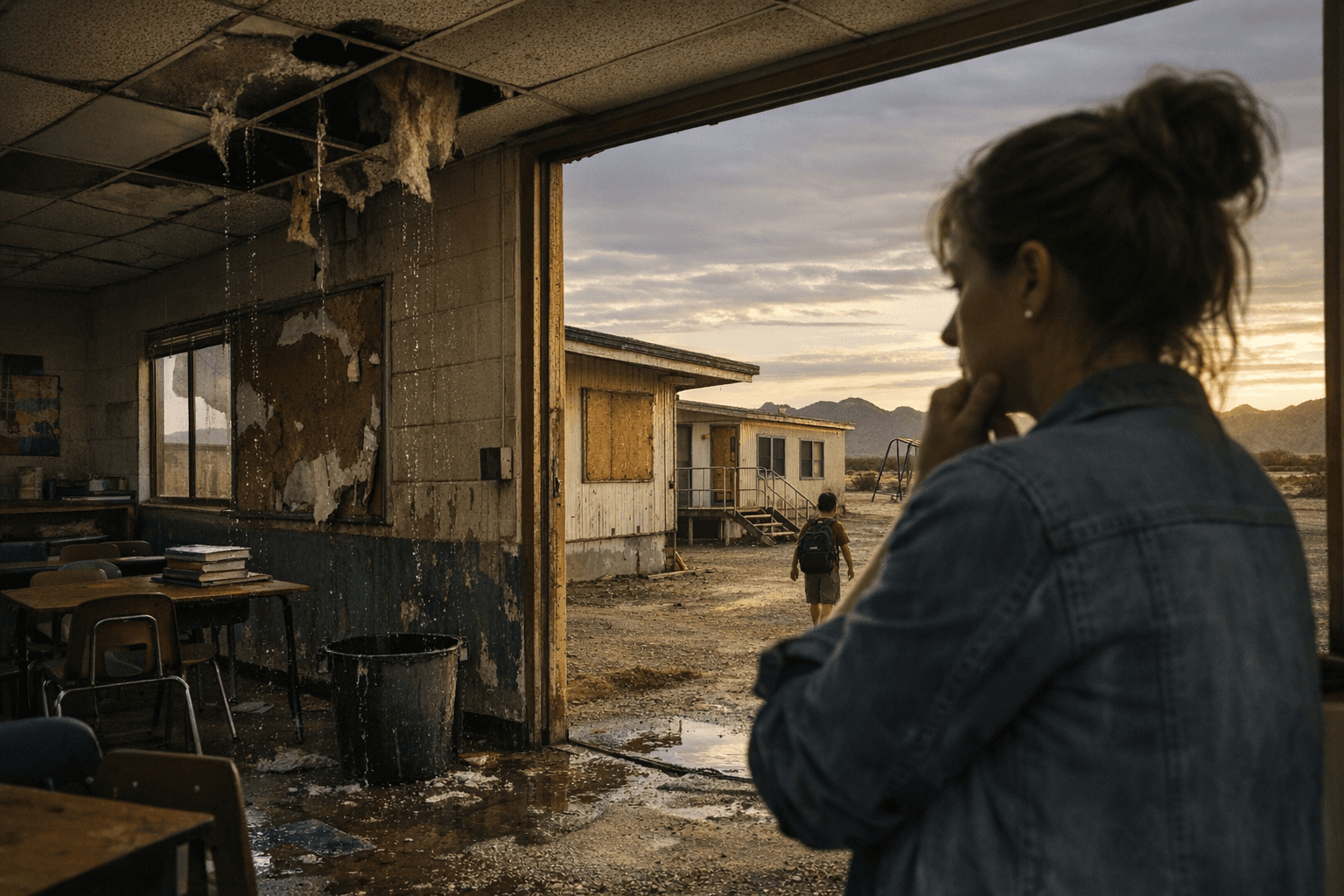
Court exhibits and inspection photos submitted in the case documented long standing facility problems, and included images from schools in Yuma and La Paz counties. Quartzsite Elementary School in La Paz County appeared in the evidence as an example of deteriorating conditions, with modular buildings described as in poor condition, failing systems, and repeated temporary fixes instead of comprehensive repairs. Other cited problems included leaking roofs, failing HVAC systems, mold and rot, unsafe wiring, and dilapidated modular buildings.
The plaintiffs argued that Arizona’s approach has left capital funding largely dependent on local property tax capacity, advantaging wealthier districts. Dale Ponder, chief financial officer for Crane Elementary School District, said, "we have also become very reliant on our local property taxpayers to support the district. We're incredibly appreciative of their investments, but that's not something that the local taxpayers should have to carry the burden for." Danny Adelman, director of the Arizona Center for Law in the Public Interest, summarized how prior funding shifts created the current disparity, saying, "The way Arizona had it set up is almost all of the capital funding, and capital is everything from facilities to air conditioners, your roof, but it's also things like buses, curriculum technology, security, infrastructure, all those things, the way Arizona funded that was largely dependent on the property values in each district and each school district."
The ruling does not prescribe a specific remedy, but it requires the legislature to develop a funding scheme that ensures a general and uniform public school system. Legal and policy options under discussion include restoration or redesign of a centralized capital program, guaranteed funding streams for facility maintenance, or revisions to distribution formulas to ensure minimum standards statewide.
For La Paz County families and local officials, the decision underscores how facility conditions affect student safety, teacher working conditions, and district budgets. State leaders have signaled they will evaluate next steps, and legislative review and possible hearings are expected. Small and rural districts may gain strengthened access to capital support if lawmakers and courts approve a remedial plan that addresses the inequities documented in the case.
This article was produced by Prism’s automated news system from verified source data, official records, and press releases, then run through automated quality and moderation checks before publishing. The system is built and supervised by the people who set the standards it runs under. Read our full AI policy.
Did this article answer your question?