La Paz County landfill network helps residents avoid long drives to Parker
La Paz County's spread-out landfill network keeps Parker from becoming every resident's only dump run, with different hours and fees for each community.
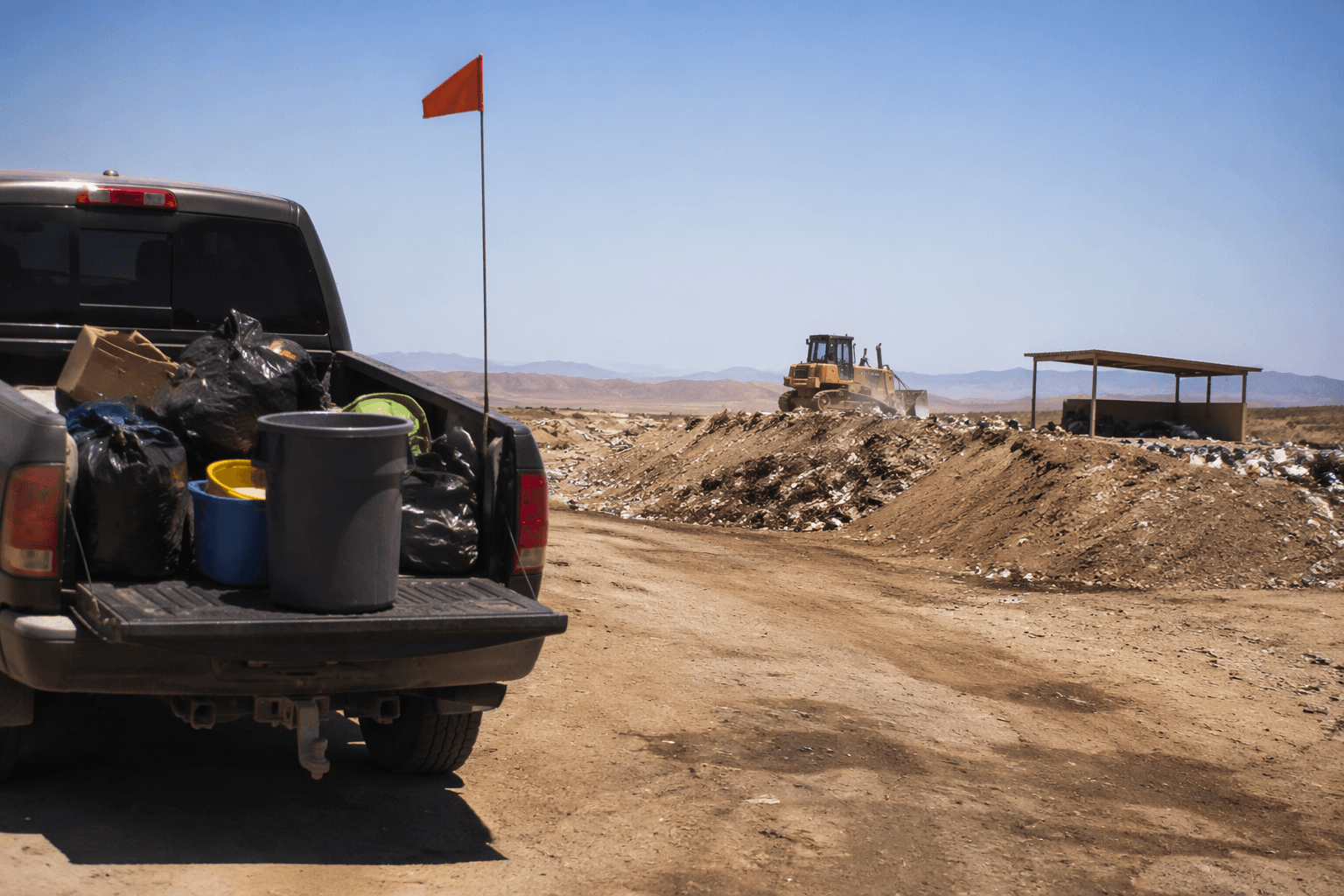
A couch, a mattress or a load of yard waste does not have to mean a drive to Parker for every La Paz County cleanup. The county’s landfill-and-transfer-station network spreads disposal points across Bouse, Cibola, Ehrenberg, Parker Strip, Quartzsite and Salome, cutting fuel costs and giving rural households a closer lawful option. That matters in a county where a missed dump run can turn into a backyard pile, a roadside drop or a cleanup delayed for weeks.
How the county system works
La Paz County describes its main landfill as a Subtitle D landfill with 100 million cubic yards of capacity, operated by Republic Services. In plain terms, that is the regulated municipal solid-waste landfill that handles ordinary household trash at scale, so the county is not relying on a small local pit but on a long-term disposal asset built for repeat use.
The county’s setup is best understood as a hub-and-spoke system. The landfill in Parker handles the heavy disposal volume, while separate transfer stations and drop-off locations make it easier for people in outlying towns to get rid of routine waste without making Parker the answer to every trash problem. In a low-density desert county, that difference can decide whether a cleanup gets done this weekend or sits in the yard until the next long drive becomes practical.
Which community uses which site
The county’s winter-hours sheet does not use one countywide timetable. It lists different days for each community, which is exactly why checking the right location matters before loading a truck.
The Parker-area landfill listing puts La Paz County Landfill Upriver at 33040 N 97th St in Parker, AZ 85344. In the winter schedule, the landfill is open Monday through Friday from 7:00 a.m. to 3:30 p.m. and closed Saturday and Sunday.
For the outlying towns, the winter-hours sheet lists these schedules:
- Bouse: Thursday through Saturday, 7:30 a.m. to 2:30 p.m.
- Cibola: Monday only, 7:30 a.m. to 2:30 p.m.
- Ehrenberg: Friday and Saturday, 7:30 a.m. to 2:30 p.m.
- Parker Strip: Sunday, Wednesday, Thursday, Friday and Saturday, 7:30 a.m. to 2:30 p.m.
- Quartzsite: Sunday through Wednesday, 7:30 a.m. to 2:30 p.m.
Salome is also part of the county’s transfer-station network. The Indian Hills Airpark Association’s trash-disposal page identifies the Salome Waste Transfer Station as a local disposal point and says it accepts refrigerator appliances, tires, household garbage, yard trimmings and old furniture. It adds that disposal is free in that setup, with limits and exceptions set by the person on site.
That patchwork is the practical reality of waste service in La Paz County. A resident in Quartzsite can use a station four days a week, while someone in Cibola has a Monday-only option. The result is a network built around distance, not convenience in the city sense.
What it costs to dump common household waste
The county’s rate sheet names the items many people actually haul: household trash, white goods, furniture, mattresses and bulk items. It is the kind of pricing table people need when they are cleaning out a property, handling an estate load or moving out of a rural home where bulky items have nowhere else to go.
For county residents, household trash is free up to the minimum charge threshold under 500 pounds, and regular municipal waste is listed at $26.50 per ton. That structure rewards smaller household loads and gives residents a straightforward way to bring in ordinary trash without paying a fee on every trip.
Construction-related waste is priced separately. The rate sheet lists construction-related charges of $8.00 per ton, $33.00 per ton and $120.00 per ton for different construction categories. That matters because a homeowner’s cleanup load and a contractor’s debris pile are not treated the same way, and the difference can change the cost of a project quickly.
Why the rules and hours matter for daily life
The county’s waste pages are not just an address book. They are a guide to avoiding wasted fuel, missed trips and confusion about which load belongs where. A refrigerator, a mattress and a pile of yard trimmings may all be bulky, but they do not all follow the same rules, and a closed station can turn a short chore into a long, expensive rerun.
The state also treats La Paz County’s transfer stations as part of the regulated system. Arizona Department of Environmental Quality’s waste-transfer-stations list includes county contacts Dan Field, 928-669-6115, and Larry Henk, 602-398-6846. That means the local network sits inside a broader state oversight structure, not outside it.
For comparison, Pima County’s landfill-and-transfer-station page says its disposal locations are private businesses and do not accept hazardous materials. That is a reminder that Arizona counties often depend on outside operators and site-specific rules rather than a single uniform public system.
How the system became part of county planning
La Paz County’s current arrangement took shape years ago. On Sept. 16, 2013, the Board of Supervisors voted unanimously in a special meeting to enter into an agreement with Republic Services to operate the landfill and add a rail pact. Industry coverage around that time placed the landfill on Highway 95 and described it as a valuable asset because of its disposal capacity and proximity to urban centers.
Republic Services later emphasized its broader landfill-energy business in a 2014 press release about landfill gas-to-energy projects. More recently, Peter Sternberg, the company’s general manager, told the county board that inbound tonnage had fallen from about 261,000 tons in 2023 to about 189,000 tons and that a new landfill cell would be constructed. That kind of board-level update shows the landfill is not just a convenience site, but a facility that requires capacity planning and public attention.
For people living far from Parker, the value of the network is immediate. A nearby transfer station in Bouse, Quartzsite, Ehrenberg or Parker Strip can mean the difference between a lawful trip and an illegal shortcut, especially when hours are narrow and loads are bulky. In a county this spread out, the usefulness of the system is measured in fewer miles, fewer gallons burned and fewer reasons for trash to end up where it does not belong.
This article was produced by Prism’s automated news system from verified source data, official records, and press releases, then run through automated quality and moderation checks before publishing. The system is built and supervised by the people who set the standards it runs under. Read our full AI policy.
Did this article answer your question?