La Paz County voting centers link rural communities across the county
La Paz County’s vote centers bring Parker, Quartzsite and desert communities into one countywide network, but long drives still shape access on election day.
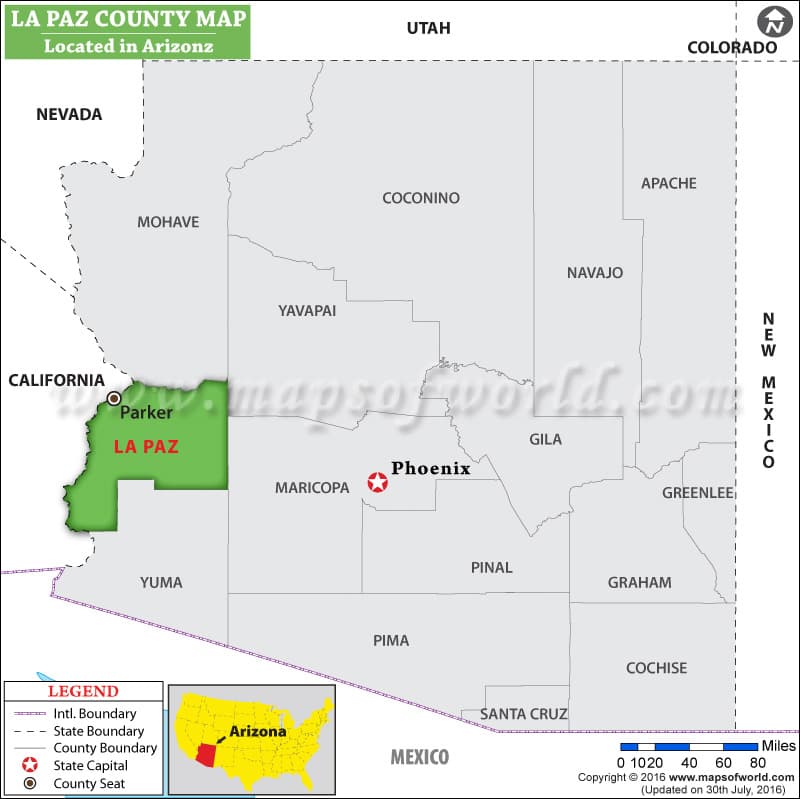
La Paz County’s vote-center map is built for a county where towns are far apart and population is thinly spread across the river corridor and the desert. Instead of forcing residents to rely on a single tiny precinct site, the county’s 2024 election plan links Parker, Poston, Upriver, Bouse, Wenden, Salome, Quartzsite, Cibola, Ehrenberg, Vicksburg and Quartzsite Three into one system that is easier to navigate across county roads and major local routes.
Where the county puts the vote centers
The specific sites show how the county tries to match elections to the places people already use. Parker voters are assigned to United Methodist Church on Ocotillo Avenue, Poston voters to Le Pera Elementary School on Tahbo Road, Upriver voters to La Paz County Boating & Safety on Riverside Drive, and Bouse voters to the Bouse Community Building on E. Plomosa Road. In the western and central desert communities, Wenden, Salome and Vicksburg are grouped at the Indian Hills Airpark Pilot’s Lounge in Salome, while Quartzsite voters are directed to the Quartzsite Community Center on E. Chandler Street.
The county’s published materials also fold in the smaller river and desert communities that can be easiest to overlook in a large county. Cibola and Ehrenberg are both identified in the vote-center network, and Quartzsite Three appears in the precinct map as part of the county’s election layout. That matters in a place where the county is not asking every settlement to support a separate precinct operation of its own.
Why the map matters in a county this spread out
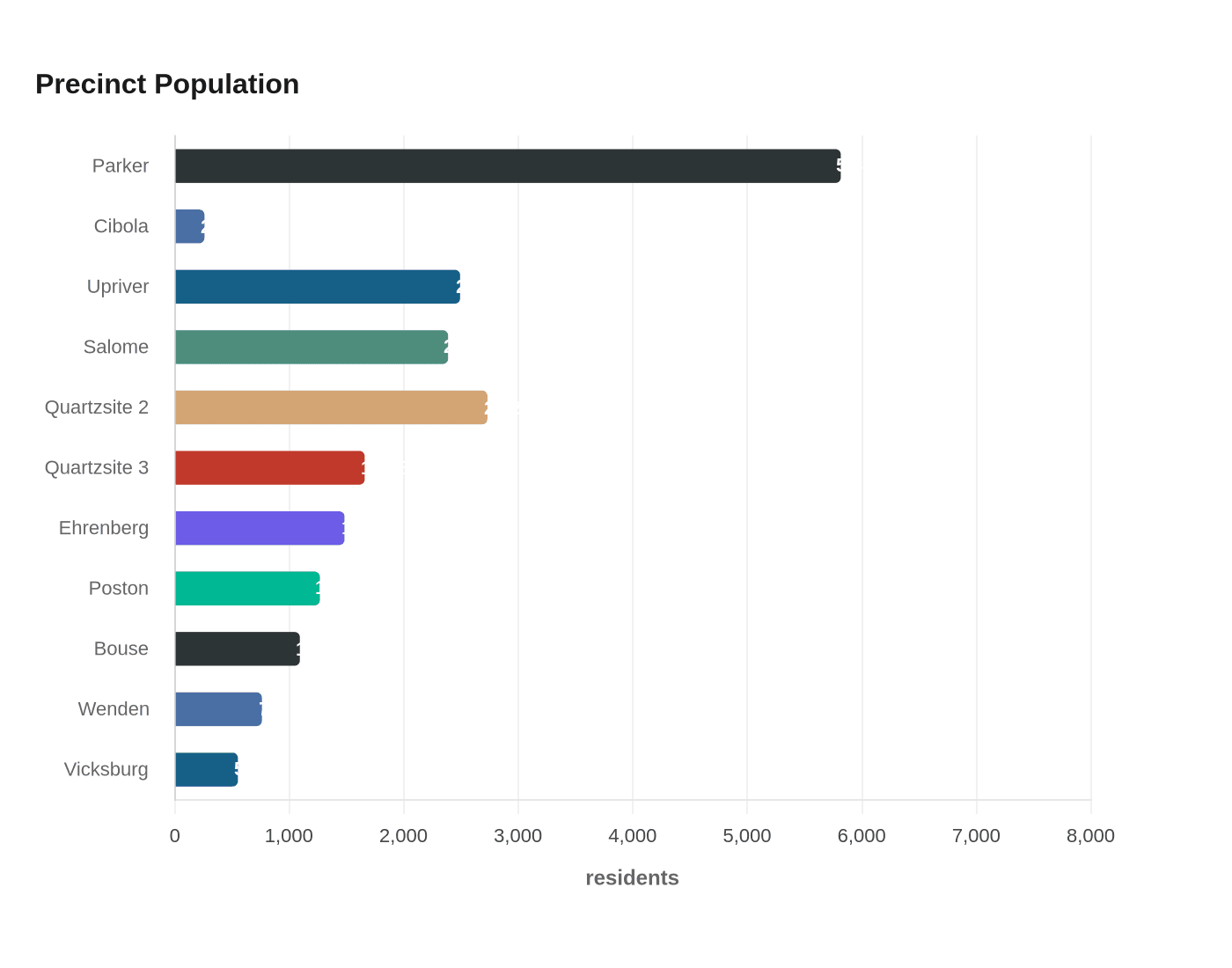
The precinct map shows why La Paz County has leaned into this structure. Parker is the largest precinct listed, with 5,814 residents, while Cibola has just 259. Between those poles sit Upriver at 2,491, Salome at 2,386, Quartzsite Two at 2,729, Quartzsite Three at 1,658, Ehrenberg at 1,482, Poston at 1,266, Bouse at 1,092, Wenden at 761 and Vicksburg at 551.
That spread creates the practical tradeoff at the heart of the vote-center model. Residents gain flexibility because the county can place voting sites where roads, parking and existing public buildings make sense, but the model does not erase distance for people who live far from town centers. For Parker, Quartzsite and the smaller river or desert communities, the question is not just whether a ballot is available, but how much travel, planning and time off work it takes to reach the site.
How early voting fits into the choice
La Paz County Elections says the county is responsible for coordinating and administering Primary and General elections, and its early-voting page gives voters another path when a trip to a vote center is difficult. The recorder issues early ballots before all elections upon request, no reason is necessary, and any registered voter may vote early.
That option is especially useful in a county where long drives can discourage participation. If election-day travel is a burden, the early-ballot process can reduce pressure on households that have to balance work schedules, school runs and the distance between outlying communities and the nearest town site. In practice, the county is offering two forms of access at once: a vote-center network for election day and an early-voting system for voters who need more flexibility.
How La Paz County fits Arizona’s wider system
La Paz County’s 2024 setup was not an isolated local experiment. The Citizens Clean Elections Commission lists the July 30, 2024 primary in La Paz County as a vote-center election, and it lists the Nov. 5, 2024 general election as a statewide vote-center election. Arizona election materials also describe vote centers as the standard election-day model in many places, which puts La Paz County’s approach squarely inside the state’s broader system.
The statewide shift away from strict precinct-only voting has been building for years. A 2022 Votebeat report on Arizona primary voting said the state had already added more vote centers and other voting changes by that point, and a 2021 to 2023 state task-force report said Arizona’s election system is strong but still open to bipartisan improvements. That broader evolution runs through state election leadership and debate involving Katie Hobbs, Mark Brnovich, Michele Reagan, Stephen Richer and the Governor’s Bipartisan Elections Task Force.
What the county’s own records show after voters cast ballots
The county’s election-results page shows that administration does not end when the doors close. It includes a 2024 General Election section dated 11/05/2024, along with a recount-results heading for the primary, which shows that close races and post-election review are part of the county’s election work too. That archive matters in a county where voters may already be balancing distance and timing before they even reach a ballot box.
For La Paz County, the vote-center model is less about a single building and more about stitching together a scattered landscape of river towns, desert communities and county facilities into one usable election system. The real test is whether a Parker resident, a Quartzsite voter or someone living in a smaller place like Cibola can get to the polls without the county’s geography becoming a barrier, and the answer depends on both the site list and the early-ballot option working together.
This article was produced by Prism’s automated news system from verified source data, official records, and press releases, then run through automated quality and moderation checks before publishing. The system is built and supervised by the people who set the standards it runs under. Read our full AI policy.
Did this article answer your question?