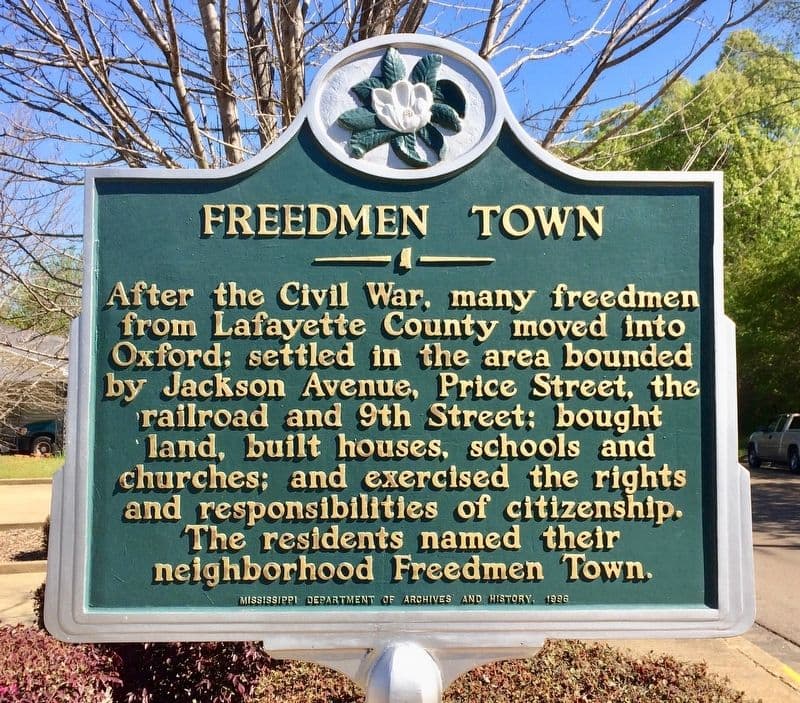
Freedmen Town marker highlights Oxford's Black heritage and schools
Freedmen Town's footprint still traces Oxford's Black schooling story, from the 1867 Freedmen's Bureau classroom to Del Mount Seminary and county church schools.

Freedmen Town still sits in Oxford’s street grid, and the neighborhood’s marker makes that history hard to miss between Jackson Avenue, Price Street, the railroad and 9th Street. What looks like a simple boundary on a sign is really the outline of how freedpeople bought land, built houses and created schools and churches that anchored Black life in Lafayette County.
A footprint still visible between Jackson Avenue and 9th Street
The residents named the neighborhood Freedmen Town, and the name itself signals what was happening there after the Civil War: Black families were building a place of their own in Oxford. The marker, erected by the Mississippi Department of Archives and History in 1996, turns that local geography into public history, placing Freedmen Town inside a statewide marker program that has identified historic sites since 1949 and now includes more than 1,000 markers.
The point of the marker is not only memory. It is a map of land ownership, kinship and institutions, because the exhibit from the University of Mississippi says freedmen from Lafayette County moved into Oxford, settled that bounded area, bought land and built the structures that made daily life possible. Family names in the archival record, including Mrs. Susie Marshall, Niler Franklin, Linder Burt, Annie Lee Burt and Mary Gordon, show how the story survives through households as much as through buildings.
Schools were the first durable institutions
Education began almost as soon as the neighborhood did. The first school in Oxford for African Americans opened in 1867 under the Freedmen’s Bureau and was taught by Alexander Phillips, an African-American preacher. It met five days a week from 8:30 a.m. to 5 p.m., with grammar, arithmetic, geography, spelling, reading and writing forming the core of the day.
That schedule matters because it shows how urgently Black Oxford wanted schools that were serious, regular and lasting. The first Oxford Colored High School followed in 1882 in Freemantown, giving the community a public education foothold that extended beyond the earliest Reconstruction years. The school later burned, but the fact that it was founded there ties Freemen Town directly to the city’s first Black secondary education.
At the turn of the century, Walter Johnson and his wife, Dovie Evelyn Wilburn Johnson, carried that work forward by creating Del Mount Seminary on North 7th Street, now Martin Luther King, Jr. Boulevard. A University of Mississippi photo caption from around 1927 identifies graduates of Del Mount Seminary Grammar School, evidence that the school had become an established part of Black educational life in Oxford rather than a short-lived experiment.
Churches and rural schools filled the gaps
Freedmen Town’s story widens once you look beyond the city limits. The Lafayette County exhibit says roughly 46 one-room African American schools were created in rural areas of the county, often spaced every three miles and frequently meeting in churches until dedicated school buildings could be built. That pattern shows how Black communities turned worship spaces into classrooms when no public system would serve them.
Second Baptist Church School, taught by H.W. Bowen, is one of the clearest examples of that arrangement. Churches were not just spiritual centers; they were incubators for literacy, discipline and local leadership. In a county where transportation was limited and segregation shaped everything from funding to access, a church classroom could be the difference between schooling and none at all.
That same community model later powered the Rosenwald era. Across the South, Rosenwald schools became community centers, and at their peak between 1920 and 1928 the Rosenwald Fund supported nearly 500 schools a year. About 5,000 Rosenwald schools were built across the South, including the Oxford school that became a major part of Lafayette County’s Black education line.
Oxford High School, Lafayette County Training School and the churches that kept classes going
The Oxford Rosenwald school was renamed Oxford High School in 1930, then became Lafayette County Training School in 1933-34. When the building burned in 1936, classes moved into Black churches and continued there from 1936 to 1939 until a new structure was completed. That replacement school cost $78,000 and was later renamed Oxford Training School.
The sequence is important because it shows education in Oxford surviving fire, segregation and constant shortage. The school system did not simply appear from the county; it was repeatedly rebuilt by Black parents, ministers and teachers who used the institutions they already had. In that sense, the churches and schools around Freedmen Town form one continuous civic story.

The records that keep the neighborhood legible
The deeper paper trail begins with the Freedmen’s Bureau, created in 1865 to handle relief, education, labor contracts and other services for freedpeople. In Mississippi, the bureau’s records include labor contracts and marriage records, and the Mississippi Department of Archives and History preserves microfilm copies that help connect family life, work and landholding.
That archive matters because Freedmen Town was shaped by migration as well as by local emancipation. African Americans in Oxford and Lafayette County came from South Carolina, Virginia, Alabama, North Carolina and Georgia, with some arriving before the Civil War and others after it. The neighborhood grew out of those routes, and its legacy remains visible in the streets, the churches, the school names and the institutions that still interpret the past.
The University of Mississippi Archives and Special Collections and the Lafayette County Digital Museum continue to preserve these materials, which keeps Freedmen Town from fading into a footnote. In Oxford, the neighborhood’s history still survives in plain sight, where a marker, a boulevard name, a church classroom and a school site all point back to the same Black civic foundation.
This article was produced by Prism’s automated news system from verified source data, official records, and press releases, then run through automated quality and moderation checks before publishing. The system is built and supervised by the people who set the standards it runs under. Read our full AI policy.
Did this article answer your question?