Greenfield Farm reveals Lafayette County’s farmland and Faulkner history
Greenfield Farm ties Oxford’s rural edge to Faulkner’s fiction, and the new residency is turning that same ground into Lafayette County’s next cultural asset.
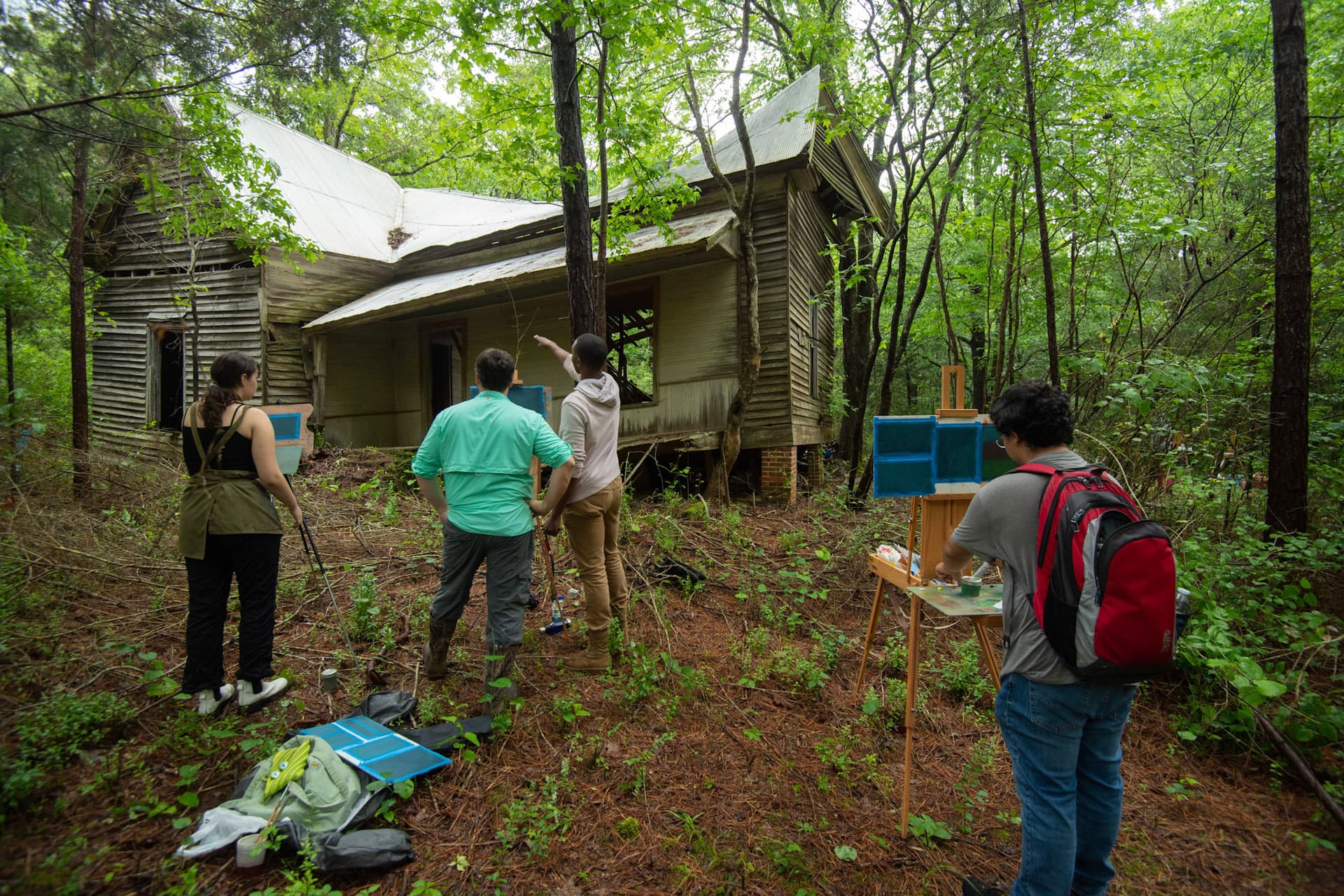
Greenfield Farm sits where Lafayette County’s hilly farmland, Faulkner’s fictional geography and Oxford’s rural edge still overlap. About 15 miles east of Oxford on the road toward New Albany, the land gives visitors a direct look at the creek bottoms, timber and working fields that shaped both the county and William Faulkner’s imagination.
From Chickasaw cessions to Puskus Creek
Lafayette County was carved out in 1836 after Chickasaw land cessions, and much of its hilly ground remained largely uncultivated until after the Civil War. Greenfield’s setting on Puskus Creek fits that broader story of slow agricultural development. In 1875, F. C. Parks established a farm there and built it around the kind of production that defined the county’s rural economy: livestock, corn, cotton and vegetables.
That origin matters because Greenfield was never just scenery. It began as a working Mississippi farm on the line between Oxford and New Albany, and the land still reads that way. The site’s location, shape and creekside terrain made it useful farmland long before it became a literary landmark.
Faulkner bought a working farm, not a country estate
William Faulkner bought 362.5 acres of the property in 1938 using money from the film rights to The Unvanquished and a mortgage from the Federal Land Bank of New Orleans. By the time he took ownership, eight tenant families were already living there. He inherited a place with labor, infrastructure and obligations already in motion, not an empty estate waiting to be dramatized.
Faulkner treated it that way. He kept a commissary on the grounds to supply staple goods and other necessities to tenants and nearby neighbors, and the farm remained tied to the daily needs of the people living and working there. Even when advised to raise cattle, he stuck with mules, a practical choice that fit the farm’s existing life more than any romantic idea of plantation grandeur.
The property also held a stand of virgin pine timber, which Faulkner partially harvested in 1947. He leased the mineral rights in 1938 and again in 1942, but the land was never drilled, mined or quarried. Those details give Greenfield its economic shape: a place of crops, timber, tenants, supply lines and land value, all layered into one tract east of Oxford.
Where the real farm became Yoknapatawpha
Greenfield’s literary importance is rooted in geography as much as in biography. The map of Yoknapatawpha County in Absalom, Absalom! places the fictional McCallum farm where Greenfield sits in Lafayette County, tying one of Faulkner’s best-known imaginary landscapes to a real piece of ground near Puskus Creek. That link is visible in the way the farm still helps readers place Faulkner’s world inside the county’s actual roads and ridgelines.
The creek itself carries another recognizable connection. Puskus Creek was used for the quicksand scene in the film version of Intruders in the Dust, giving the site a second cultural afterlife beyond the novels. For local readers, that means Greenfield is not simply a name in a map or a line in a biography. It is a landscape that remains legible in Faulkner’s fiction and in the film adaptations that reached a wider audience.
A new cultural use for old ground
The University of Mississippi is now developing the Greenfield Farm Writers Residency on a 20.4-acre site once owned by Faulkner. Ole Miss says the retreat-style compound is projected to nurture 50 to 60 writers with Mississippi ties each year, with stays of one to three weeks. The project is being built as both a writers retreat and a cultural destination, extending the farm’s role from agricultural production and literary memory into a new creative economy.
The financing has grown in visible steps. As of May 2024, the university said $4.6 million was in place through private support and university-committed funds, including a $2 million grant from the Robert M. Hearin Support Foundation. By October 2024, support had topped $4 million, and in February 2026 the Mississippi Arts Commission awarded a $500,000 grant for an overnight writer studio at Greenfield Farm. Oxford donors Patty and Will Lewis also gave $100,000 to the effort, adding local backing to a project that is increasingly being framed as a county asset, not just a university one.
The design calls for six new buildings and two renovated buildings, and university programming has already started to preserve the site’s visual history. Photo-documentary work has focused on the ruins and daffodils that still mark the grounds, using the landscape itself to connect the farm’s past with the residency to come. A 2026 exhibit and lecture series is set to carry that story through summer programming, tracing the land from the Choctaws to Faulkner’s purchase in 1938 and through the years after his death in 1962, when the university came to own part of the property.
That layered future is what makes Greenfield Farm matter in Lafayette County now. It is still a working map of local agriculture, but it is also a place where heritage tourism, donor investment and literary memory meet the same ground near Oxford and New Albany.
This article was produced by Prism’s automated news system from verified source data, official records, and press releases, then run through automated quality and moderation checks before publishing. The system is built and supervised by the people who set the standards it runs under. Read our full AI policy.
Did this article answer your question?