Lafayette County EMS Combines Fire Services, Advanced Tools to Save Lives
When a fire truck arrives at your Lafayette County 911 call, it carries hospital-grade cardiac monitors and automated CPR devices — nearly everything an ambulance has, minutes sooner.
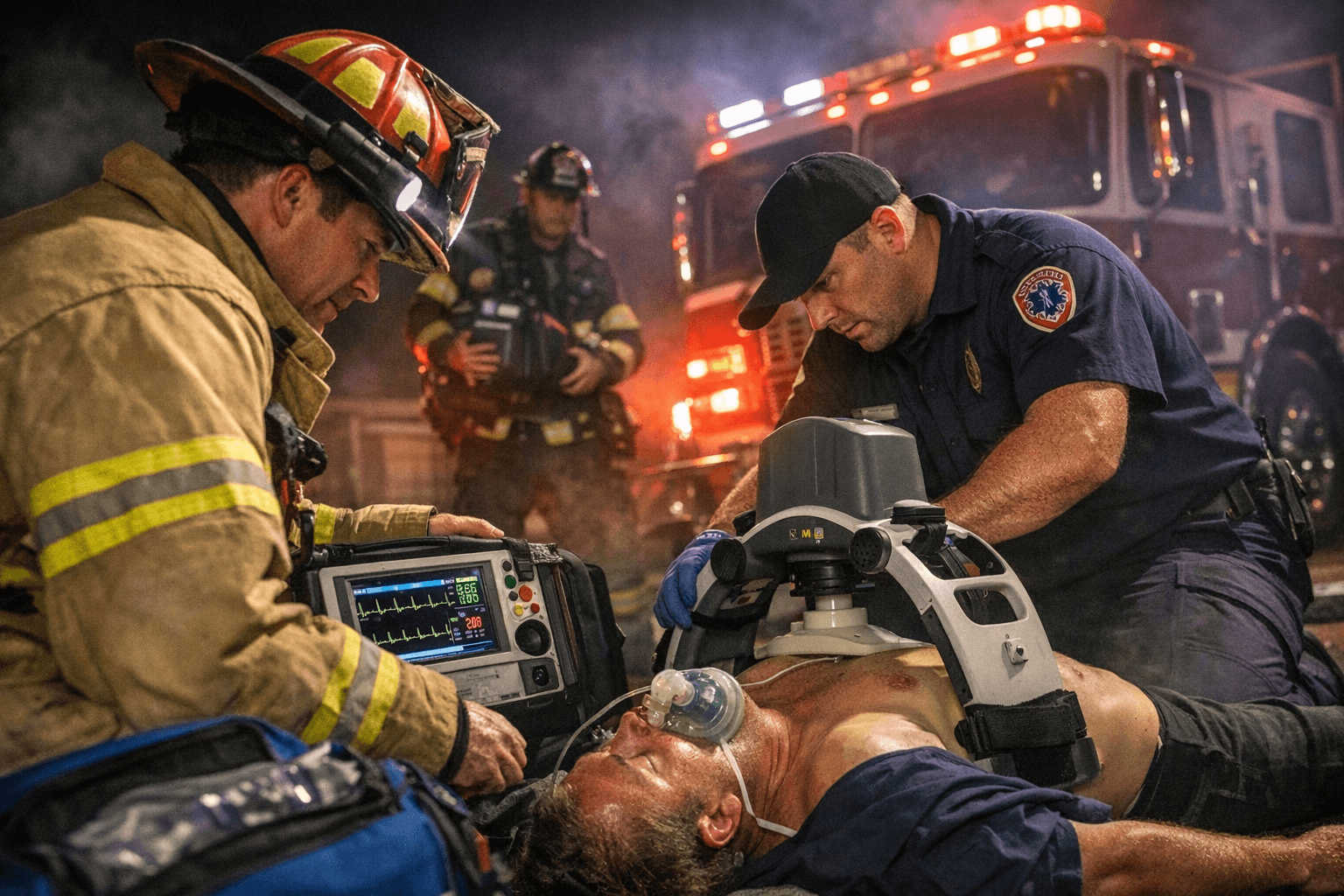
When a fire truck rolls up to a medical emergency in Lafayette County, it is not simply standing by until the ambulance arrives. It is, in practical terms, an advanced life support unit: stocked with hospital-grade cardiac monitors, mechanized CPR equipment, and crew members trained to begin critical interventions the moment they step out of the cab. That reality reflects a deliberate, county-wide strategy to save more lives by fusing fire and EMS services into a single, faster-responding system.
How the Combined Fire-EMS Model Works
Lafayette County Emergency Medical Services operates on a fire-based model, meaning fire stations positioned across the county double as forward staging areas for advanced medical equipment and trained responders. Because those stations are geographically distributed, a fire crew is frequently the closest unit to any given emergency address. When they arrive before the ambulance transport unit, they do not simply wait; they begin monitoring, airway management, and advanced life support immediately.
The practical result is that the clock on critical interventions starts earlier. For conditions where every minute of delay worsens outcomes, including cardiac arrest, stroke, and major trauma, that head start is not procedural; it is the difference between survival and death. Lafayette County has structured its entire response architecture around compressing that window.
The Tools That Make the Difference
The fire-based EMS trucks in Lafayette County carry equipment that mirrors what a patient would encounter inside an ambulance. As described by county EMS leaders, crews arrive with "everything an ambulance has except a stretcher and narcotics." That includes airway management kits and, critically, two pieces of technology that have redefined pre-hospital cardiac care: ZOLL cardiac monitors and LUCAS automated CPR devices.
The county maintains multiple ZOLL units in active service. These are hospital-grade monitors capable of 12-lead ECG acquisition, defibrillation, and continuous vital sign tracking, giving crews diagnostic information in the field that was once available only in an emergency department. The LUCAS device addresses a separate but equally important problem: the quality of manual CPR degrades rapidly as responders fatigue, and in a chaotic scene, technique can be inconsistent.
Division Chief and Paramedic Jamie Roy has seen the impact directly. "The LUCAS device has really changed the way we treat cardiac arrest," Roy said. The machine delivers consistent chest compressions at a calibrated depth and rate, freeing responders to focus on airway management, medication, and rhythm analysis simultaneously. Roy is direct about the outcome: the LUCAS device "absolutely saves lives."
The People Behind the Response
Assistant Chief of EMS Toby Lafayette describes the work in terms that resist easy generalization. "There's really no such thing as a typical EMS call," he said, a statement that captures the cognitive and clinical demands placed on responders who must pivot from a diabetic emergency to a vehicle collision to a pediatric call within the span of a single shift. That variability is precisely why training is treated as a continuous obligation rather than a box checked at certification.
Lafayette's leadership approach is rooted in a commitment to incremental improvement. "We're always trying to improve," he said, a philosophy that runs through both the department's investment in equipment and its culture around skill maintenance. Division Chief Roy's dual role as a paramedic and administrative leader reflects the same principle: the people setting policy are the same people managing airways in the field.
Training as a Core Investment
Modern equipment only delivers its potential when the people using it are proficient under pressure. Lafayette County EMS treats recurrent training as a non-negotiable operational standard, not a periodic formality. Responders drill on the same tools they deploy on real calls, ensuring that muscle memory with a LUCAS device or a ZOLL monitor is reliable in a high-stress environment at three in the morning.
For a small, rural county, this level of investment is notable. County elected officials and administrative leaders have prioritized funding access to advanced tools that many comparable jurisdictions simply cannot afford. The combination of sustained financial commitment and a rigorous training culture is what allows Lafayette County EMS to deliver care in the field that approaches the standard of a hospital emergency bay, without the walls.
What Residents Should Know When They Call 911
If a fire truck is the first unit to reach a medical emergency at your address, that is not a response gap or a miscommunication from dispatch. It is the system working exactly as designed. That crew carries the monitors and the mechanized CPR equipment. They can begin defibrillation, establish an airway, and initiate advanced life support protocols before an ambulance transport unit arrives. The stretcher comes later; the critical care starts immediately.
For families, schools, and community organizations thinking through public safety needs, this operational reality matters. An event in a part of the county closer to a fire station than an EMS substation will still receive advanced medical support rapidly, because the fire truck and the ALS equipment arrive together. The structural investment Lafayette County has made in this integrated model is one of the more consequential public safety decisions in recent county history, and its benefits extend to every resident who dials 911.
The department's ability to sustain that capability depends on continued public and budgetary support for training programs and equipment replacement. LUCAS devices and ZOLL monitors have finite service lives, and the paramedics who operate them require ongoing education to stay current with evolving protocols. Lafayette County has built something genuinely valuable in its fire-EMS integration; the work now is making sure it endures.
This article was produced by Prism’s automated news system from verified source data, official records, and press releases, then run through automated quality and moderation checks before publishing. The system is built and supervised by the people who set the standards it runs under. Read our full AI policy.
Did this article answer your question?