Lafayette County Planning Commission Denies Hipp Industrial Park Rezoning Petition
The Lafayette County Planning Commission denied a bid to downzone the Max D. Hipp Industrial Park, even as 560 residents signed a petition backing the change.
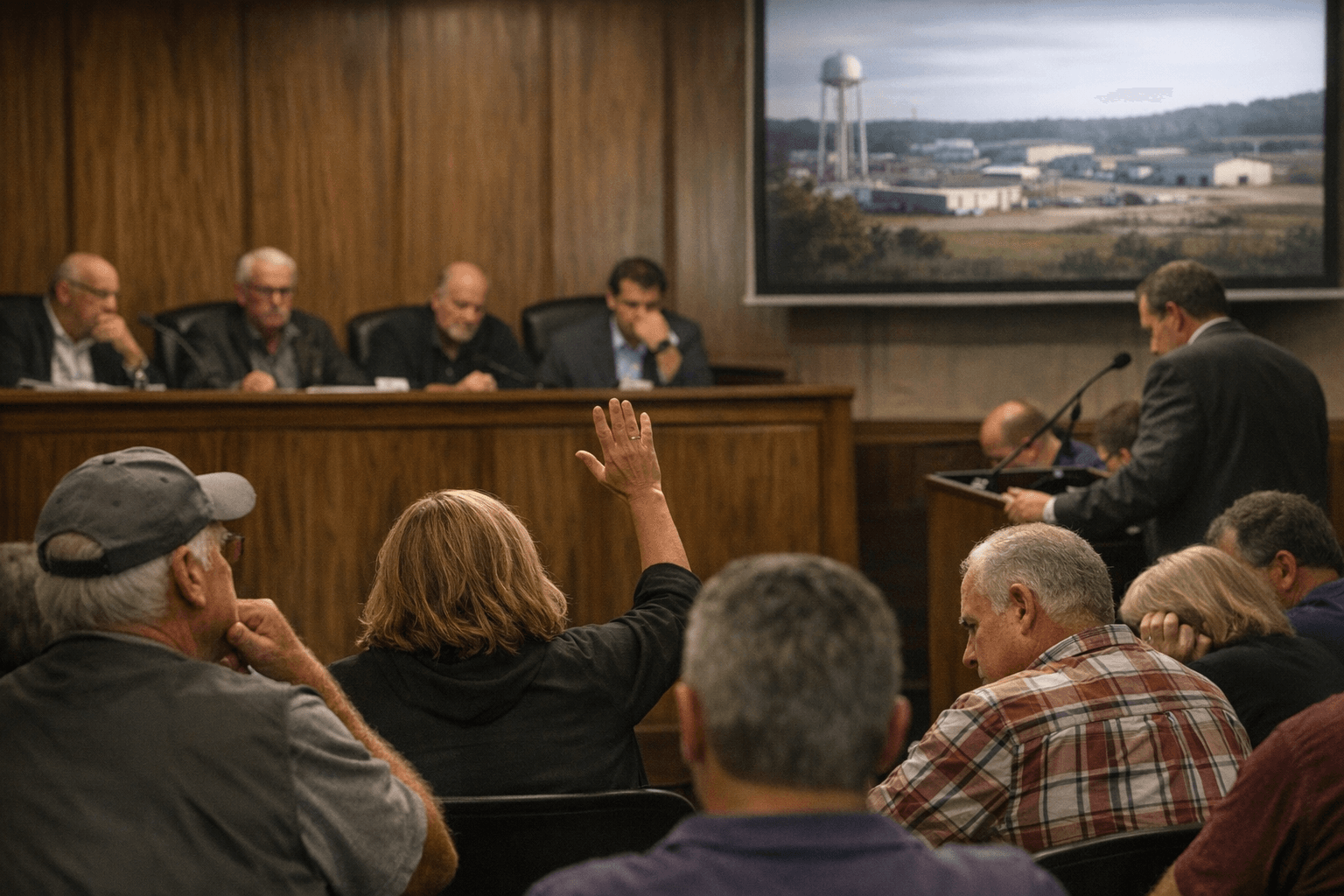
The Max D. Hipp Industrial Park, established in the 1980s along County Road 166, will remain zoned Heavy Industrial after the Lafayette County Planning Commission voted Monday night to deny a petition to reclassify portions of the park from I-2 to Light Industrial. The hearing ran nearly four hours.
Ronnie McGinness, who has lived near the park since 2008, filed the rezoning application arguing that the character of the area has shifted dramatically over time, moving from primarily industrial to largely residential. A petition bearing approximately 560 signatures in support of the downzoning was presented to the commission.
The push to reclassify the park carries urgency because Magnolia Materials, owned by JWM Development, plans to build an asphalt plant at the site after withdrawing a previous proposal near Taylor. The Lafayette County Board of Supervisors has agreed to lease the land for $5,000 per year over 35 years. Planning Commissioner Ray Garrett said during the meeting that he believes it is unlikely the Board of Supervisors would reverse that agreement, noting the county could be responsible for reimbursing expenses already incurred in preparing the site.
Residents who spoke at the hearing focused on the distinction between the park's current tenants and what an asphalt plant would introduce. Existing businesses operate within enclosed structures and fall under light industrial use in practice, speakers argued, while an asphalt plant would operate outdoors, bringing fumes, loud noise, and contaminated water runoff into a neighborhood that has grown considerably since the park was first established. Some commission members questioned why residents had chosen to live near a decades-old industrial park; residents countered that thousands of new homes have been built nearby in recent years, fundamentally changing the surrounding area.
Ryan Miller, president and CEO of Oxford-Lafayette, Inc., pushed back against the rezoning effort from an economic development standpoint, telling the commission that industrial parks are an important tool for attracting industry and that changing the zoning classification could limit the range of businesses the community can recruit.
The March vote is the latest chapter in a longer dispute over the proposed asphalt plant. JW McCurdy, owner of MR Construction, submitted an application in August 2025 to rezone a 40.1-acre tract on Mississippi Highway 328 from Agricultural to Heavy Industrial to build Magnolia Materials. The Lafayette County Planning Commission voted 3-1 in September 2025 to recommend that rezoning to the Board of Supervisors. After a five-hour public hearing on October 20, 2025 that drew enough attendance to prompt the Lafayette County Sheriff's Department to restrict access into the Chancery Courthouse, the Board tabled the vote. JWM Development subsequently withdrew the Highway 328 application and indicated willingness to locate the plant inside the existing I-2-zoned industrial park instead.
The Board of Supervisors, the Oxford-Lafayette County Economic Development Foundation, which manages the industrial park, and JWM Development have not finalized an agreement on the terms, conditions, and location of the asphalt plant within the park. With the Planning Commission's denial leaving the park's heavy industrial designation intact, those negotiations remain the next arena where the fate of Magnolia Materials will be decided.
This article was produced by Prism’s automated news system from verified source data, official records, and press releases, then run through automated quality and moderation checks before publishing. The system is built and supervised by the people who set the standards it runs under. Read our full AI policy.
Did this article answer your question?