MSU Extension Highlights Ground-Nesting Bees as Vital Southern Agriculture Pollinators
Ground-nesting bees quietly power Mississippi agriculture from bare soil patches, and MSU Extension wants Lafayette County residents to help map them.

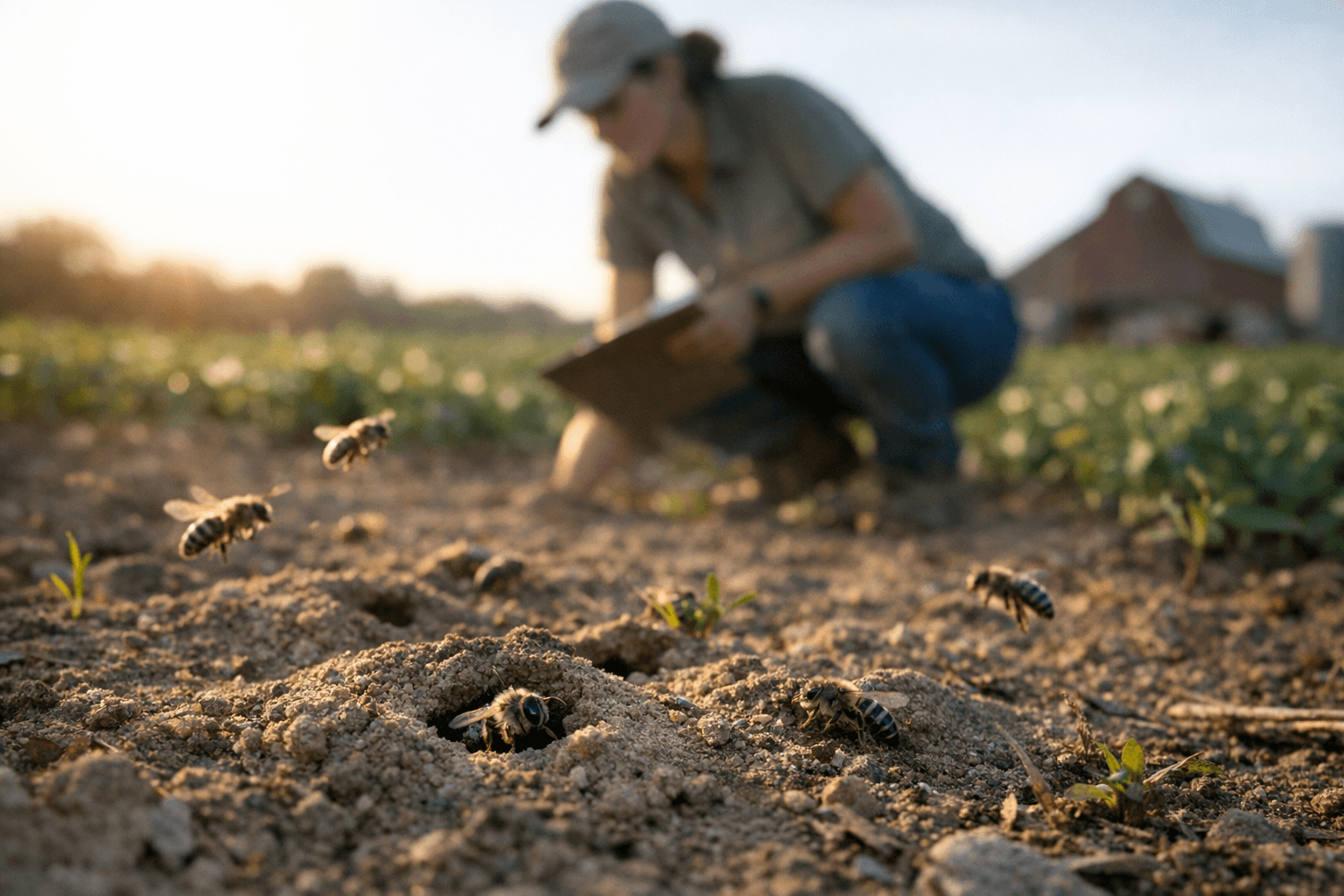
Beneath the bare soil patches along field edges, garden borders, and untended corners of Lafayette County yards, a largely invisible workforce is at work. Mississippi State University Extension has published a feature story drawing attention to ground-nesting native bees and their importance to agricultural production across Mississippi, describing how many of these species nest in sparsely vegetated soil and function as efficient pollinators. For a county where farms, gardens, and green spaces are woven into everyday life, the implications reach from the fields east of Oxford to the backyard plots in Taylor and Abbeville.
Why ground-nesting bees matter to Mississippi agriculture
Unlike the managed honey bee colonies that most people picture when they think about pollination, many native bee species build their nests directly in the ground. They seek out bare or sparsely vegetated soil patches, which means the condition and management of field margins, unpaved areas, and disturbed ground plays a direct role in whether these pollinators can survive and reproduce. MSU Extension's feature highlights that these bees are efficient pollinators, making them a meaningful part of the agricultural system that sustains Mississippi's farming economy.
The connection between ground-nesting bees and crop production is easy to overlook precisely because these insects are so inconspicuous. They do not live in hives that farmers can transport and place near crops. Their nesting habitat is often inadvertently destroyed by tilling, heavy foot traffic, or aggressive groundcover management. Recognizing their value is a first step toward the conservation practices that MSU Extension is urging.
Project GNBee: mapping a hidden population
To address the knowledge gap around where these bees live and how their populations are faring, a team of researchers from the Entomology Department at Cornell University has built a community science initiative called Project GNBee. The project's explicit aim is to promote local community-driven research and conservation for aggregations of ground-nesting bees, and it operates by asking participants from anywhere in the world to upload observations of ground-nesting bee aggregations to a dedicated iNaturalist project.
The scale of participation to date offers a sense of what coordinated community effort can accomplish. As of the MSU Extension page's last update on February 23, 2026, Project GNBee had accumulated nearly 4,000 observations covering over 330 bee species worldwide. That breadth of data, gathered from backyards and field margins by everyday observers, is what researchers hope to use to study nesting requirements and the biology of these bees across space and through time.
MSU Extension is actively promoting Project GNBee through its website, hosted by the MSU Extension Center for Technology Outreach and linked to the Mississippi Master Naturalist program. The pairing makes sense: Master Naturalists are already trained to observe and document local ecology, and the iNaturalist platform gives those observations a direct pipeline into scientific research.
A coalition from your backyard to the world
The project's designers are candid about what it takes to make the data meaningful. "It takes a broad coalition of actors to make a meaningful number of observations that can become a tool for conservation and research," the project description states. "This is a developing project in all our backyards, occurring for the future benefit of ground-nesting bees worldwide."
That framing, "your backyard" as the listed project location, is intentional. Participation does not require special equipment, a research background, or access to farmland. Anyone who spots a congregation of small bees nesting in a patch of exposed soil can photograph the site, note the location, and upload the observation to the Project GNBee iNaturalist page. The aggregation, not the individual bee, is the unit of observation the project is mapping.
The call to action from the MSU Extension page is direct: "Help collect data on native bee species populations! Join this joint effort or consider helping spread the word regarding this project. Your help is integral to this project's continued success."
For Lafayette County residents who spend time outdoors, whether farming, gardening, hiking in Tara Wildlife areas, or simply maintaining a yard, encounters with ground-nesting bee aggregations are more common than most people realize. A cluster of small holes in a sunny, bare bank or a patch of yard where bees repeatedly hover close to the ground can indicate an active aggregation worth documenting.
How to participate
Engagement with Project GNBee runs through the iNaturalist platform, which is free to use and accessible by mobile app or web browser. The project also maintains a presence through its own website and on Instagram at the handle projectGNBee. For anyone who observes what appears to be a ground-nesting bee aggregation, the process centers on uploading photos and location data to the Project GNBee iNaturalist collection.
Dr. Jordan Kueneman serves as the contact person for the project. Questions about participation, the research methodology, or how observations are used can be directed to groundnestingbees@gmail.com. The MSU Extension page also offers a downloadable "save the bees" flyer for those who want to help spread the word in their communities, schools, or agricultural networks.
The larger conservation picture
The partnership between MSU Extension and Cornell's Project GNBee reflects a broader shift in how conservation science gets done. Traditional field surveys cannot cover enough ground, in enough places, often enough, to track populations of thousands of bee species across a continent. Community science platforms like iNaturalist close that gap by turning every observer into a data collector, provided the observations are consistent and well-documented.
For Mississippi specifically, the MSU Extension feature signals that the state's agricultural community has a stake in this work. Ground-nesting bees pollinate crops and wild plants across the region, often without recognition or protection. Conservation steps begin with awareness, and awareness begins with knowing what to look for.
Lafayette County sits at a useful intersection for this kind of work: a mix of agricultural land, university resources through Ole Miss, and an engaged community of outdoor enthusiasts and naturalists who already spend time paying attention to the natural world. The bare soil along a garden bed in Oxford or a field margin near Water Valley is not just dirt. It may be exactly the habitat a ground-nesting bee needs to survive, and exactly the observation that Project GNBee's researchers need to understand why.
This article was produced by Prism’s automated news system from verified source data, official records, and press releases, then run through automated quality and moderation checks before publishing. The system is built and supervised by the people who set the standards it runs under. Read our full AI policy.
Did this article answer your question?