Ole Miss law course tours Oxford housing history, challenges
A law seminar became a citywide housing lesson, linking Oxford’s past development to today’s affordability fights and the choices now shaping who can stay.

From seminar room to city streets
What started as a fair housing law seminar at the University of Mississippi School of Law became a public tour of Oxford’s housing past and present, with the city itself as the classroom. Assistant professor Jade Craig designed the course to do more than explain legal doctrine, bringing students and community members into a conversation about how Oxford settled, expanded and formed the neighborhoods residents know today.
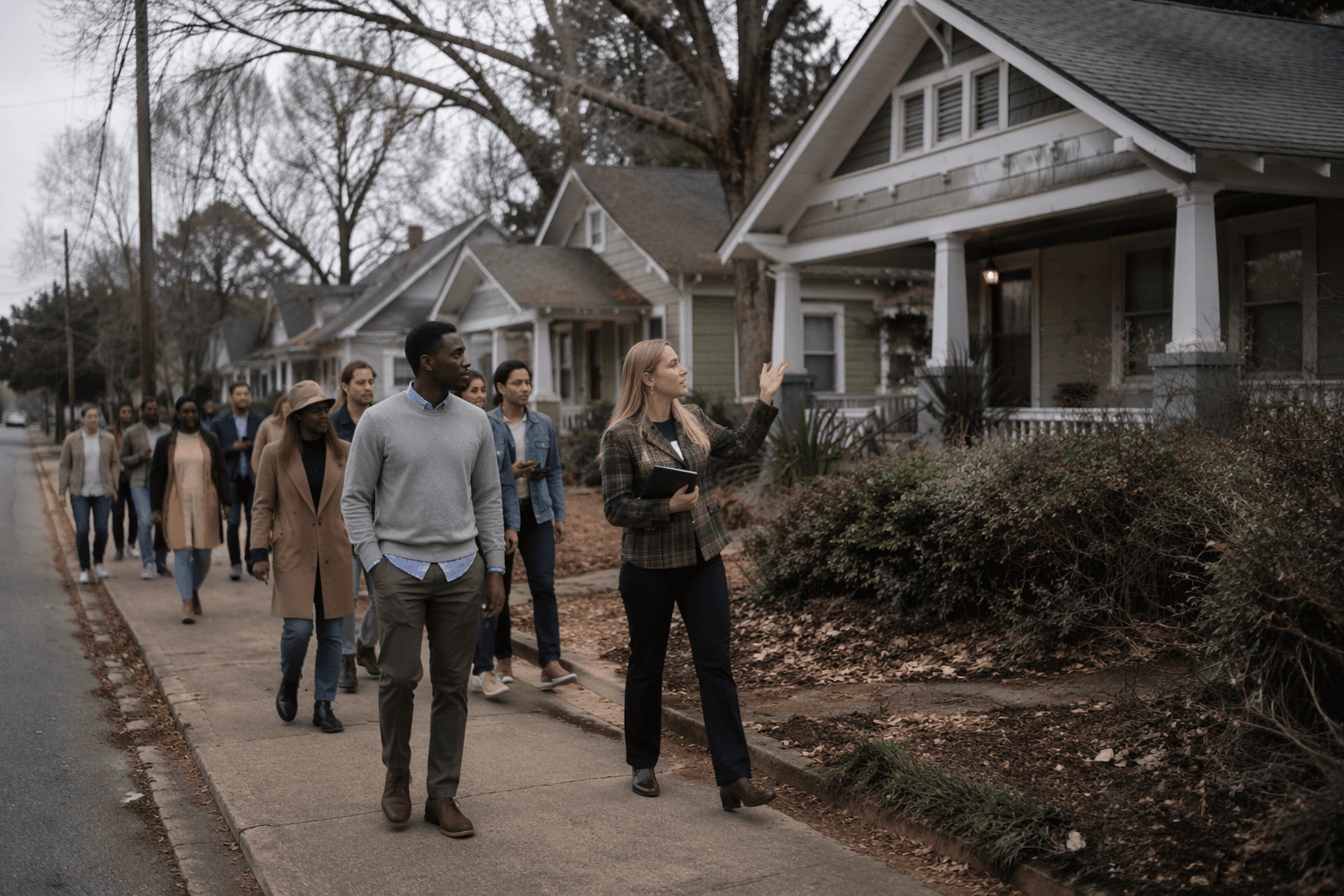
That shift matters because housing in Oxford and Lafayette County is not a background issue. It sits at the center of development debates, local planning decisions and the everyday question of who can afford to live near campus, downtown or in older neighborhoods that have changed as the city has grown. The course tied fair housing law to those realities, showing how legal rules and local development patterns are connected in ways many residents feel only when rent rises, a house is renovated out of reach or a neighborhood begins to change faster than longtime neighbors can absorb.
Why the city’s housing history still shapes the present
The value of the tour was not just historical curiosity. By tracing Oxford’s settlement and development patterns, Craig’s class helped connect the city’s past choices to the pressures now facing students, workers and longtime residents. Housing law, in that frame, is not an abstract subject reserved for lawyers. It is part of the machinery that decides where people can live, how neighborhoods evolve and whether growth produces access or exclusion.
Oxford’s own planning structure reflects that reality. The city’s Planning Department says it formulates goals, plans, policies and ordinances that provide orderly growth and development. That is a broad mandate, but in a fast-changing college town it has immediate consequences, from zoning and land-use decisions to the pace and location of new housing. The public lecture and tour made those policy levers easier to see by placing them against the city’s older development patterns.
The discussion also underscored that many residents do not encounter housing law until a dispute reaches them personally. A public-facing event like this one lowers that barrier by making fair housing principles part of civic understanding, not just legal vocabulary. In a county where housing pressure has become a defining local issue, that kind of education is itself a form of public service.
A policy landscape already under strain
Oxford’s housing debate is unfolding against hard numbers. A 2024 city housing assessment projected that Oxford’s population would grow by 6.1% over five years, reaching 28,537 by 2028. The same assessment projected Lafayette County would reach 61,111 by 2028. Those figures show why the question is not whether growth will come, but how the city and county will manage it without pushing more people out of the housing market.
Local government has already begun building a policy response. The Oxford Affordable Housing Commission was formed by the City of Oxford Board of Aldermen on June 15, 2021, to address affordable housing needs in the city. More recently, Oxford launched the Oxford-Lafayette Housing Trust Fund in March 2025, creating a long-term funding tool aimed at owner-occupied home repairs, housing emergency relief and down payment assistance.
Those priorities reveal the pressure points local officials are trying to address. Home repairs help longtime homeowners stay in place. Emergency relief can keep a temporary crisis from becoming a permanent housing loss. Down payment assistance opens a path to ownership for households that might otherwise be locked out of the market. Taken together, they show that the housing debate in Oxford is not only about building new units. It is also about preserving existing neighborhoods and making sure residents with deep local ties are not priced out as the market tightens.
What makes Craig’s course especially relevant
Craig is unusually well positioned to lead that conversation. He teaches constitutional law, political and civil rights, real estate law and fair housing law at Ole Miss, a combination that bridges the legal, political and property issues at the center of Oxford’s housing debates. His background gives the course a practical edge, not just a classroom one.
Before joining the faculty, Craig served as a special policy advisor to HUD’s Office of Fair Housing and Equal Opportunity during the Obama administration. That experience matters because fair housing is not only about federal standards on paper. It is about how those standards meet local patterns of development, neighborhood change and access to opportunity. In Oxford, where a university, a growing city center and surrounding neighborhoods all compete for limited space, the connection between federal law and local outcomes is easy to see.
The course’s public lecture and tour also broadened its reach beyond law students. That is significant in a county where housing policy can feel remote until a person is directly affected by it. By opening the discussion to the community, the class turned a legal seminar into a civic event, one that asked participants to think not just about what Oxford looks like now, but about how it got that way and what kind of housing future is being built next.
Why the story reaches beyond campus
This is ultimately a story about how institutions shape daily life. The University of Mississippi School of Law used one course to connect scholarship to Oxford’s streets, but the lesson extends well beyond campus boundaries. Housing history is not fixed in the past. It still affects access to neighborhoods, the pace of development and the choices local government has to make as population growth continues.
For Lafayette County, that means the old patterns are still active in new forms. Decisions about planning, affordability and neighborhood change will determine whether Oxford remains livable for students, workers and families who already call it home. The housing tour made that point plain: the city’s past is still present in every debate over who gets to live where, and the next chapter will be written through the policies Oxford adopts now.
This article was produced by Prism’s automated news system from verified source data, official records, and press releases, then run through automated quality and moderation checks before publishing. The system is built and supervised by the people who set the standards it runs under. Read our full AI policy.
Did this article answer your question?