Oxford Depot preserved as landmark of campus and rail history
Oxford Depot is more than a preserved rail building: it became a small-event space after a 2003 restoration that saved a campus landmark tied to mail, travel and town life.

The Oxford Depot no longer waits for trains, but it still moves people. After decades as a working rail stop, the building was saved, restored and reopened as a civic space that now hosts meetings, lectures and other events in the middle of Oxford. Its transformation from transport hub to community asset shows how preservation can shape downtown life as much as it protects memory.
From rail stop to Oxford landmark
The depot’s story begins with the Mississippi legislature chartering the Mississippi Central Railroad in 1852 to connect Canton, Mississippi, with Grand Junction, Tennessee. Passenger trains from Holly Springs began arriving in Oxford in late summer 1857, service south to Water Valley followed the next March, and by early 1860 the railroad tied Oxford into a network reaching from the Gulf of Mexico to the Ohio River. In practical terms, that meant Oxford was no longer a rail outpost. It had become a stop on a route that connected the town to commerce, students, mail and movement far beyond Lafayette County.
Oxford has had three railroad depots since the 1850s. The original Mississippi Central depot was destroyed during the Civil War, a temporary wood-frame shelter served in 1866, and the present Italianate-style building dates from 1872, the year the Mississippi Central entered a partnership with the Illinois Central Railroad. Its design still reflects that era, with scrolled scissor brackets, subtly arched windows and arched brick reveals over the double loading-bay doors. For roughly 70 years, the building served students, faculty, visitors and the surrounding community, making it a working part of campus life rather than a decorative relic.
That long run matters because the depot was built for use, not nostalgia. It handled the daily rhythms of a university town, where the station was a place to arrive, depart, meet and wait. In an Oxford where rail service shaped the pace of life, the depot functioned as both a transit point and a social one.
Why the building still carries weight
The depot’s significance reaches beyond its architecture. Mail trains carried books, care packages and letters to the University of Mississippi, turning the station into a lifeline for academic life. William Faulkner, who once served as university postmaster, helped retrieve mail sacks with his brother Murry, a detail that ties one of Mississippi’s best-known writers to the practical labor of keeping campus connected.
Oral history adds another layer. Thomas Ethridge recalled a waiting room heated by a hot pot-bellied stove and described special trains leaving Oxford for ball games, including trips to New Orleans for games against Tulane University. Those trips came with baggage cars and a university cafeteria food stand on board, which gives a vivid picture of how the depot served school spirit as well as travel. It was a place where local children watched locomotives, businessmen gathered for news and crop prices, and the university’s calendar was literally carried on the rails.
That history helps explain why the depot became more than a preservation project. It was a witness to the way Oxford grew around the university, and to the way the town’s public life once depended on a narrow strip of track and a small station house.
How preservation happened
The University of Mississippi purchased the depot in 1983, then successfully lobbied in 1992 for it to be declared a Mississippi Landmark. The university’s exhibit describes that designation as the highest honor the state can bestow on a property, and in this case it served as a shield as much as a title. It marked the depot as worth saving in a town where older buildings often have to compete with redevelopment pressure and the demands of a growing campus.
The turning point came in the summer of 2001, when the Mississippi Department of Transportation awarded an $800,000 grant for preservation and restoration under the Transportation Enhancement Act of the 21st Century. The UM Foundation added $200,000 in matching funds. The City of Oxford and the University of Mississippi jointly submitted the grant application, and the project moved through review by MDOT regional and state offices, the Federal Highway Administration and the Mississippi Department of Archives and History.
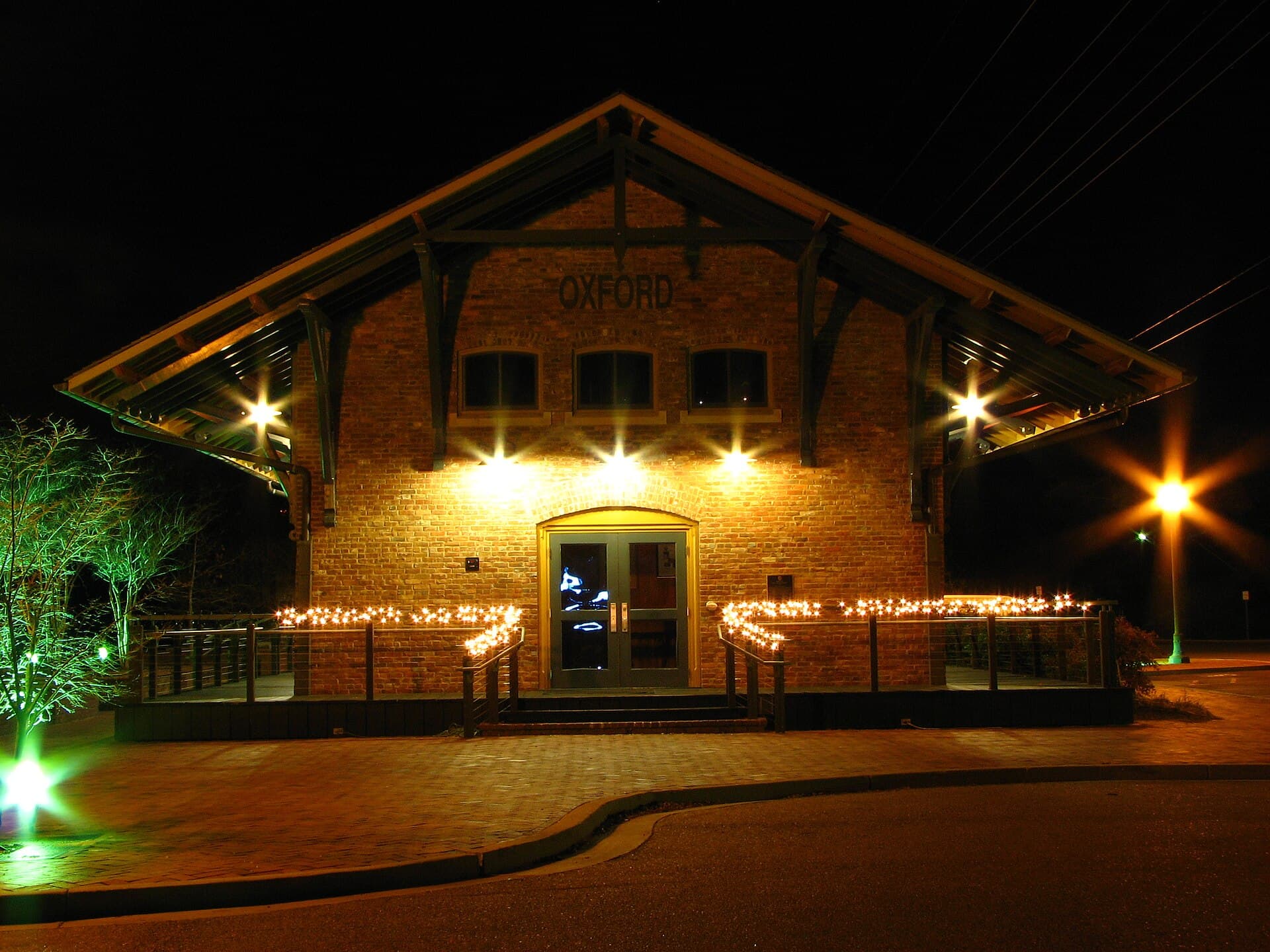
Belinda Stewart Architects, P.A., of Eupora, handled the design and oversaw the exterior renovation and interior rehabilitation. Kenneth Dillion of Dillion Construction Co. of Carriere carried out the work. The project later received a Mississippi Heritage Trust Heritage Award of Merit in 2004, one of 14 preservation awards presented in Mississippi that year. Those details matter because they show preservation as a coordinated public effort, not a one-step rescue.
What the depot became after reopening
The restored depot reopened in October 2003 as a multipurpose facility and a center for small meetings and conferences. It can host groups of up to 60 people for meetings, lectures and other events, which gives the building a new civic role without erasing its old one. Instead of moving passengers, it now gathers people, and that shift helped keep the structure active rather than frozen as a display piece.
The public also helped shape the building’s second life. In fall 2003, a university-city committee invited residents to contribute original materials, and items came in from places as close as Coffeeville, Mississippi, and as far away as Toledo, Ohio. That collection effort turned the depot into a shared archive of local memory, linking the building’s physical restoration with community participation.
For Oxford, the result is a landmark that still serves the district around it. The depot anchors a part of town where campus history, downtown activity and public gatherings overlap. Its value now comes from what it does every day: it gives Lafayette County a preserved space with a working purpose, proof that an old rail building can still serve modern civic life without losing the history that made it worth saving.
This article was produced by Prism’s automated news system from verified source data, official records, and press releases, then run through automated quality and moderation checks before publishing. The system is built and supervised by the people who set the standards it runs under. Read our full AI policy.
Did this article answer your question?