Oxford Police K-9 Jocko helps track suspects, find drugs, and people
Jocko gives Oxford police a skill set patrol cars do not have: tracking suspects, finding drugs, and helping locate missing people fast. His work shows why the K-9 unit matters across Lafayette County.
Why Jocko matters in Oxford
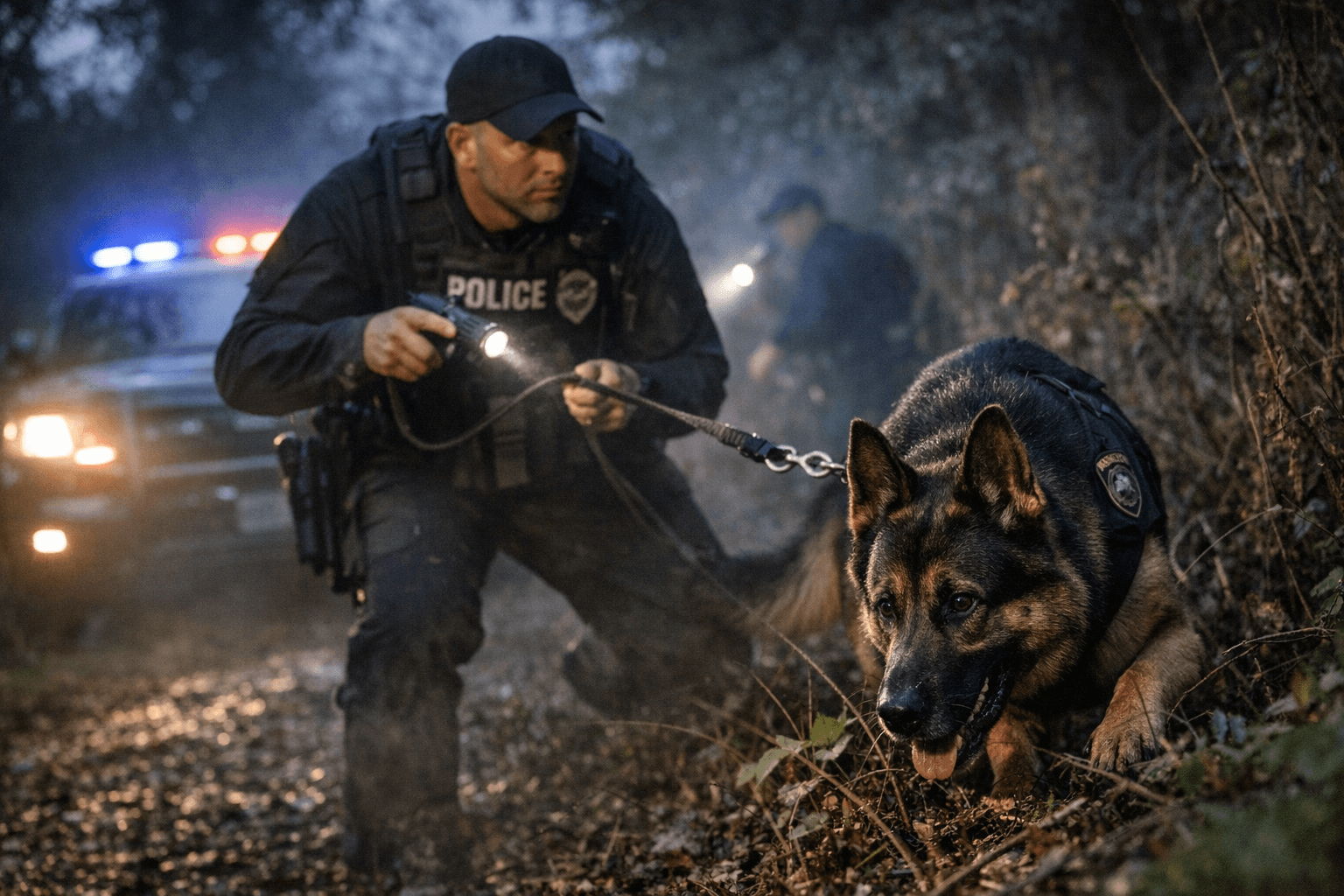
Oxford’s K-9 unit gives the city something standard patrol work cannot always provide: a nose for narcotics, a talent for tracking people, and a faster way to search when minutes matter. At the center of that effort is Officer Brandon Byrd and Jocko, a 5-year-old black Labrador retriever who has become one of the Oxford Police Department’s most visible public-safety assets.
That visibility matters in a college town and county seat where police coverage stretches beyond routine traffic stops and neighborhood patrols. The Oxford Police Department says it has 91 sworn officers and more than 114 total staff, and it operates from 9 Industrial Park Drive. Lafayette County’s 2020 Census population was 55,813, which underscores how many people rely on city and county law enforcement working in tandem across Oxford and the surrounding area.
What a K-9 unit does that officers cannot do alone
Byrd’s point about the job is simple: a dog can do things a person cannot. Jocko is trained to track suspects, detect narcotics, and help protect his handler, which makes the unit useful in situations where speed, scent, and persistence change the outcome. The dog also helps locate lost persons, extending the unit’s value beyond drug cases and into searches where a quick break in a trail can mean everything.
That is what gives the K-9 team its practical edge. A patrol officer can contain a scene, question witnesses, and follow leads, but a trained dog can work in places where the trail is faint, the timing is tight, or the terrain is difficult. In a city that describes its police force as community-oriented and says it provides around-the-clock patrols, that added capability becomes part of everyday safety, not just a special assignment.
Inside the handler-dog partnership
The relationship between Byrd and Jocko is built on constant contact. Byrd treats the assignment as a 24/7 responsibility because the dog is with the handler nearly all the time, on duty and off. That level of closeness is not a ceremonial detail; it is the basis of trust, timing, and obedience when a search, stop, or track turns urgent.
Jocko’s day starts with fetch, which helps burn off energy and focus him before work begins. That kind of routine is part of the discipline that keeps a police dog ready for calls that can change without warning. The team’s success depends on repetition, not novelty, and that is why the bond between handler and dog is just as important as the dog’s training record.
Training is what makes the unit work
Canine teams must complete at least 16 hours of training each month, but Byrd says the work often goes beyond that minimum. He and Jocko practice every Wednesday for several hours, a schedule that reflects how much precision the job requires. A K-9 unit is only as effective as the training behind it, and Oxford’s approach shows that the department treats the dog as a working officer, not a mascot.
That discipline is part of the larger safety equation for Lafayette County. Residents may only see Jocko during a patrol, at a public event, or in a moment when police need to find a person or evidence quickly, but the real value is in the hours of preparation that happen away from the spotlight. Those repeated sessions are what make a dog reliable when the call turns into a search for a suspect, a missing person, or narcotics hidden out of sight.
How Jocko became part of Oxford policing
Jocko’s role with the department was publicly introduced in March 2022, when local coverage reported that businessman Johnny Morgan donated the money for Jocko and related equipment. The dog came from Little Rock K9 Academy in Little Rock, Arkansas, after several months of training, and then completed two weeks of handler training with Byrd.
That earlier coverage also said Jocko was trained in narcotics detection, tracking, and article searches, and that he came at no cost to Oxford taxpayers. Those details still shape how the unit is understood today. His addition was not just about bringing in a dog; it was about expanding the department’s ability to respond to drug cases, locate people, and search for evidence without placing the whole burden on human officers alone.
Why the countywide picture matters
Oxford Police handles the city, while the Lafayette County Sheriff’s Department is the county law-enforcement agency outside Oxford’s city limits. That split matters because public safety in Lafayette County is shared across different jurisdictions, each with its own responsibilities but overlapping concerns. A strong K-9 team helps the city side respond quickly, especially when incidents involve tracking or evidence recovery in and around Oxford.
The county’s size also makes that capability more important. Lafayette County is not a sprawling metro area with endless layers of specialized units, so the tools local departments have on hand matter. A dog like Jocko can cut response time, help narrow a search area, and support cases that would otherwise rely only on manpower and luck.
What residents see, and what they do not
Most people notice a K-9 unit at the end of a leash, but the real work is less visible. It is the early morning fetch session, the Wednesday training block, the constant presence of the dog with the handler, and the daily readiness that turns a Labrador retriever into a public-safety tool. Those details help explain why Jocko is more than a crowd favorite.
In Oxford, the K-9 unit stands for a practical kind of policing. It helps track suspects, find drugs, and locate people when every minute counts, and it does so with a level of specialization that ordinary patrol work cannot match. For a city serving both a busy college community and the broader Lafayette County area, that is not a novelty. It is a force multiplier the department can use every day.
This article was produced by Prism’s automated news system from verified source data, official records, and press releases, then run through automated quality and moderation checks before publishing. The system is built and supervised by the people who set the standards it runs under. Read our full AI policy.
Did this article answer your question?