Oxford Sophomore Wins Regional Science Fair With AI Roundabout Safety System
Oxford sophomore Yoon Jang won Best of Fair for an AI roundabout safety system; the city just awarded a $4.9M contract for its newest one.
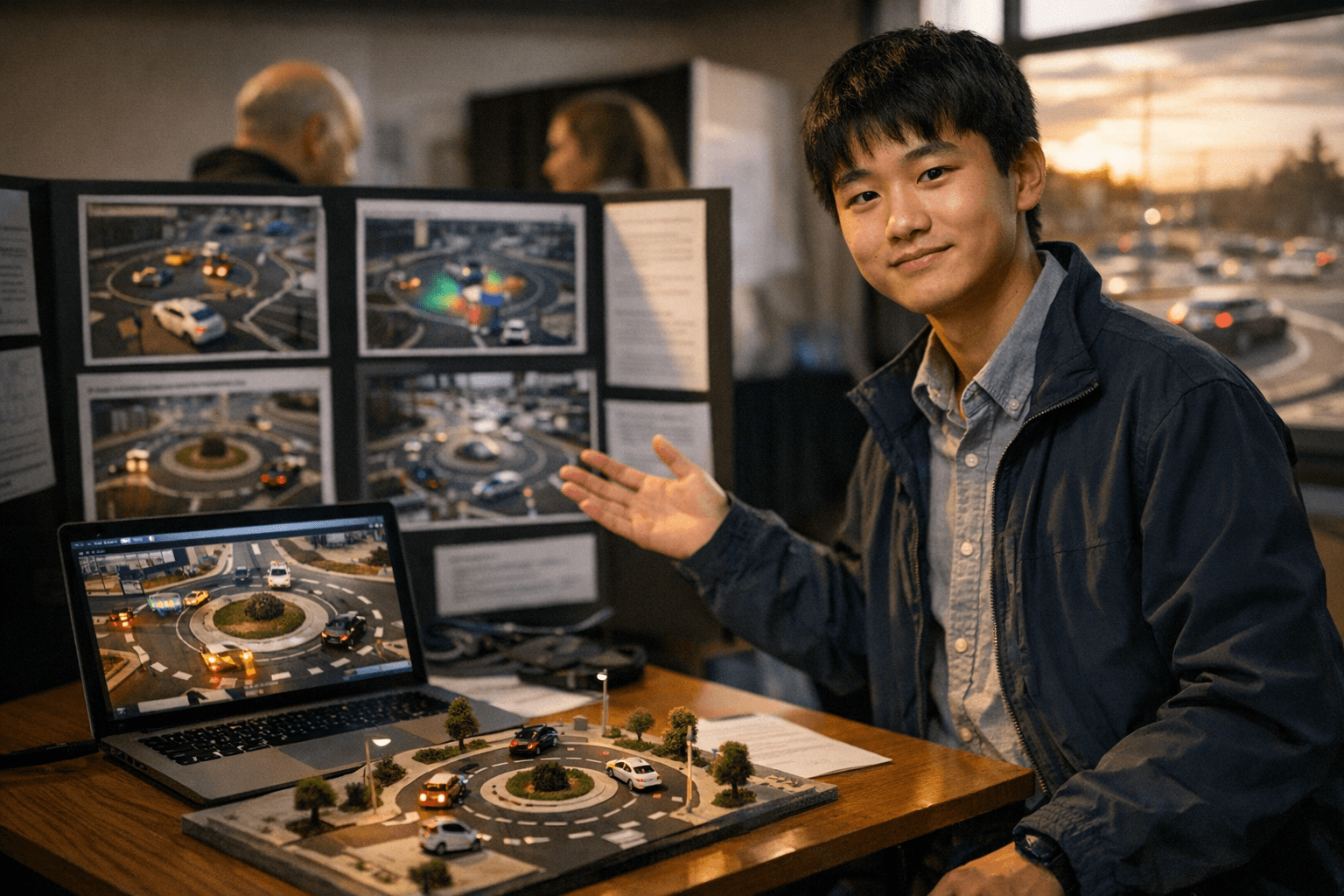
While construction crews were still finishing Oxford's newest $4.9 million roundabout at Highway 7 and University Avenue, a sophomore at Oxford High School was already designing the AI system that could make intersections like it safer everywhere.
Yoon Jang won "Best of Fair," the top prize at the Regional Science and Engineering Fair on March 26, for a project called ORBIT: Optimized Roundabout Behavior via Intelligent Trajectory-mapping. The win automatically advances Jang to the Mississippi state competition on April 9 and qualifies the project for the International Science and Engineering Fair in Phoenix, Arizona, from May 9-15.
The timing is sharply local. Mayor Robyn Tannehill has championed Oxford's rapid expansion of traffic circles so persistently that she has earned a nickname. "Everyone gets a good laugh when people call me Roundabout Robyn," Tannehill has said, "but that's a moniker I wear with honor." The $4.9 million Highway 7 contract, awarded to Cook and Son, LLC of Smithville, was nearing completion this spring and represents just the latest addition to a network that already includes roundabouts on South Lamar Boulevard, at the Mississippi Highway 6 interchange, and along Old Taylor Road near the Ole Miss campus.
ORBIT targets one of the persistent problems those intersections create: drivers unfamiliar with the format frequently hesitate, cut across yield lines, or misread the right-of-way rules. Jang's system uses YOLO, a computer vision AI model built to detect and track objects in real time. Rather than reading full vehicle shapes, which vary widely across car types, ORBIT focuses on tire positions, a more consistent visual reference whether a pickup truck or a compact sedan is entering the circle.
That positional data builds a trajectory library for a given roundabout. As a new vehicle approaches, the system compares its movement against mapped paths and predicts where it is headed. When the predicted path signals a likely conflict or improper entry, embedded traffic signals inside the roundabout activate to guide the driver through. A camera mounted at the center island feeds a local edge computing device, keeping latency low enough to intervene in real time rather than simply logging the near-miss after it happens.
Oxford's existing roundabouts have already produced measurable safety gains. A federal performance study of the South Lamar Boulevard and Highway 6 interchange roundabouts found that crash reductions cut the comprehensive cost of those intersections by 54.4 percent. City Engineer John Crawley has noted that roundabouts demand significantly more design and construction investment than a standard signalized intersection, but that their record of reducing congestion justifies continued expansion. The question ORBIT raises is whether the safety floor at those intersections, already improved, can be raised further through real-time AI guidance, particularly at high-volume locations like Highway 7 and University Avenue where driver uncertainty peaks during game days and peak commute hours.
Jang's path to Phoenix builds on a visible pattern at Oxford High. Class of 2026 valedictorian Jun Jang is a two-time finalist at the Regeneron International Science and Engineering Fair and earned a National Security Agency third-place special award at ISEF in 2024. The school has also produced multiple National Merit Semifinalists and STAR Students in recent years.
ISEF draws roughly 1,700 finalists from more than 60 countries. Jang will arrive there in May as a sophomore, competing with a project built around the specific, unglamorous problem of what happens in the three seconds before a driver decides whether to yield.
Know something we missed? Have a correction or additional information?
Submit a Tip