Oxford woman turns health battles into faith-based memoir and mission
After a knee problem led to a wheelchair, ICU stay and months in bed, Shalonda Thompson Spears turned her Oxford fight into a faith book and a $500 scholarship.

Illness changed the shape of her life
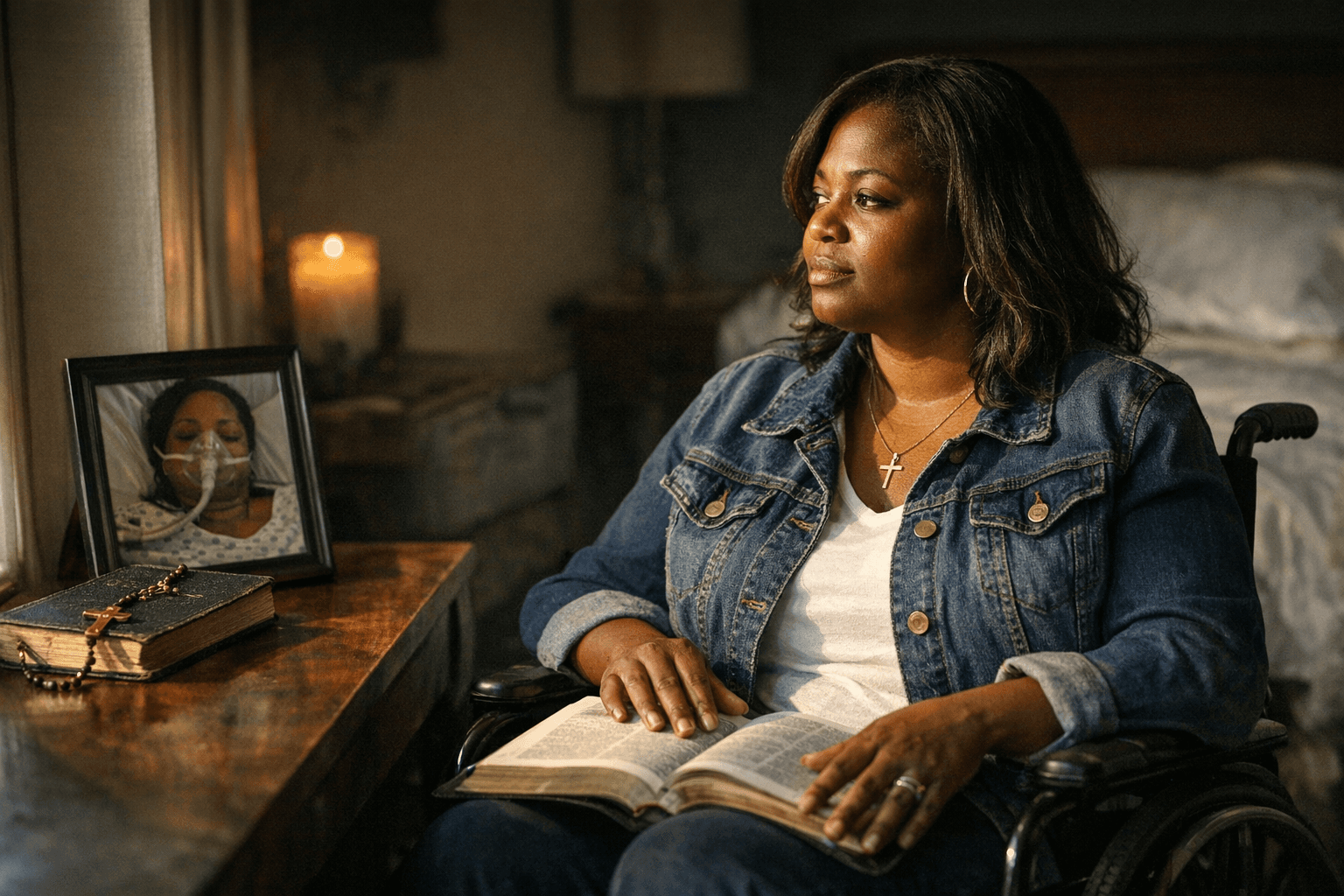
Shalonda Thompson Spears knows what it means when health problems stop being background noise and start rearranging everything. The Oxford native, now 45, went from working about a decade as a retail sales representative for AT&T to navigating a chain of medical crises that moved quickly from a knee issue to a wheelchair, then to a diagnosis of vascular necrosis in her hips and rheumatoid arthritis.
That decline did not stay contained to her body. Spears went on disability in 2018, was rear-ended in May 2023 in front of a local business and suffered spinal fractures, then later developed neuropathy, low blood pressure and fainting spells. By April 2025, she had been admitted to the ICU, and since then she has been mostly bedridden, a reality that has forced daily life, work and independence into a completely different rhythm.
Turning pain into a public message
Instead of treating that history as a private ending, Spears has turned it into a message she wants others in Oxford to see. Her self-published book, *Who Am I*, is built around faith, identity, perseverance and the idea of transforming pain into purpose. Amazon lists the paperback edition as 93 pages, with a March 24, 2026 publication date, and the Kindle edition as 89 pages, with a March 15, 2026 publication date.
The book matters because it shows how illness has changed not just what Spears can do, but how she defines her work. What once may have been measured in sales goals and customer interactions is now expressed through a devotional-style memoir and speaking platform, with her personal story becoming the central material of her public life. For readers in Lafayette County, that shift is significant because it turns a familiar local face into a case study in how chronic illness can force reinvention rather than simply pause ambition.
Spears is not carrying that work alone. She says a support network she calls her Dream Team helps promote and distribute the book, a reminder that even when health narrows a person’s world, community can widen it again. In her case, faith and practical help appear to work side by side, with one giving meaning and the other giving momentum.
A book that mirrors a recovery story
*Who Am I* is not just a title, but the question running through Spears’s recent years. The memoir-style book reflects a life where identity had to be rebuilt after mobility loss, repeated diagnoses and long stretches of physical weakness. That is part of why the project resonates locally: it does not present suffering as abstract inspiration, but as a lived sequence of medical setbacks, family support and faith-based endurance.
The timing also matters. Publishing in March 2026 placed the book in the public eye just as Spears’s story was already circulating through local coverage, making the memoir feel less like a separate product and more like a continuation of the same struggle. For Oxford readers, that creates a rare kind of local narrative in which the person, the book and the health crisis are all tightly linked, each one explaining the other.
A scholarship that turns testimony into support
The most immediate local impact of Spears’s story is not literary at all. Spears and her mother, Martha Thompson, created the Shalonda Thompson-Spears Scholarship, a $500 award for senior girls at Oxford High School and Lafayette High School. The application requires an essay about who the student is and what impact she hopes to make on the world, which folds Spears’s own themes of identity and purpose directly into the selection process.
That design makes the scholarship more than a simple cash award. It asks students to name their goals in their own words, and it ties those goals to a woman who has had to wrestle with illness while still trying to give something back. In a community where Oxford’s population was estimated at 26,801 in 2024, up from 25,416 in the 2020 census, and where Lafayette High School says it serves around 850 high school students, even a modest scholarship can have a visible presence.
Spears has said she wants the scholarship to grow every year, and she hopes to add small care packages for applicants as they prepare for college. That detail matters because it shows the project is not only about rewarding achievement, but about easing a transition point that can be expensive and emotionally difficult for families. In a county where school and community ties remain close, the scholarship becomes a practical extension of her recovery story rather than a symbolic gesture.
Why the local context gives the story weight
Spears’s story carries extra force because it is rooted in Oxford, not in a distant or abstract setting. She was born and raised here, worked here, and now lives with the long aftermath of illness in the same community that watched her life change. That gives the memoir and scholarship a distinctly local texture, especially for families connected to Oxford High School, Lafayette High School and the broader Lafayette County School District.
The numbers help explain why the story lands so strongly. Oxford’s growth from 25,416 residents in 2020 to an estimated 26,801 in 2024 suggests a city that is expanding, but still small enough that a name, a family and a scholarship can travel quickly through local networks. In that kind of place, a story about illness, faith and giving is not just personal news; it becomes part of the civic conversation about how neighbors respond when one of their own faces hardship.
What makes Spears’s path compelling is that it is built on real limitations. She is not presenting recovery as simple or complete, and the day-to-day reality of being mostly bedridden remains part of the story. Even so, she has created something tangible for others: a book shaped by suffering and a scholarship that can help local girls take the next step toward college.
In Oxford and Lafayette County, that is what public giving looks like when it comes from lived experience. It is not polished distance, but a direct answer to pain, with faith, family and community support carrying the work forward.
This article was produced by Prism’s automated news system from verified source data, official records, and press releases, then run through automated quality and moderation checks before publishing. The system is built and supervised by the people who set the standards it runs under. Read our full AI policy.
Did this article answer your question?