Lake County explains road rules for signs, mailboxes, dust and snow
Lake County spells out who fixes signs, mailbox damage, dust and ADA access, and when residents must share the bill for extra treatment.

When a sign goes missing, a mailbox gets clipped, or gravel-road dust starts drifting across a front yard, Lake County already has a playbook. The Highway Department spreads its service points across Two Harbors, Finland and Ely, and it routes everyday road complaints through a single sign-maintenance line. That matters because the county is also clear about what it will fix, what it will only do with shared payment, and what may take time to move from complaint to repair.
Who handles what
Lake County groups a wide range of road work under one Highway Department umbrella, including ADA compliance, dust control, mailbox damage, construction recommendations, noxious weed control and snow removal. The department lists offices in Two Harbors, Finland and Ely, so residents in the county’s far-flung communities are not dealing with a one-town system.
The directory shows highway offices at 1513 Hwy 2 in Two Harbors, 6586 Hwy 1 in Finland and 2210 E Sheridan St in Ely. The county also posts weekday hours and its main phone line, 1-800-450-8832, which makes the first call less guesswork and more routing. In a county where roads stretch from the North Shore inland to smaller communities, that spread matters.
Signs and mailbox damage: where the complaint starts
For sign problems, Lake County wants motorists to email signmaintenance@co.lake.mn.us or call (218) 510-5103. The county uses that same line for sign-related issues, questions and wintertime mailbox damage, which gives residents one place to start instead of trying to guess which crew handles which problem.
The county also explains why some sign work does not happen instantly. A replacement can require a special order, work may be pushed behind higher-priority jobs, underground utility checks can be needed before digging starts, and staff availability can slow a fix. For residents who are used to seeing a damaged sign for days or weeks, that timeline is part of the county’s process, not a sign that the issue was ignored.
Dust control on gravel roads: who pays and what gets done
Lake County’s dust-control policy is one of the clearest examples of how the county decides who gets service and who shares costs. Roads with average daily traffic counts of 50 to 199 vehicles receive dust control in front of homes. Roads with 200 or more vehicles per day receive solid dust control.
That traffic-count system means the county does not base dust treatment only on who complains the loudest. It uses roadway use, then matches treatment to traffic volume. Extra dust-control application is available, but only on a 50-50 cost share with prepayment, so anyone asking for more than the standard program must be ready to pay half up front.
For residents living along gravel corridors, that distinction is crucial. The county is saying it will maintain a baseline level of dust control where traffic justifies it, but added treatment becomes a shared expense rather than a routine county-paid fix.
Accessibility: where the ADA plan fits
Lake County’s ADA Transition Plan is available for public review and comment, and the county says it evaluates pedestrian infrastructure in the public roadway right-of-way. The plan uses PROWAG standards as adopted by MnDOT, which puts curb ramps, sidewalks and other pedestrian features in a formal review process rather than leaving them to ad hoc decisions.
That matters for anyone trying to understand when a sidewalk, curb ramp or crossing gets upgraded. The county’s plan also lists correction schedules and accommodation contact information online, which gives residents a direct path to raise accessibility concerns instead of waiting for a larger construction project to come through. In practical terms, ADA work is treated as a road-rights-of-way issue, not just a building issue.
Snow, spring restrictions and what not to do
Lake County is blunt about snow removal on county roads: do not plow snow onto them. The county says the practice is illegal and can damage snowplow equipment, and the warning notice is signed by Highway Engineer Jason DiPiazza.
The county also manages spring load restrictions as a seasonal safety tool, adjusting them based on roadway strength and weather. In 2026, Lake County said restrictions would begin lifting Friday, May 14, except on a listed group of roads, with the remaining restrictions expected to come off before June. The county’s 2024 and 2025 notices show the same pattern of flexibility, with end dates shifting as conditions change.
That is the county’s message to drivers and haulers alike: the road system is not static once winter ends. Load limits stay tied to the actual condition of the pavement and gravel base, and they are lifted when the roads can handle it, not when the calendar says spring should be over.
Big projects: when roads close, access still has to work
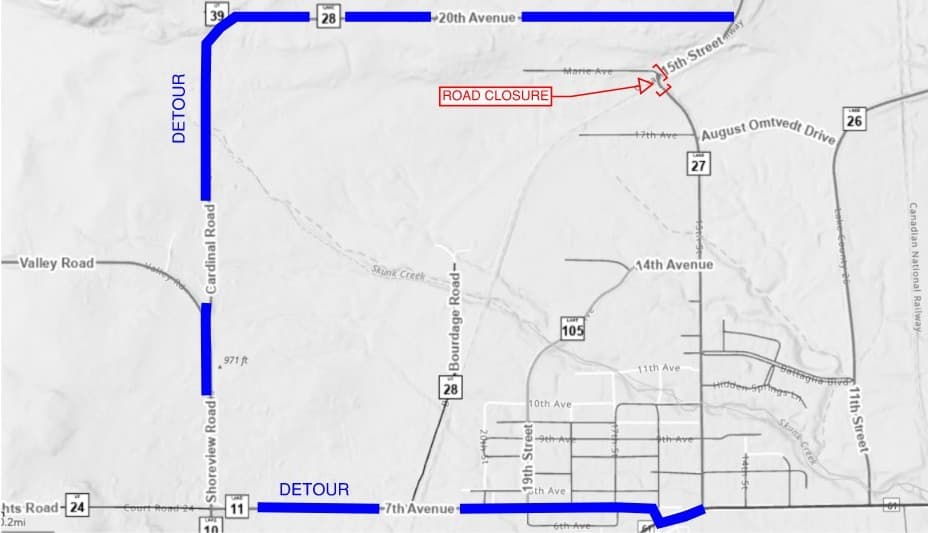
Lake County’s bigger construction notices show how much coordination goes into a road closure. For 4th Street, also known as Hwy 2, in Two Harbors, the county tied a closure to city water-system improvements and said access for residents, businesses and the hospital would be maintained through a detailed detour and coordination plan.
The county also said Hwy 2 work in Two Harbors was scheduled to reopen to traffic on Aug. 21, 2025 after improvements that included city utilities, storm sewer, new curb, sidewalk and pavement. That kind of project shows the Highway Department’s job is not limited to patching potholes or clearing shoulders. It also handles the interfaces between roadway work, city utilities and everyday access to important destinations such as the hospital.
How the county fits roads into public safety
Lake County’s winter hazard awareness work shows that the highway system does not operate alone. The department works with Lake County Public Health, the Sheriff’s Office, Lake County Emergency Management, the Safety Office and the Minnesota Department of Emergency Management and Public Safety during seasonal preparedness efforts.
That network matters when roads, weather and public access collide. It means sign problems, snow issues, load restrictions and access disruptions are handled as part of a broader safety system, not as isolated maintenance tickets. In Lake County, the road rulebook is really a countywide operations manual, and it is built around the same question every resident eventually asks: who fixes this, who pays for it, and how long will it take?
This article was produced by Prism’s automated news system from verified source data, official records, and press releases, then run through automated quality and moderation checks before publishing. The system is built and supervised by the people who set the standards it runs under. Read our full AI policy.
Did this article answer your question?