North Shore students step back into the 1800s for Pioneer School Day
At Larsmont’s 1914 schoolhouse, North Shore fourth graders lived pioneer routines for a day, turning Lake County history into something they could sew, taste and remember.
A history lesson built around place
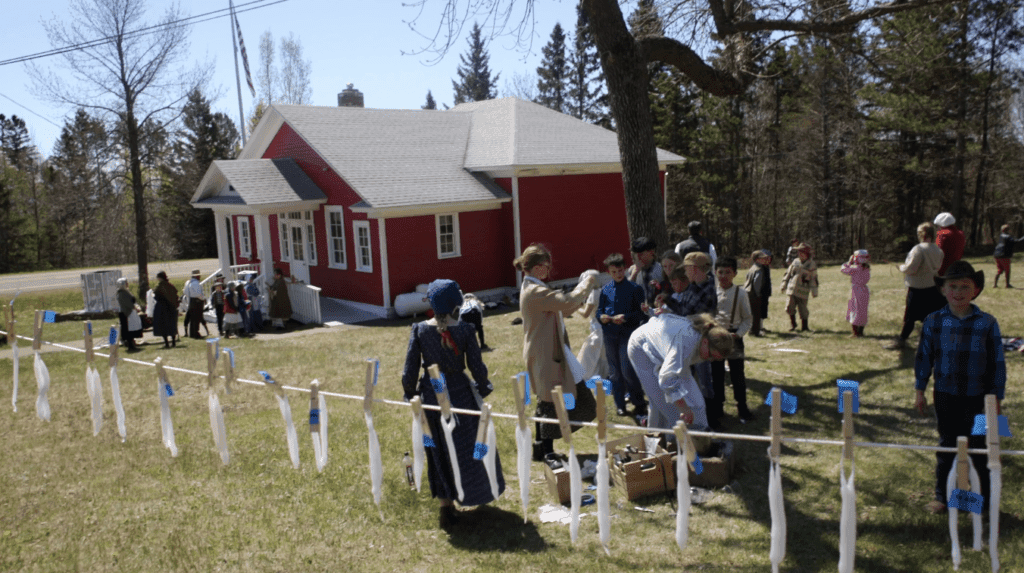
At the 1914 Larsmont Schoolhouse, North Shore Community School fourth graders spent Pioneer School Day stepping into the 1800s, turning a social studies unit into a hands-on lesson about how people once lived, worked and learned on the North Shore. The one-day program in Larsmont put local settlement history in the center of the classroom, not on the edges of it.
That approach fits the school’s mission. North Shore Community School is a rural charter school midway between Duluth and Two Harbors, serving about 350 students in grades K-6, and it says it aims to connect academics with students’ natural and social environments. In practice, that means the lessons are tied to the places children pass every day, from the shoreline communities along Lake Superior to the historic sites that still mark how this region was built.
For Lake County families, that matters because pioneer history is not just about costumes or nostalgia. It is about the origins of settlement, labor, transportation and land use in a county where those forces shaped the communities that now debate preservation, public priorities and the future of local landmarks. A day like this gives students a way to see that history as part of the place they inhabit, not as distant background.
How Pioneer School Day worked
The fourth-grade program served as the culmination of the class’s pioneer unit in social studies, and it was designed to feel as close to the past as possible. Many students arrived in period-style clothing, including suspenders and bonnets, and the school said those outfits could be bought by families or borrowed from the school. The point was immersion: students were not just reading about pioneer life, they were expected to act the part for the day.
Inside the schoolhouse, the class rotated through six stations that reflected daily life in an earlier era. The activities were simple but purposeful, giving students a chance to use their hands and their attention in ways that a textbook cannot replicate.
- Sewing buttons by hand
- Making rope
- Dipping candles
- Playing games
- Making lemonade from scratch
- Making butter from scratch
The day also came with one-room-schoolhouse expectations. Students were expected to address adults as “ma’am” and “sir,” and they were supposed to speak only when spoken to, which gave the event a more formal and period-accurate rhythm. That kind of structure helps explain why the experience feels memorable to students: it changes not only what they learn, but how they move through the day.
Why the Larsmont schoolhouse matters
The setting is as important as the activities. The Larsmont Little Red Schoolhouse, also known as the Larsmont Schoolhouse, was built in 1914 by Swedish and Finnish settlers and stands on its original site off Old Highway 61 near Ryan Road. It is listed on the National Register of Historic Places, and its history gives the Pioneer School Day more than theatrical flavor. Students are learning inside a building that is itself a surviving artifact of North Shore settlement.
The schoolhouse also reflects how education once worked in rural communities. According to the historical plaque described in the research, it served as an elementary school for grades 1-7 and had a teaching staff of one from 1914 to 1932. That detail alone tells a story about labor, scale and community expectations in the early 20th century, when one teacher often carried the full weight of a local school.
Today, the building remains a preserved landmark and a community space available to rent for events. That continued use keeps the site from becoming a static museum piece. It stays part of civic life, which is exactly why Pioneer School Day resonates so strongly in Larsmont: the lesson takes place in a building that still belongs to the public memory of the region.
What students remember, and why that matters now
The clearest sign that the lesson worked came from the students themselves. Rhoda Schmidt said her favorite parts were making lemonade and butter from scratch and then eating the butter on crackers at lunch. Clayton Pierce said the experience was like going back in time, compared the outdoor games to modern recess, and called the whole time-travel experience “OK.”
Those reactions may sound lighthearted, but they point to something serious in education policy and community history. Students who physically make rope, sew buttons and churn butter begin to understand the labor behind everyday life. They also begin to see how transportation, clothing, food and schooling changed over time, which is essential in a county where residents still live with the legacy of settlement patterns, rural land use and historic institutions.
That is why North Shore Community School’s approach is more than a themed activity. It is a place-based civic lesson, one that uses the Larsmont Schoolhouse to connect children to the region’s past and to the decisions communities still make about heritage, public space and what deserves to be preserved. In Lake County, history like this is not just remembered. It is learned where it happened.
This article was produced by Prism’s automated news system from verified source data, official records, and press releases, then run through automated quality and moderation checks before publishing. The system is built and supervised by the people who set the standards it runs under. Read our full AI policy.
Did this article answer your question?