Wolf Ridge marks 56 years as Lake County’s environmental education anchor
Wolf Ridge draws 15,000-plus school visitors and 90 staff a year, making its classroom mission a real economic engine for eastern Lake County.
From teach-in to regional anchor
More than 15,000 children, teachers and parent chaperones pass through Wolf Ridge each school year, a scale that makes the Finland campus one of eastern Lake County’s most important economic engines as well as its best-known classroom. Wolf Ridge says it is the largest accredited residential environmental education center in the United States, and the first environmental learning center in the country to earn K-12 school accreditation.
How Wolf Ridge took root
The center’s story begins with a 1970 environmental teach-in organized by Cloquet teacher Jack Pichotta and the student group SCARE. That event brought together more than 135 speakers, including then Vice President Hubert Humphrey, to talk about conservation and pollution, and it helped spark the creation of the Environmental Learning Center in 1971. What started in a former Job Corps facility in Isabella grew into a model that now reaches far beyond the North Shore.
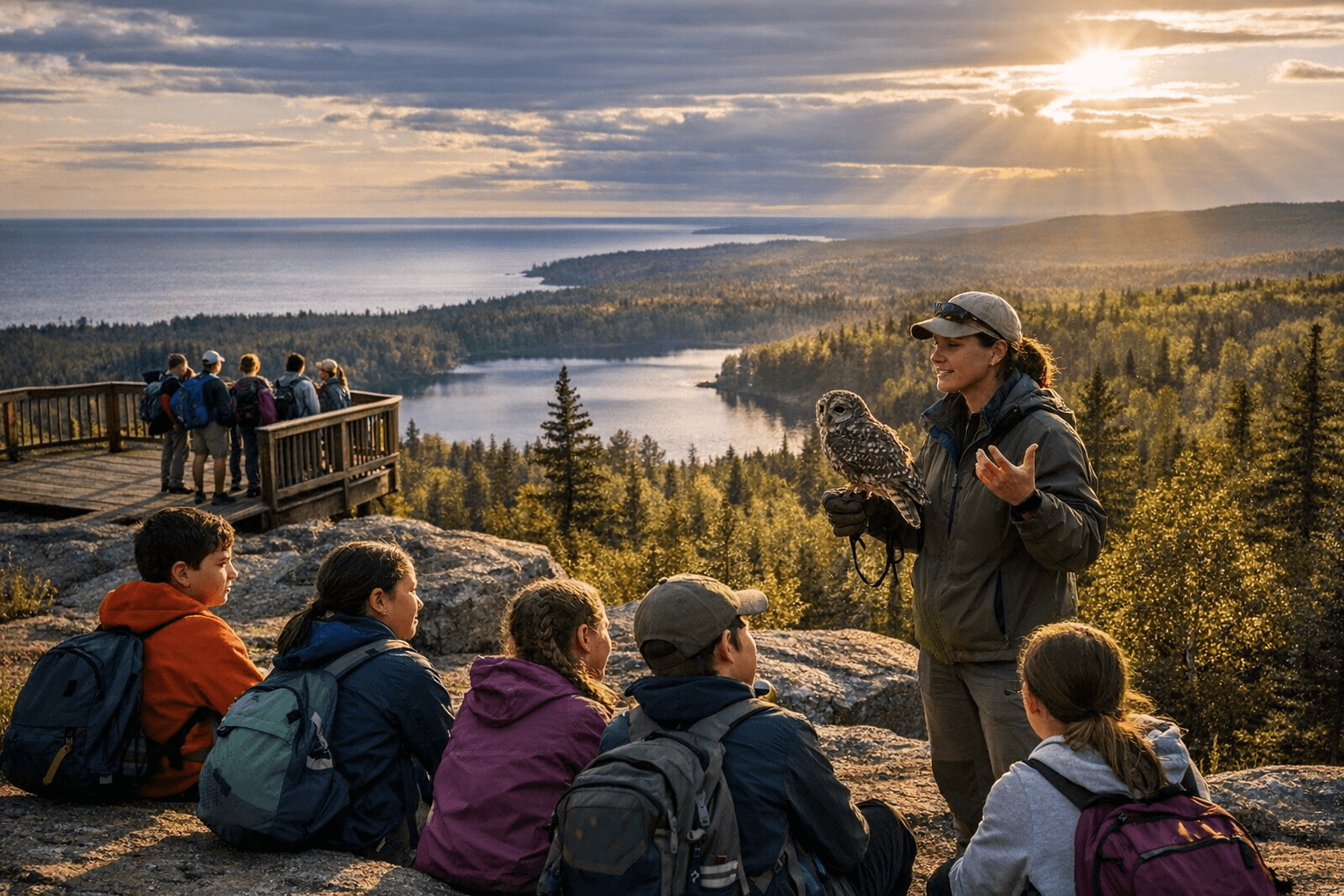
The move to Finland in 1988 changed the scale of the program. The current campus sits on 2,000 acres above Lake Superior and gives students access to 18 miles of hiking and skiing trails, two lakes, creeks, high peaks, a farm and a raptor aviary. That landscape is not just scenery. It is the core of how Wolf Ridge teaches ecology, outdoor skills and stewardship in a place where the forest, water and weather become part of the lesson.
Why the campus matters to Lake County
For Lake County, Wolf Ridge’s value is measured in more than enrollment. Over the decades, the center says it has hosted more than 700,000 students, a flow that brings lodging, meals, transportation and seasonal spending into the local economy. It says it welcomes 12,000-plus visitors annually and offers more than 50 different classes for students, teachers, parent chaperones, youth, families and adults.
That traffic matters in a part of the North Shore where many jobs are tied to tourism and seasonal cycles. Wolf Ridge says it employs 90 full-time and seasonal staff members each year and describes itself as the eighth-largest employer in Lake County. Earlier local reporting has placed its workforce in the 60 to 75 range and generally among the county’s top 20 employers, but either way the center stands out as a steady year-round payroll in a county where many businesses thin out after the summer rush.
The employment ripple goes beyond direct hiring. Wolf Ridge also hosts roughly 20 graduate student naturalists each year, creating an early-career pipeline for people headed into teaching, environmental education, science interpretation and park work. For a rural county trying to hold onto young talent, that kind of training matters as much as the visitor count.
A school network that reaches across three states
Wolf Ridge is not just a destination for Lake County families. A Living Future case study says more than 15,000 children, teachers and parent chaperones come during the school year from more than 165 schools in Minnesota, North Dakota and Wisconsin. That puts the center in the middle of a wide regional partnership network that reaches urban districts, small towns and rural schools alike.
The program’s reach is also part of its workforce value. Since 1971, Wolf Ridge says it has trained more than 1,000 environmental educators, which means its influence extends into classrooms, camps and nature programs well beyond Finland. In practical terms, that means more teachers with outdoor-science experience, more students exposed to field-based learning and more institutions that know how to use northern Minnesota’s landscape as a classroom.
A sustainability model with national reach
Wolf Ridge has also made its campus part of the lesson. Its sustainability work centers on Net Positive living, with the Lakeview Student Lodge and the Margaret A. Cargill Lodge serving as highly visible examples. The 22,000-square-foot Margaret A. Cargill Lodge renovation is the first renovation project in the world to receive full Living Building Challenge certification, and Wolf Ridge says the building produced more energy and water than it used over a 12-month period.
That achievement matters because it shows a rural institution competing at the highest level of green building design. The International Living Future Institute’s certification is not a symbolic award. It is a stringent benchmark that gives Wolf Ridge credibility with schools, architects, funders and environmental programs looking for a working model of sustainable construction in a northern climate. For students, it turns the building itself into a live demonstration of conservation, engineering and resource management.
From Lake County to China
Wolf Ridge’s impact has also traveled far outside Minnesota. The center says its programs were used as a model to develop environmental education curricula in China, and executive director Peter Smerud was sent there through the National Committee on U.S.-China Relations’ Professional Fellows Program, with support from the U.S. Department of State Bureau of Educational and Cultural Affairs. That kind of international transfer is rare for a school in rural northeastern Minnesota, and it underlines how unusual Wolf Ridge’s model has become.
The fact that a Finland, Minnesota, institution is shaping curriculum design abroad is part of the broader story here. Wolf Ridge is not simply serving visiting students for a few nights on the ridge. It is exporting a method of environmental education that grew out of the North Shore and now carries Minnesota’s outdoor-school reputation to other states and other countries.
Why funding and access matter now
The biggest policy question is access. Wolf Ridge says outdoor-school funding is meant to expand opportunities for students, especially those from underserved and rural communities. In 2025, Minnesota lawmakers approved $848,000 in outdoor education grants for the state’s five accredited outdoor schools, and a separate public-funding push helped secure more than $800,000 for outdoor-school access.
That money matters because tuition support has shifted dramatically over time. Wolf Ridge says its support ranged from $20,000 to $40,000 in the early years and has grown to more than $400,000 in recent years. That change reflects a broader recognition that outdoor learning is not a luxury add-on. It is a gateway to science education, career exploration and environmental literacy for students who may never otherwise spend a week living and learning on the shore of Lake Superior.
Wolf Ridge’s mission is to build a citizenry with the knowledge, skills, motivation and commitment to work together for a quality environment. In Lake County, that mission has become something more concrete than a slogan. It is a classroom for thousands of students, a training ground for educators, a draw for visitors and a payroll that helps stabilize the local economy. After more than five decades, Wolf Ridge remains one of the North Shore’s rare institutions that can shape both the landscape and the ledger.
This article was produced by Prism’s automated news system from verified source data, official records, and press releases, then run through automated quality and moderation checks before publishing. The system is built and supervised by the people who set the standards it runs under. Read our full AI policy.
Did this article answer your question?