Bright Fireball Meteor Lights Up Oregon Sky, Visible Statewide
A brilliant green fireball streaked across Oregon skies at 6:06 a.m. Monday, March 24, visible as far south as Lane County and captured on security and dashcam footage.

Jason Jenkins was driving to work before dawn on Monday, March 24, when a bright green streak blazed across the pre-dawn sky. His dashcam captured the moment at 6:06 a.m. while he was in southwestern Washington state, about 20 miles north of Portland. "It kind of reminded me of a lightning strike because it was so bright," Jenkins said. The fireball was visible statewide across Oregon, with sightings reported as far south as Lane County.
According to Jim Todd, director of space science education for the Oregon Museum of Science and Industry, viewers from across the Pacific Northwest logged the sighting of a "bright green fireball" at roughly 6:06 a.m., with sightings reported to the AMS Fireball Log. "It was bright, it was green, it was spectacular," Todd said Monday. "One tiny little piece of rock put on such a show this morning."
What witnesses saw was a fireball, a particularly bright meteor that can be seen up to 80 miles above the Earth, according to the Oregon Museum of Science and Industry. "As a meteor travels through the atmosphere at high speeds, it creates friction, which heats the meteor and causes it to vaporize," Todd said. That rapid combustion is responsible for the intense flash that lit up skies from the coast to central Oregon.
The vivid green color had a specific chemical explanation. When a fireball appears green, Todd said it is often due to the presence of magnesium. Nickel can also cause a green color when it burns away, but Todd said magnesium is the element most often associated with green fireballs.
The U.S. National Weather Service's Medford office said a satellite placed the flash about 50 to 75 miles above Lake County. "Due to the curvature of the earth, the satellite plots the flash more to the north and east of where it actually occurred, which is likely more over central Lake County," the NWS said. That satellite-corrected position puts the fireball's likely origin well to the southeast of Eugene, though its brightness made it visible across a wide swath of the state.
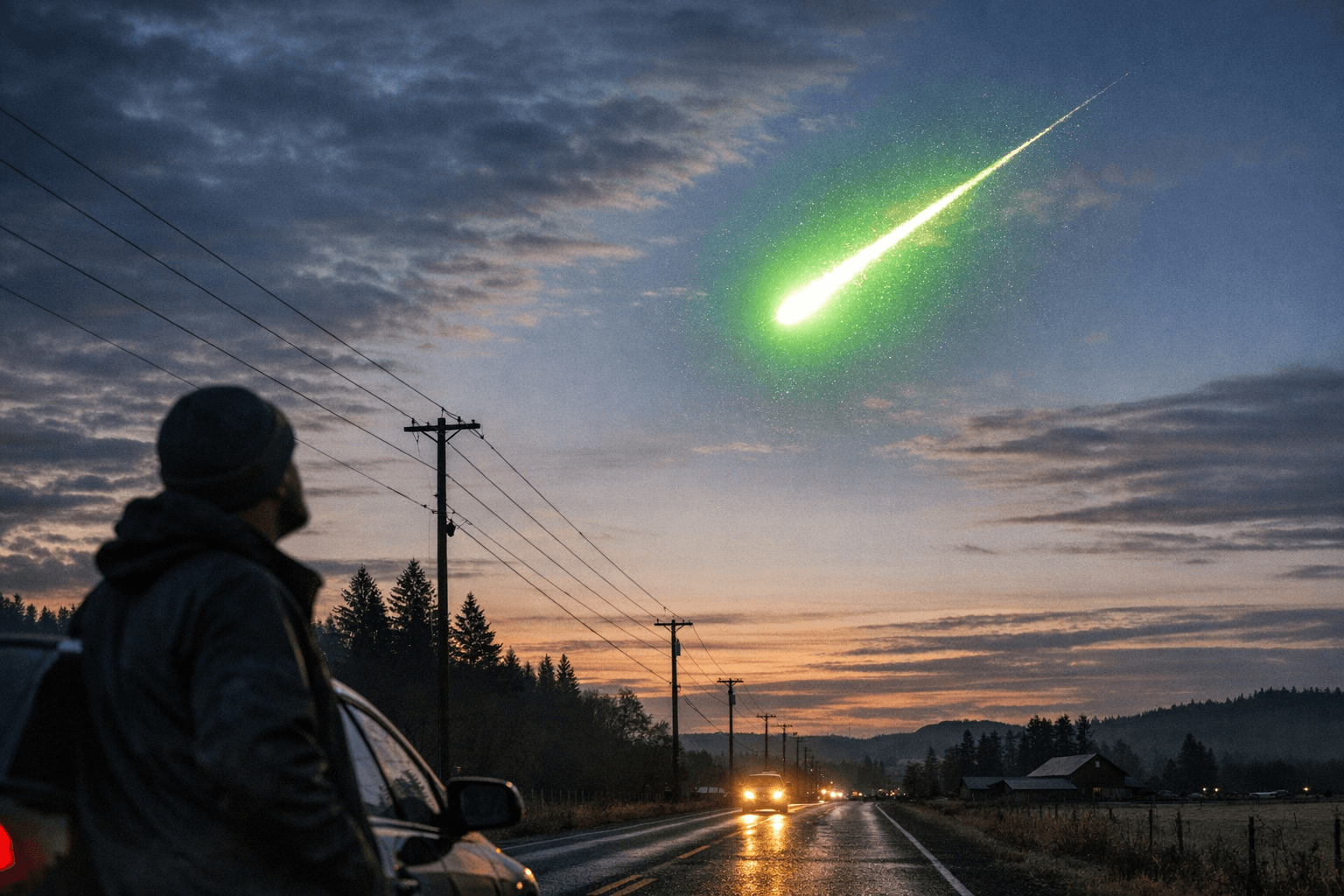
In most cases, it is rare that a fireball makes contact with the Earth, and when it does, it can be hard to locate, Todd said. "Even if it does survive, it looks like a common everyday rock, and nearly almost impossible to find, unless it hit a house or a street or leaves debris behind," he said. No impacts or injuries were reported from the Monday morning event.
As the number of people with cameras on their dashboards and doorbells has grown, so have reports of such sightings, Todd added. With video and other people reporting sightings, it may be possible to determine the direction the fireball was traveling and whether it landed on the Earth's surface.
Todd noted that there is no major meteor shower currently occurring, making the fireball a random, solitary event rather than part of a broader celestial pattern. The next notable shower will be the Lyrids, a medium-strength shower that can produce fireballs, peaking the night of April 21-22, 2026.
While Earth is constantly bombarded by small space rocks, 2026 is shaping up to have a higher-than-average number of notable fireball events producing eyewitness reports. Last week a 7-ton meteor sped across the Ohio sky in a fireball that broke apart in a thunderous boom. On Saturday, a meteor traveling 35,000 miles per hour broke apart north of Houston, according to NASA, and a resident told a local TV news outlet that a piece of the meteor crashed through her roof. Monday's Oregon fireball, visible from Eugene to the Washington border, appears to have caused no such damage.
This article was produced by Prism’s automated news system from verified source data, official records, and press releases, then run through automated quality and moderation checks before publishing. The system is built and supervised by the people who set the standards it runs under. Read our full AI policy.
Did this article answer your question?


