Cottage Grove offers a scenic route through Lane County covered bridges
Start in Cottage Grove and you can see the best of Lane County’s covered bridges in one easy loop, with a bike-friendly route that fits families and first-timers.
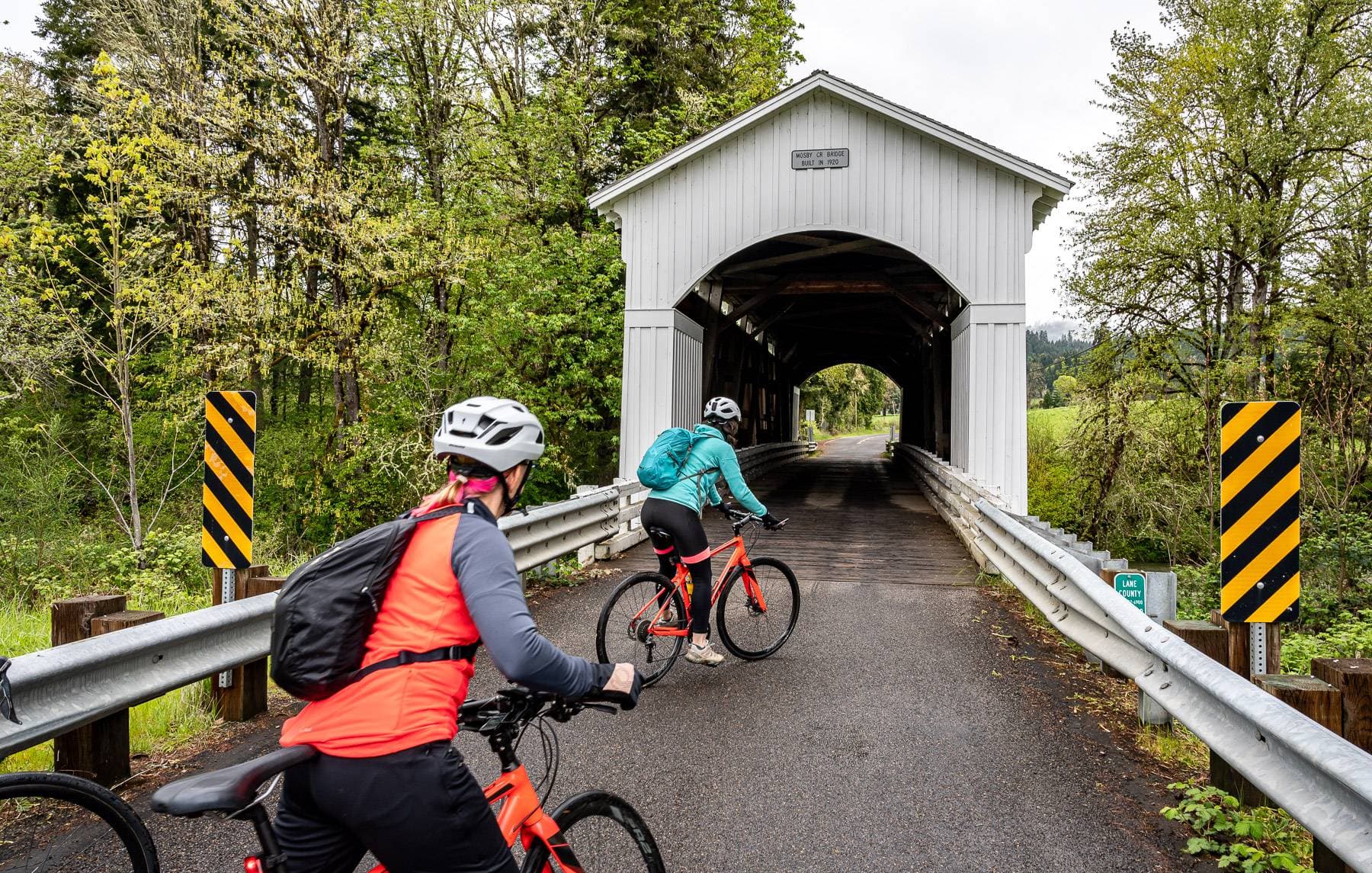
Six covered bridges sit in and around Cottage Grove, making the city the natural launch point for a one-day Lane County loop. If you only do one covered-bridge outing this season, make it the Cottage Grove route: it gives you the county’s deepest concentration of bridges, easy access from town, and a ride or drive that can fit a relaxed weekend schedule.
Why Cottage Grove is the place to start
Lane County has 20 covered bridges, including 17 listed on the National Register of Historic Places, and no county west of the Mississippi River has more remaining covered bridges. Oregon has 50 remaining covered bridges in all, which makes the Lane County cluster unusually dense and unusually easy to experience without long detours. Travel Oregon calls Cottage Grove the covered bridge capital of Oregon, and the city has twice received the All-American City Award.
Most Lane County covered bridges are open to bicycles and pedestrians, while some still carry vehicle traffic, so the bridges function as both historic landmarks and working parts of the road network. For a first visit, that mix is ideal: you can drive a loop, bike it, or combine the route with trail time and a downtown stop.
The one route to choose first
The Cottage Grove Covered Bridge Tour Route is about 20 miles, or 32 kilometers, and it gives you the simplest introduction to the county’s covered-bridge landscape. The Covered Bridges Scenic Bikeway follows that same route and is appropriate for almost any rider. Travel Oregon lists the ride at about 36 miles in one description and 37.8 miles on Cottage Grove’s city page. It is part of Oregon Scenic Bikeways, a statewide system of 18 designated bicycle routes.
The driving loop is short enough to handle in a half-day with stops, while the bike route is long enough to feel like a proper ride without turning into an endurance test.
What to see along the way
The most useful first stop is Mosby Creek Bridge, just east of Cottage Grove near the Row River Trail trailhead. Built in 1920 at a cost of $4,125, it is Lane County’s oldest covered bridge and was named for pioneer David Mosby, who settled in 1853 and claimed 1,600 acres east of present-day Cottage Grove. Its position near the Row River Trail makes it especially useful for a family stop or a bike-based outing, because you can pair the bridge with time on the 14-mile trail adjacent to the trailhead.
Goodpasture Bridge gives the route its most dramatic river crossing. It spans the McKenzie River in Vida, about 21 miles east of Eugene on Highway 126, and was completed in 1938 at a cost of $13,154. With 10 Gothic-style louvered windows on each side and a 165-foot housed Howe truss, it is the second longest covered bridge in Oregon and one of the state’s most photographed. The bridge was rehabilitated in 1987 after traffic weakened it, and it is decorated with holiday lights in winter.
Currin Bridge shows how these structures have changed with the road system around them. Lane County built it in 1925 for $4,205, saving $2,495 over the lowest bid of $6,250, and it was closed to vehicular traffic in 1979 after a concrete bridge was built nearby.
How to make the day work
For a first-time visitor, the easiest play is to start in Cottage Grove, park once, and treat the bridge loop as the day’s main event. That keeps the logistics simple and leaves you free to move between spans without constantly resetting your route. Cottage Grove also works well as the place to eat before or after the loop, since the route is short enough that you do not need to spend the whole day in the car.
A bike-friendly version works especially well because the Scenic Bikeway follows the Cottage Grove route and is mild enough for almost any rider. The route’s mix of road bridges, trail access, and short-town connections means you can keep the pace easy and still see a lot. Families with younger riders can focus on the shorter bridge stops and the Row River Trail connection near Mosby Creek; cyclists looking for a fuller ride can extend the day toward the McKenzie River side and pair Goodpasture Bridge with the 26-mile McKenzie River Trail.
For photos, the biggest payoffs are the bridges that still read clearly against water and forest, especially Goodpasture over the McKenzie River and Mosby Creek near the trailhead. If you want fewer cars in the frame and a calmer experience, a morning start is the cleanest choice, especially on a route where some spans still carry vehicle traffic. Winter also has its own draw at Goodpasture because of the holiday lights, but the clearest all-around conditions usually come when the roads are dry and visibility is good.
Why this route still matters
Oregon once had 450 covered bridges, most built after World War I when steel was scarce and wood was plentiful.
This article was produced by Prism’s automated news system from verified source data, official records, and press releases, then run through automated quality and moderation checks before publishing. The system is built and supervised by the people who set the standards it runs under. Read our full AI policy.
Did this article answer your question?


