Eugene Monument Honoring Founding Black Families Gets First Public Viewing
Jennifer Scurlock, whose family was among Eugene's first Black settlers, watched as a 100-pound clay monument to their erased community got its first public viewing.
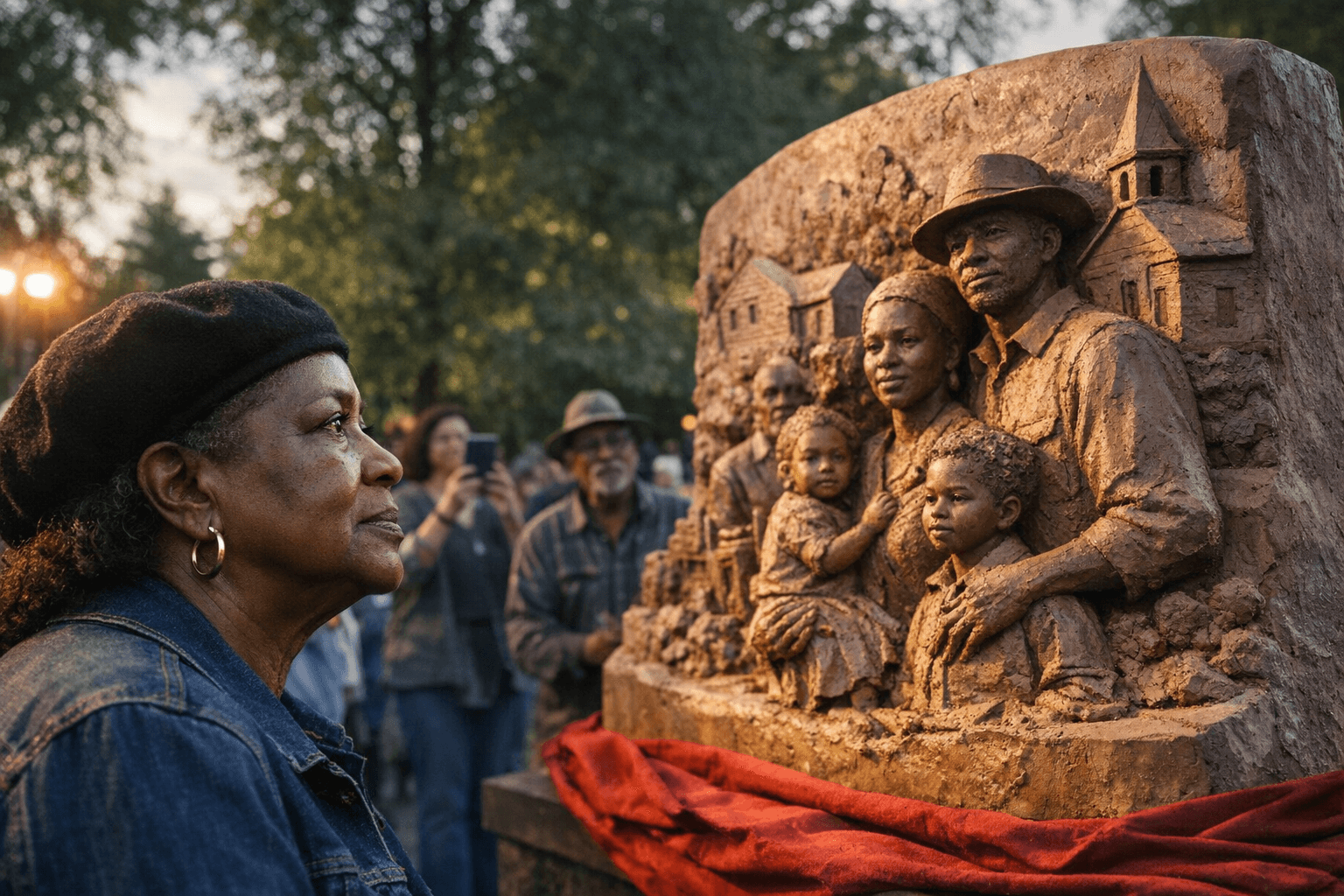
Jennifer Scurlock stood before a clay sculpture of a Black family in 1940s dress and described what she was witnessing as an act of recovery. "This was history that was meant to be forgotten; they tried to erode it and erase it — and to see the celebration of something beautiful, celebrating a hardship, and bringing beauty to light of African American culture and people and resilience is truly an honor," said Scurlock, the daughter of one of Eugene's first Black families, at a public viewing of the "Across the Bridge" monument at Reinmuth Bronze Studio on Meadow Lane.
The sculpture, created by West Eugene artist Percy Appau, depicts a husband and wife alongside two children and a sleeping infant, rendered as they would have appeared in the 1940s. The family members wear suits, dresses, and jewelry; their natural hair is on proud display. Aside from the sleeping baby, each figure holds its head high. At roughly 100 pounds in its current clay-and-Styrofoam form, the piece will be sent to Portland to be cast in bronze, eventually weighing close to 1,000 pounds when it takes up permanent residence at Alton Baker Park this fall.
The monument, commissioned by the Black Cultural Initiative of Lane County, honors the five founding Black families of what was known as the "Across the Bridge" community, a settlement that occupied land where Alton Baker Park now sits. Those families were forced out when, on Aug. 24, 1949, the Lane County government bulldozed the village. Many left Oregon entirely.
Talicia Brown, founder and executive director of the Black Cultural Initiative, said early Black residents had been barred from living within city limits. "They couldn't live in city limits, so many residents lived across the bridge," Brown said. The monument, she added, "is a representation of the 'across the bridge' community" and was deliberately designed to reflect the whole community rather than any single household.
Appau, an artist originally from Ghana who now lives in West Eugene, built the figures with direct input from relatives of the five families. Some shaped specific details: Lyllye Reynolds-Parker requested a mother holding an infant; a descendant named Mims asked for a joyful little boy. "It's not of any specific family," Brown said, noting that each element traces back to real family memory.
Close to 20 descendants attended viewings of the sculpture, including Rosita Johnson, sister of Billy Johnson and a direct descendant of the community. "We love that this history is not lost, and we're excited that it's being shared with more people," Johnson said.
The Black Collective has noted that had the five families been permitted to stay longer, they could have secured their properties under the federal Homesteaders Act, underscoring how consequential the 1949 displacement proved to be.
The finished monument will be placed in a high-traffic area just south of where the original settlement stood, not on the exact footprint of the former community. The Black Cultural Initiative plans a public installation ceremony in September. Once in place, it is expected to rank among the largest public landmarks to Black history in Oregon.
This article was produced by Prism’s automated news system from verified source data, official records, and press releases, then run through automated quality and moderation checks before publishing. The system is built and supervised by the people who set the standards it runs under. Read our full AI policy.
Did this article answer your question?