Lane Arts Council tour spotlights Eugene's historic downtown landmarks
A walk through Eugene’s downtown landmarks traces rail-era growth, theater corridors, and preservation rules that keep the city center alive.
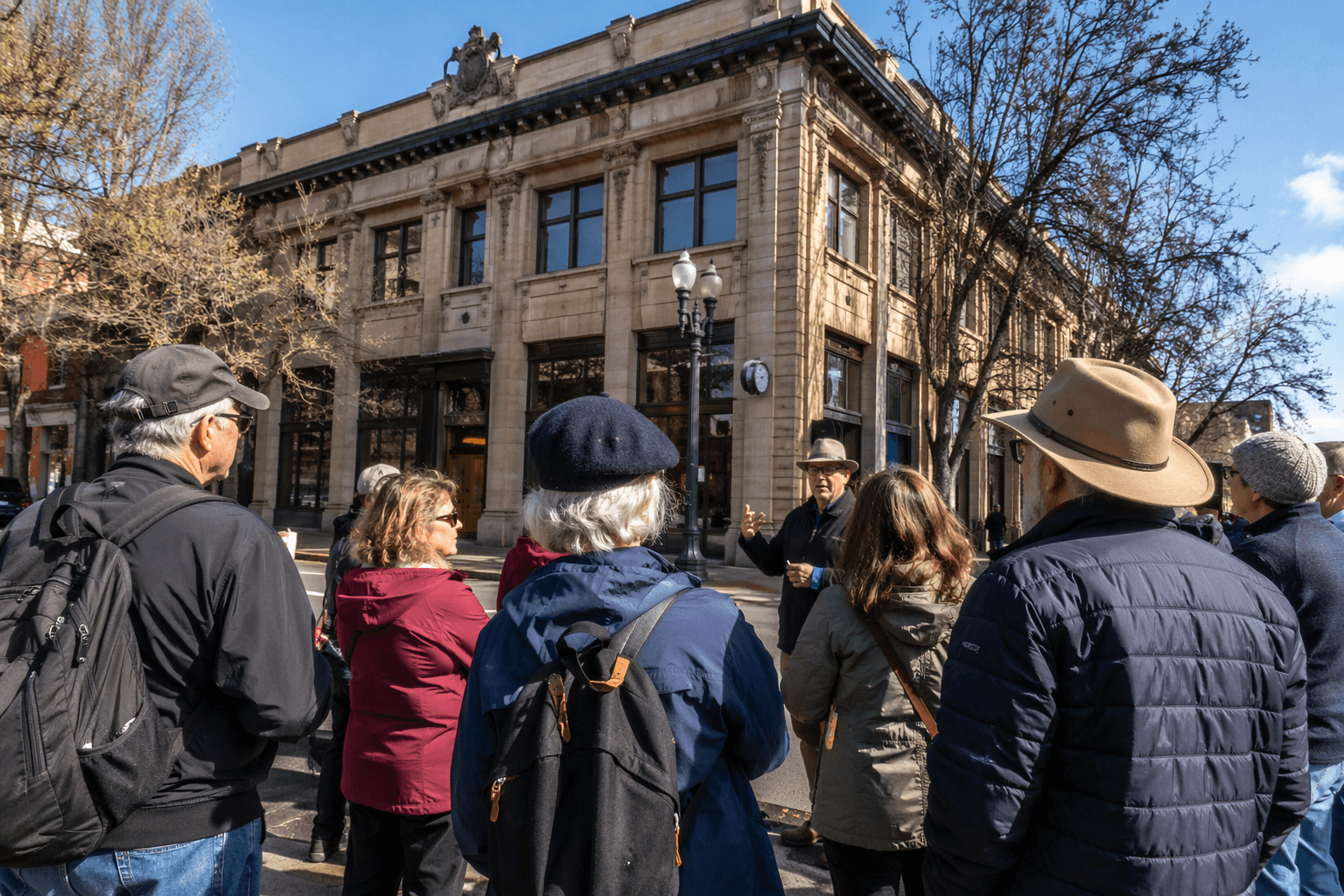
Lane Arts Council’s Historic Sites Tour threads 15 National Register properties through downtown Eugene, where the city’s boom-and-bust history still sits in brick, stone, and marquee light. A majority also carry City Landmark status. The route turns the city center into a walkable afternoon guide to how Eugene grew from rail-era arrivals and commercial ambition into a denser civic and entertainment district.
Start with the oldest blocks
The earliest stops on the tour make the clearest case for beginning on foot. The Smeede Hotel dates to 1884 to 1885, the Shelton McMurphey Johnson House to 1888, and Campbell House to 1892, placing them in the city’s first decades of visible expansion. Those buildings show Eugene before the big downtown grind, when the city was still defining itself through homes, lodging, and the first layers of commercial street life.
The tour reads the city chronologically, one facade at a time, showing how downtown became the center of public life. Downtown Eugene is the social, economic, and cultural heart of the community, and these older buildings show what that heart looked like before the district filled in around it.
Follow the rail and business boom
From the older residential and hotel-era landmarks, the route moves into the years when Eugene accelerated as a commercial hub. The Quackenbush Building and Tiffany Building, both from 1902, sit close to the Lane Building from 1903, while the Eugene Depot, built in 1908, and the Oregon Electric Station, completed in 1914, anchor the transportation story. The Downtown Athletic Club, built from 1909 to 1910, adds a different marker of urban growth, showing how the city’s core was beginning to support not just transit and trade, but organized recreation and social life.
Seen together, those stops show how downtown changed from a place people passed through into a place people worked, met, and spent the day. The Depot and Oregon Electric Station reflect the rail era that pulled Eugene into regional circulation. The business blocks around them show the confidence of a city that expected more foot traffic, more office space, and more storefronts.
If you are making this into an afternoon walk, this is the stretch to slow down. The blocks around Broadway and Willamette Street reveal how the city’s commercial grid hardened over time, and how the old transportation spine still shapes where people naturally cluster.
End with the civic and entertainment core
The later landmarks show downtown Eugene becoming a place for gathering, not just arriving. The Eugene Hotel was designed by Eugene architect John Hunzicker and built in 1924 to 1925, with its main entrance facing Broadway, which had earlier served as the mid-city route for Highway 99. The building was conceived for a street pattern and a traffic world that no longer exists in the same way.
Nearby, the McDonald Theatre, built in 1925, and W.O.W. Hall, which dates to 1932 and was officially designated a National Register historic landmark in 1996, carry the entertainment side of downtown history forward. The McDonald Theatre remains owned and operated by the Kesey family, a rare example of a historic venue still tied to a family stewardship model. W.O.W. Hall, operated by the Community Center for the Performing Arts, paid off the mortgage in 1983 with support from the public.
The U.S. Post Office from 1937 to 1939 rounds out that story with a civic landmark from the Depression era, when downtown was still being asked to serve as the city’s public face.
Why the landmark rules matter
A City Historic Landmark is a building, structure, object, landscape, or district that is significant to Eugene’s history and worthy of protection. Landmark properties can be eligible for low-interest rehabilitation loans from the city, and Eugene regulates alterations, moving, and demolition for both Historic Landmark properties and National Register properties.
Eugene’s Historic Review Board, created in 1975, oversees landmark designations, National Register recommendations, and issues involving alteration and demolition. The Historic Preservation Program exists to increase public awareness of this history and character while facilitating preservation, restoration, and rehabilitation of historic structures and culturally significant places.
In a downtown that still functions as a social and economic center, preservation shapes what kind of businesses can stay, what kind of streetscape people walk through, and which older buildings remain part of the daily landscape.
How the tour grew into a downtown walk
Lane Arts Council first organized the Historic Sites Tour in spring 2015 during Historic Preservation Month, with support from the Lane County Historical Society & Museum, the Shelton McMurphey Johnson House, and the Oregon Electric Station. Bob Hart, Donald Peting, and Dick Williams led that original tour, and site-specific hosts helped interpret the buildings along the way.
This article was produced by Prism’s automated news system from verified source data, official records, and press releases, then run through automated quality and moderation checks before publishing. The system is built and supervised by the people who set the standards it runs under. Read our full AI policy.
Did this article answer your question?