Lane County's Three Heritage Trees Offer Living History Worth Exploring
Three Lane County sites hold Oregon heritage tree status — a Black Tartarian cherry planted in 1847, a hazelnut orchard powering half the state's industry, and a grove tied to Applegate Trail settlers.

Walk into the Owen Rose Garden on a spring afternoon and you'll find it easily: a massive Black Tartarian cherry tree planted in 1847, its canopy spreading over a paved path along the Willamette River in Eugene. The tree is believed to be the country's oldest and largest Black Tartarian cherry tree. It was planted by Eugene Skinner, the city's own founder. That single tree, still alive and standing more than 175 years later, is one of three Lane County sites carrying Oregon's official heritage tree designation, a distinction that carries both civic pride and real ecological responsibility.
Oregon, as it happens, wrote the book on this. In 1995, Maynard Drawson helped launch the Oregon Heritage Tree Program, making it the first state-sponsored heritage tree program in the country. Nearly 30 years on, the program continues to recognize trees of exceptional age, size, cultural significance, or historical importance, using those designations to drive public education and long-term conservation. Lane County's three sites span three communities, three centuries of local history, and three very different ecosystems.
The Owen Cherry, Owen Rose Garden, Eugene
The Owen Rose Garden sits along the Willamette River, part of a stretch of riverfront park running from the Ferry Street Bridge to the Greenway bike bridge near Valley River Center. The garden is paved and pergola-lined, with a 28-foot diameter gazebo and a dedicated parking lot, making it one of the more accessible heritage tree sites in the county. The paved walkways accommodate wheelchairs and strollers throughout.
Shortly after the original land donation, the Eugene Rose Society added 750 rose bushes; that collection has since expanded to more than 4,500 roses across over 400 varieties. The Owen Cherry anchors the garden's heritage section, and free site maps are available through the City of Eugene parks website. Combined with its riverside setting and proximity to downtown Eugene, this is the most urban of the three sites, and the easiest first stop on a heritage tree circuit.
The Dorris Ranch Hazelnut Orchard, Springfield
The first commercial-sized planting of hazelnuts in Oregon occurred when George Dorris planted a five-acre orchard at this site in 1905. In addition to growing trees for nut production, Dorris started a hazelnut nursery that operated for 40 years and produced an average of 70,000 trees per year. The downstream effect was enormous: it is estimated that more than half of the trees in Oregon's hazelnut industry originated from Dorris Ranch nursery stock. That makes this orchard not just a heritage site but arguably the single most economically consequential grove of trees in Oregon's agricultural history.
The 268-acre park and commercial filbert orchard sits just south of downtown Springfield and features miles of gravel, paved, and natural-surface trails that weave through riparian woodland and oak prairie habitats. Dorris Ranch also serves as the western access point of the paved, 4-mile Middle Fork Path. The site is located at 205 Dorris Street in Springfield, offers ample parking and fully equipped restrooms, and is open seven days a week from dawn until dusk at no charge. The paved portions of the trail system are accessible, and the site also hosts school programs that connect the orchard's agricultural history to its documented Indigenous significance, a layer of context that Willamalane and state partners have made central to how the site is interpreted.
The Ellmaker Grove, Zumwalt Park, Veneta
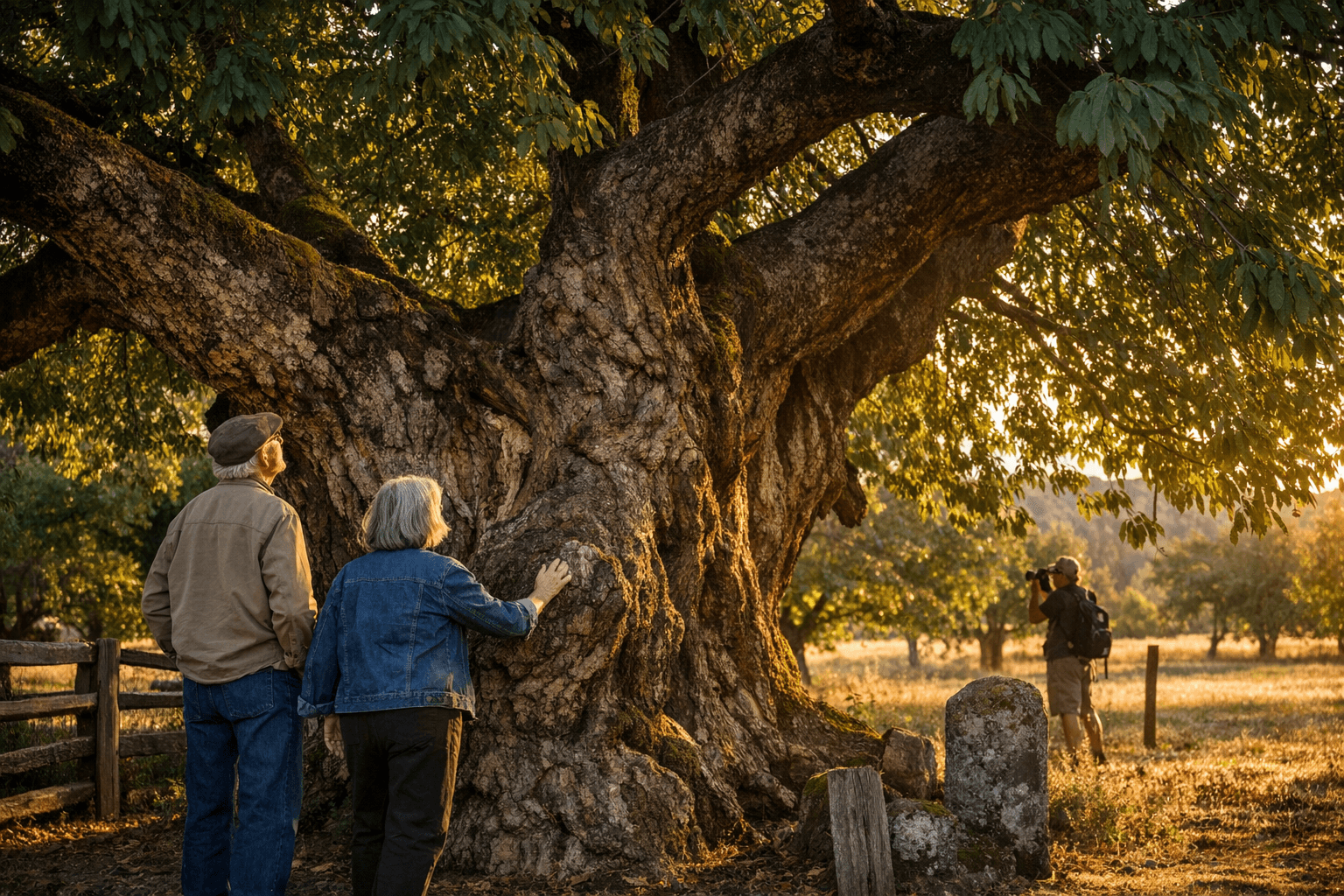
The third site requires the most effort to reach, but offers some of the county's most layered historical context. In 1857, Enos and Elizabeth Fisher Ellmaker traded donation land claims with Levi W. and Mary Malinda Zumwalt. The Ellmakers built their house and blacksmith shop by an Oregon white oak, while a nearby incense cedar sheltered their livestock. The bigleaf maples, planted along the driveway by the Ellmakers, linked blacksmith shop customers to the ancient route sometimes known as a branch of the Applegate Trail.
Zumwalt Park is a 74-acre county park open to off-leash dogs located in Veneta on the edge of Fern Ridge Reservoir. The park is closed to motorized traffic but is accessible from Vista Drive and Jeans Road, where limited parking is available. It is managed by the Lane County Parks Department but maintained largely by the Friends of Zumwalt Park, a volunteer organization. The terrain is natural-surface and uneven in places, making it less suitable for mobility aids than the other two sites; plan accordingly and wear sturdy footwear. The grove includes a 300-400 year old Ellmaker Oak and numerous large bigleaf maples, along with a large incense cedar that once sheltered the family's cattle. Some of the maple trees are now in decline, but those that remain still stand along the north side of the old parking lot in the center of Zumwalt Park.
What "heritage" status actually means, and how to add to it
A heritage designation isn't simply an honor. Accessibility to the public, tree health, and historic significance all play a role in whether or not a tree or grove qualifies. Once designated, trees receive a 9-inch by 12-inch plaque mounted on a single-leg pedestal, and they enter a system of ongoing monitoring by program partners including the Oregon Department of Forestry and the Travel Information Council. For Lane County's sites, Willamalane works alongside state agencies to maintain canopy health, follow best-practice stewardship protocols, and ensure these trees remain viable amid development pressure and shifting climate conditions.
The program does not consider itself complete. The Heritage Tree Committee evaluates each nomination using a dedicated group of volunteers, and reviews applications in January, July, and October of each year. Anyone who believes a tree in Lane County qualifies can download a nomination application directly from the Oregon Travel Information Council's website, oregontic.com. Nominations are assessed on historical significance, ecological value, and public accessibility. Heritage Tree honorees are announced at a statewide dedication ceremony held in April of the year following designation.
Lane County's three sites make a compelling single-day circuit: start with coffee near the Willamette riverfront before the Owen Rose Garden opens fully in morning light, drive 10 minutes to Dorris Ranch for a loop through the orchard trails, then head west on Highway 126 to Veneta for an afternoon walk through Zumwalt Park before the light drops over Fern Ridge. All three visits are free. None requires more than a few hours. Each one connects directly to a different thread of what this region was, and what it chose to protect.
This article was produced by Prism’s automated news system from verified source data, official records, and press releases, then run through automated quality and moderation checks before publishing. The system is built and supervised by the people who set the standards it runs under. Read our full AI policy.
Did this article answer your question?


