Mount Pisgah Arboretum offers trails, wildflowers and valley views near Eugene
Mount Pisgah is Lane County’s close-in hillside escape, with eight miles of trails, spring wildflowers, fall mushrooms and valley views just southeast of Eugene.

Mount Pisgah Arboretum is close enough to Eugene for a half-day outing, yet large enough to feel like a real change of pace. The 209-acre preserve sits about five miles southeast of downtown Eugene, inside the much larger Howard Buford Recreation Area, where 2,216.3 acres of protected ground give the west Eugene foothills an unusually intact outdoor system.
A close-in landscape with real habitat value
What sets Mount Pisgah apart is not just the mileage, but the mix of plant communities packed onto one hillside. Travel Oregon describes it as one of the best remaining examples of oak woodland and savanna in the Willamette Valley, alongside river riparian forest, mixed conifer and deciduous forest, and wildflower meadows. That combination is why the arboretum works for so many different uses at once: birding in the riparian stretches, trail running on the hills, family walks in the meadow country, and photography when the valley light turns soft in the evening.
The arboretum also has the kind of scale that keeps it interesting after repeat visits. Travel Oregon lists more than 8 miles of all-weather trails, and the surrounding Howard Buford Recreation Area makes the site feel bigger than a single park boundary. For Eugene and Springfield, that matters. It gives residents a nearby place to experience native plant communities and wide-open valley views without turning the outing into a daylong drive.
Spring is the signature season
Spring is when Mount Pisgah most clearly earns its reputation. A 2013 Travel Oregon profile said more than 300 native wildflower species can be seen there from as early as February through July, with camas fields typically peaking in mid-April through May. That puts the arboretum squarely on the short list for anyone who cares about wildflower season in Lane County, from casual walkers to botany-minded visitors with field guides in hand.
It is also the best time for families and photographers. The meadows change quickly as the bloom cycle moves through the hillside, so even short visits can feel different from week to week. The arboretum’s educational programs for all ages add another layer, giving school-age kids, parents and grandparents a place where the trail experience connects directly to the valley’s native ecology.
Tom LoCascio, the longtime site manager who served the arboretum and community for 40 years before retiring, once said the place "shows what the southern Willamette Valley is all about." That is the right frame for spring here: not a manicured garden, but a living sample of what the valley looked like before most of it was settled and subdivided.
Summer favors walkers, runners and people who want distance without a long drive
By summer, the value of Mount Pisgah shifts from bloom color to consistency. The trails are described as all-weather, which makes the site useful in shoulder seasons and after dry summer weeks when visitors still want a maintained path system close to town. Runners use the hills for steady climbs, walkers can build a short loop into a longer outing, and photographers still get the payoff of open views across the Eugene-Springfield valley.
The arboretum’s location off Seavey Loop Road keeps it practical. It is close enough for a quick morning walk before work or a late-afternoon visit, but it still feels like an escape because the ridge rises above the surrounding development. The $2 daily parking fee is modest compared with the amount of ground on offer, especially for visitors who want a repeat destination rather than a one-time stop.
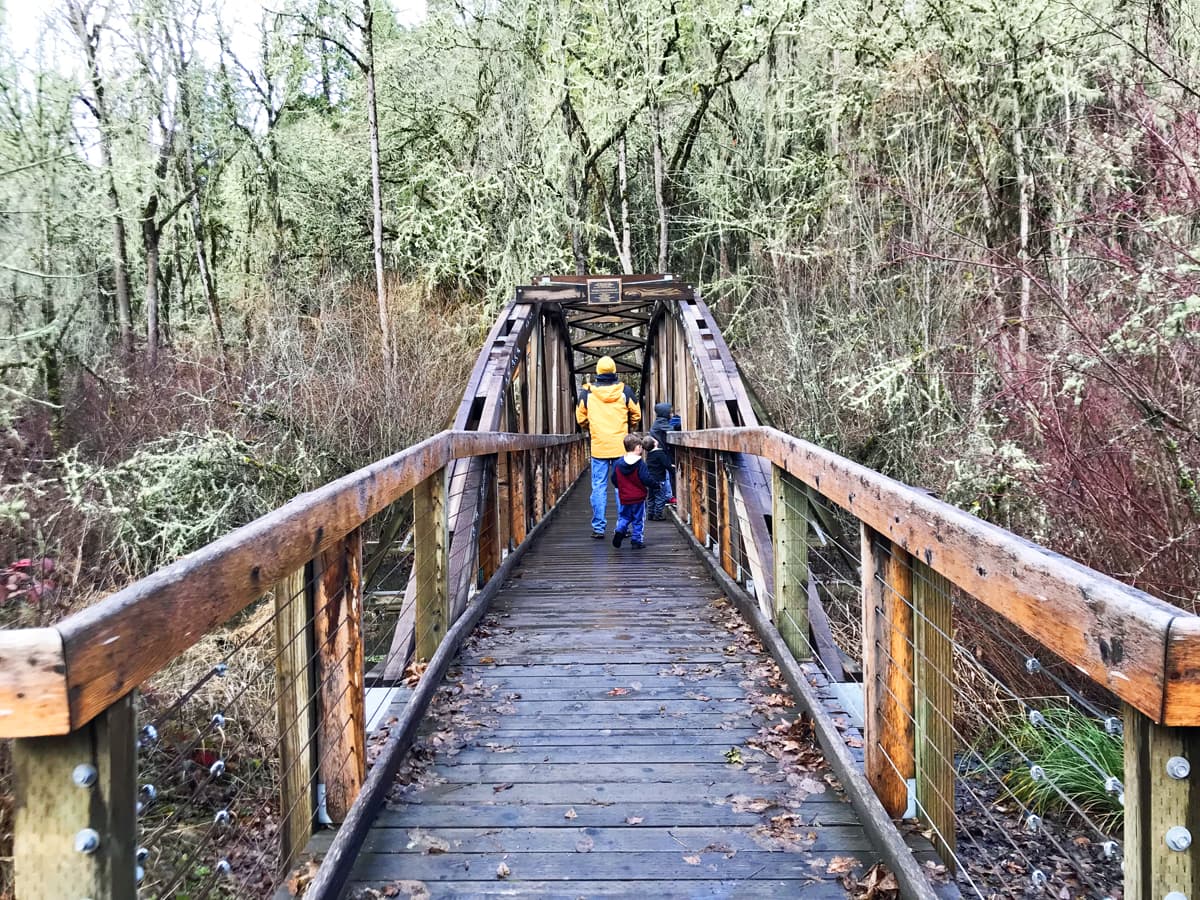
For people who want a longer outing, the summit side is the part to plan around. Lane County posted in June 2026 that the Upper Summit Trail and Summit Trail had planned closures and improvements, which is a reminder that the upper hillside is actively maintained. That kind of work is part of what keeps the park usable, but it also means the smartest summer visit is the one planned with a quick look at trail status.
Fall brings mushrooms, color and a slower pace
Fall is the season when the arboretum’s programming and its setting line up especially well. Travel Oregon highlights the Mushroom Festival as one of the site’s signature events, and the surrounding woods, meadows and riparian edges make the whole preserve feel more layered once the light changes and the crowds thin out. For visitors who like a slower pace, this is the time when Mount Pisgah can feel most expansive.
That also makes it one of the better places in Lane County for a mixed-interest outing. One person can focus on fungi, another on birds, and another on the changing color along the trails. The combination of meadow, woodland and river-edge habitat gives the preserve a stronger fall profile than a single-use park, which is part of why it works so well for casual walkers and more dedicated naturalists alike.
A park system built by local stewardship
Mount Pisgah’s current shape came from a long local effort, not a single land deal. The arboretum’s history page says Eugene’s mayor appointed a committee in the late 1960s and 1970s to establish an international arboretum. Governor Tom McCall then announced the Howard Buford Recreation Area as a 2,300-acre ecologically diverse tract on the Coast Fork of the Willamette River that would include a 118-acre arboretum, and the group incorporated in 1973 as the International Arboretum Association.
That history still shows in how the place operates now. Mount Pisgah Arboretum says it is a nonprofit supported by hundreds of volunteers and more than 1,500 members, and that it leases its 209 acres from Lane County. Friends of Buford Park & Mt. Pisgah says its mission is to protect and enhance the natural beauty and ecology of the recreation area and surrounding lands, with education programs, volunteer opportunities and pavilion rentals extending the park’s role beyond the trails themselves.
The site’s long public life also helps explain why it keeps showing up in Lane County memory. A 2007 article described Mount Pisgah as a 35-year-old site with nine miles of trails, a useful marker for how central the trail network has been for decades. The arboretum’s Winter 2021 newsletter added another layer of continuity by noting LoCascio’s 40 years of service before retirement, the kind of local stewardship that helps a place keep its character while still adapting to new demand.
For Lane County readers who want one outdoor destination that works across seasons, Mount Pisgah remains unusually complete: wildflowers in spring, long trail days in summer, mushrooms and color in fall, and dependable walking in the off-season. It is close, it is maintained, and it sits inside a protected hillside system that still feels like the southern Willamette Valley at its most visible.
This article was produced by Prism’s automated news system from verified source data, official records, and press releases, then run through automated quality and moderation checks before publishing. The system is built and supervised by the people who set the standards it runs under. Read our full AI policy.
Did this article answer your question?


