Salamanders Supercool to Walk on Ice, Threatened by Snowpack Changes
On December 24, 2025 researchers described how several salamander species use physiological supercooling to survive cold conditions and remain active on ice and snow during seasonal migrations. The finding matters for Lane County because changes in snowpack and winter temperatures could alter migration timing and survival, with consequences for forest health, recreation and local conservation planning.
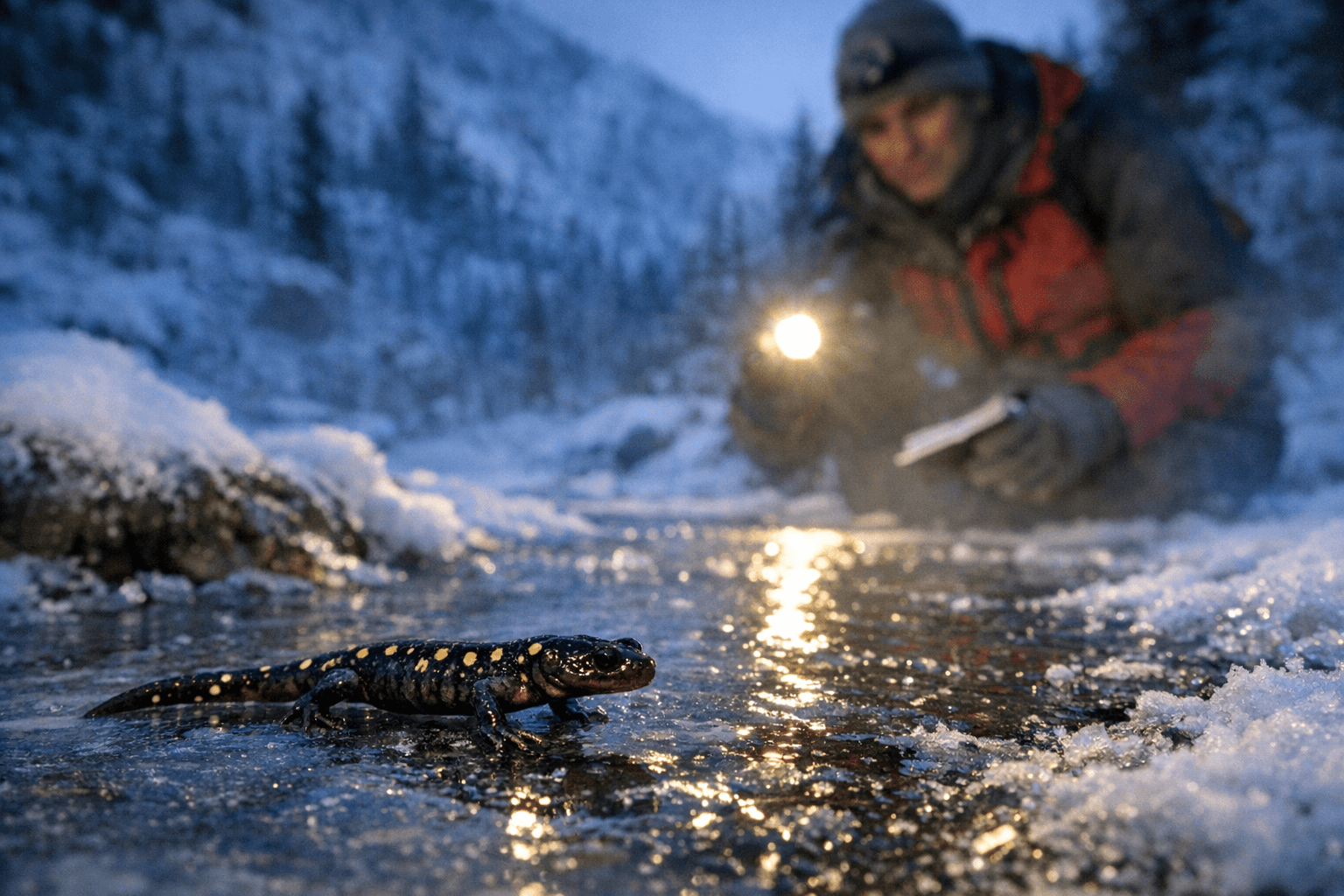
Researchers reported on December 24, 2025 that certain salamander species employ physiological supercooling strategies that lower the freezing point of body fluids, enabling these amphibians to move across ice and snow during seasonal migrations. The ability to remain mobile in near freezing conditions expands the window for movement between upland forest habitats and lowland breeding sites. For Lane County residents living near forested and mountainous areas these behaviors are more than a curiosity, they are part of the seasonal rhythm that supports forest biodiversity and the broader ecological services that communities rely on.
The study describes how supercooling allows salamanders to tolerate temperatures that would otherwise cause ice formation in tissues. This physiological adaptation can permit short distance travel over snow and ice, which researchers observed during migration periods in late fall and early winter. The timing of these migrations has local significance because salamanders play roles in nutrient cycling, soil aeration and as prey for other species. Disruptions to their life cycle can cascade through forest food webs and affect forest resilience.
Researchers also connected these behaviors to climate driven changes in snowpack and winter weather. Warmer winters with reduced snowpack can shift the timing of migration, sometimes exposing salamanders to more frequent freeze thaw cycles or to early seasonal rain events that alter breeding site availability. Conversely, less predictable snow cover can eliminate the insulation that stabilizes ground temperatures, increasing exposure risk during critical migration windows. For communities in Lane County that manage forest lands and waterways, such shifts can complicate conservation actions aimed at maintaining amphibian populations.
The implications extend beyond wildlife alone. Healthy amphibian populations are indicators of intact forest and stream ecosystems that underpin recreational opportunities, from hiking to nature viewing, which contribute to the local economy. Changes in species distributions can influence management decisions for timber harvesting, habitat restoration and road closures during migration periods. Local conservation agencies and landowners may need to adjust timing for activities such as prescribed burns, logging operations and seasonal trail maintenance to reduce impacts on migrating salamanders.
Looking ahead, the research underscores the need for coordinated monitoring in the Pacific Northwest to track migration timing, survival rates and snowpack trends. For Lane County this means integrating wildlife observations into land management planning and considering measures that protect upland migration corridors and winter refugia. Preserving the microclimates that allow supercooling strategies to succeed will be an important part of conserving these species in a changing climate.
This article was produced by Prism’s automated news system from verified source data, official records, and press releases, then run through automated quality and moderation checks before publishing. The system is built and supervised by the people who set the standards it runs under. Read our full AI policy.
Did this article answer your question?


