Springfield Jury Acquits Man Charged With Disorderly Conduct at Police Protest
A Lane County jury acquitted Jason Bowman of two disorderly conduct counts, rejecting claims he stepped into traffic while protesting a Springfield officer outside his Pioneer Parkway apartment.
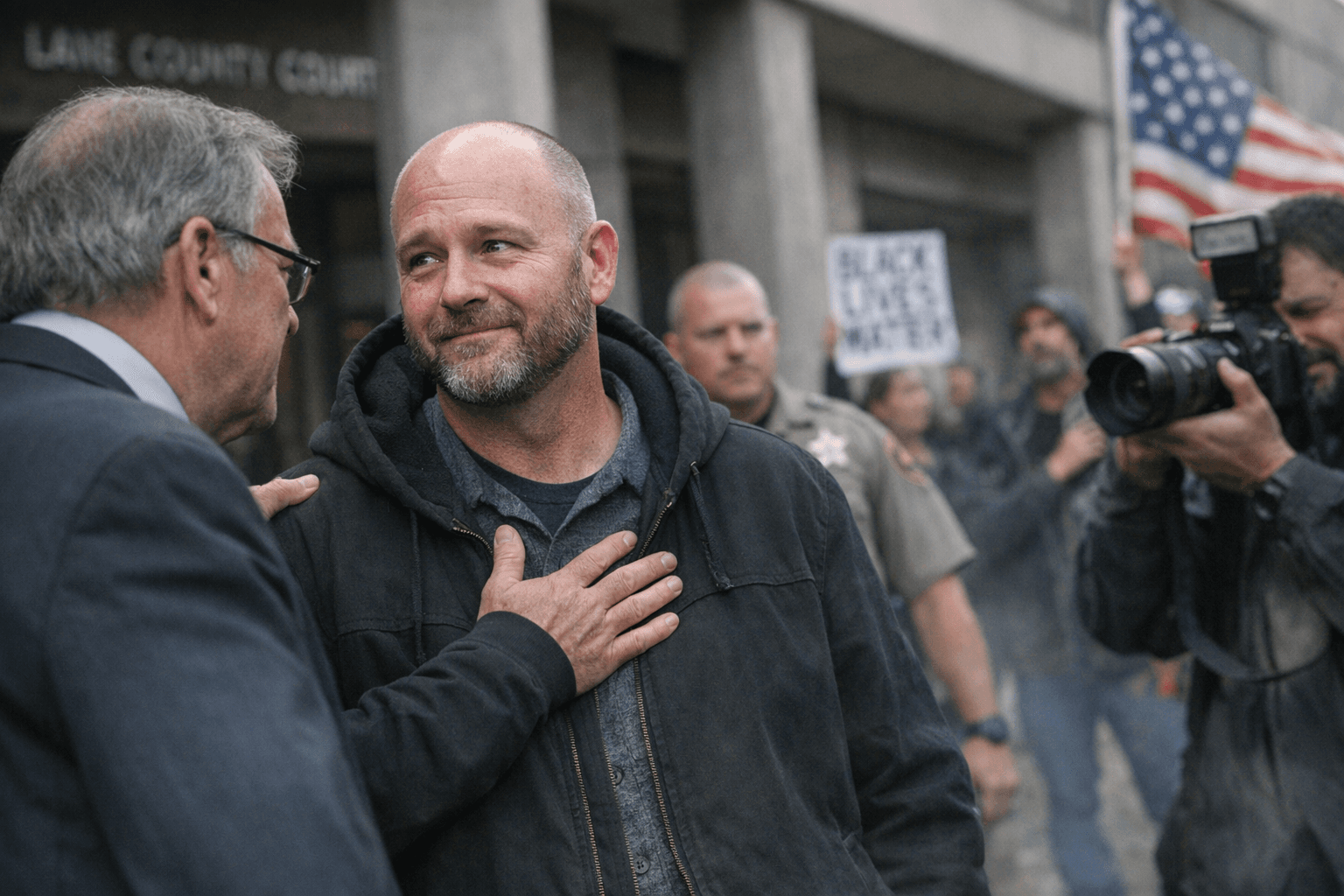
A Lane County Circuit Court jury threw out both counts of second-degree disorderly conduct against Jason Bowman on April 9, clearing the Springfield man of charges that stemmed from a Fourth of July protest outside his Pioneer Parkway apartment and rejecting the prosecution's core claim that he had stepped into traffic and threatened his neighbors.
The verdict came nearly two years after the July 4, 2024, incident that led to Bowman's arrest. That morning, Bowman stood near his apartment along Pioneer Parkway holding a sign that read "Oros beats disabled women," yelling at passing motorists about an encounter his wife, Alison Hunter, had with Springfield police earlier that year. In March 2024, body camera footage from a Springfield Police response showed Officer Saul Oros pulling Hunter from her car by her shoulder, which was broken, to arrest her. The video shows Hunter screaming in pain and bleeding.
After Bowman had been protesting for what Hunter estimated was 30 to 60 minutes, neighbors called Springfield police. Officers arrested him and city prosecutors filed two counts of second-degree disorderly conduct.
At the two-day trial in Lane County Circuit Court, both sides acknowledged the case landed squarely at the boundary between protected speech and criminal conduct. Springfield municipal prosecutor Erik Hasselman argued Bowman had stepped across that line. "(Bowman) may be frustrated but that doesn't give him the right to further get attention by stepping into traffic," Hasselman said. "It doesn't give him the right to be confrontational with members of public when being slighted." Hasselman told jurors that Bowman had also threatened the neighbors who called police, conduct he framed as crossing from expression into criminal behavior.
Public defender Sarah Ferguson countered that Bowman's manner may have been offensive, but that offense alone does not satisfy the legal standard for disorderly conduct. "He had freedom of speech," Ferguson said during closing argument. "There are limits on speech, (but) evidence showed his threats were nonspecific and his anger was directed at SPD for other reasons." Bowman denied stepping into traffic and denied threatening his neighbors.
The jury's acquittal means Springfield did not prove beyond a reasonable doubt that Bowman's conduct at Pioneer Parkway crossed into criminal territory. That finding has direct consequences for how the city frames protest-related disorderly conduct cases going forward. To obtain a conviction, prosecutors must show specific, concrete acts. A defendant's denial, when not contradicted by sufficient evidence, can be enough for jurors to walk back a charge built largely on neighbors' and officers' accounts rather than video proof of the alleged conduct.
The verdict lands in a county already tracking the outcomes of protest-related criminal charges closely. In January 2025, a separate Lane County jury acquitted two pro-Palestinian activists of disorderly conduct arising from an April 2024 blockade of Interstate 5 near the Harlow Road bridge in Eugene. Whether Springfield's city leadership will review its charging standards for future demonstrations following the Bowman acquittal remains an open question.
This article was produced by Prism’s automated news system from verified source data, official records, and press releases, then run through automated quality and moderation checks before publishing. The system is built and supervised by the people who set the standards it runs under. Read our full AI policy.
Did this article answer your question?