University of Oregon exhibit explores America at 250 through museum collections
UO’s America at 250 exhibit uses rare museum objects to ask whose histories get preserved, with free and discounted access for opening night visitors.
A campus exhibit with a civic question
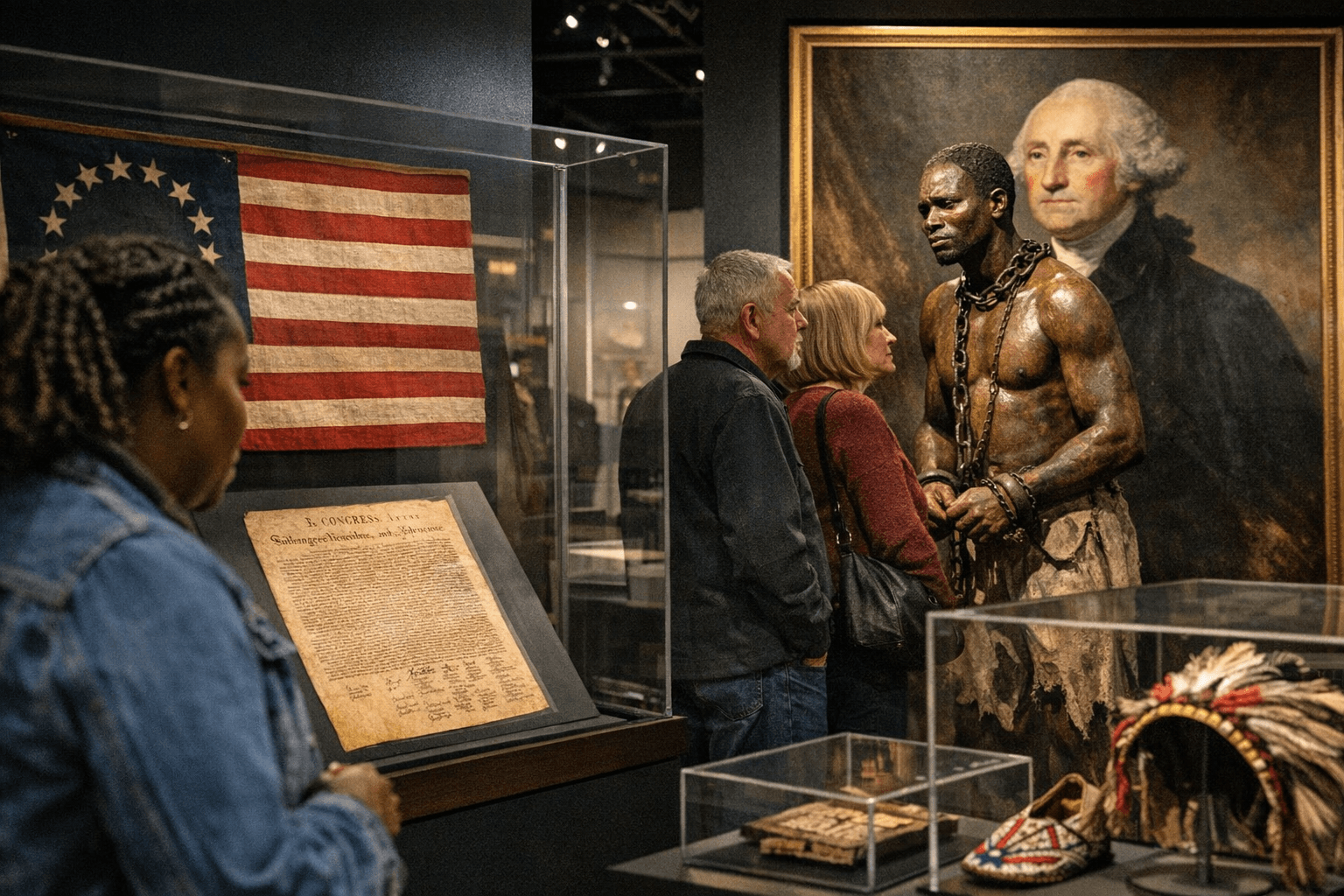
The University of Oregon is marking the nation’s 250th anniversary by pressing on a deeper issue than celebration alone: whose history gets centered when Americans look back. At the Museum of Natural and Cultural History in Eugene, the new exhibit, America at 250: Before, Between, Beyond, uses rarely seen collection items to examine who is included in the historical record and what those objects say about everyday life, memory, and identity.
That framing matters in Lane County because it turns a campus exhibit into part of the larger civic argument building toward 2026. Rather than offering a simple patriotic retrospective, the show asks visitors to think about who has been left out of familiar national stories and how museums decide what counts as history in the first place.
What the exhibit is trying to do
The museum says the exhibit rests on a simple idea: “America’s history is the story of all of us.” That line is not just a slogan for the wall text. It signals that the exhibit is meant to widen the lens, using material culture to show how people lived, what they kept, and how they understood themselves through the things around them.
The exhibit features rarely displayed objects from the museum’s collection, which gives it a different feel from a standard anniversary display. Visitors are meant to use those items as evidence of the country’s past, but also as prompts to ask what future stories may still need to be gathered, preserved, and told.
When to go and what to expect
The opening night is set for Friday, April 17, 2026, with a member preview from 5:00 to 6:00 p.m. and a public reception from 6:00 to 7:30 p.m. The first hour is reserved for museum members and invited guests, and then the event opens to everyone. Light appetizers and refreshments will be available, along with a cash bar.
The museum says public reception admission is included with regular admission, free for Museum of Natural and Cultural History members and University of Oregon ID card holders, and discounted for Oregon Trail or other EBT card holders. That matters for local access: the exhibit is not being presented as an elite-only academic event, but as a public program meant to draw students, families, educators, and neighbors from across Eugene and the wider county.
The opening weekend celebration runs Saturday, April 18, through Sunday, April 19, from 10:00 a.m. to 5:00 p.m. For anyone planning a campus visit, that gives the exhibit an immediate two-day window to see it while the opening energy is still fresh.
Why the museum’s collection gives this exhibit weight
The Museum of Natural and Cultural History describes itself as the state’s official repository for Oregon cultural and paleontological materials, and its vaults hold hundreds of thousands of objects. Those holdings span archaeological and ethnographic items, fossils, and geological specimens, which is exactly why the museum can build an exhibit around interpretation rather than a single artifact or a narrow national storyline.
Briggs, in the museum’s interpretation of the exhibit, points to the power of objects to reveal who lived in a place and how people saw themselves through what they used and kept. That is the institutional argument behind America at 250: collections are not just storage. They are records of lived experience, and they can expose the ordinary details that grand narratives often miss.
The local conversation extends into May
The exhibit is also tied to a related talk, The Power of Collections in a Changing World, scheduled for Thursday, May 14, 2026, at 6:00 p.m. Museum director Todd Braje says collections preserve stories of how humans have faced crisis and change over thousands of years, and he frames those stories as sources of lessons about resilience and sustainability.
That broader programming points to the museum’s larger civic role. In the April-June museum program guide, related panelists include Matthew Boulay, executive director of the Salem Art Association, and Gwen Carr, director of the Bush House Museum and co-founder of the Oregon Black Pioneers. Their presence suggests the museum is pairing the exhibit with a more explicit conversation about what gets remembered, what has been excluded, and who gets authority over public memory.
Why it matters for Lane County now
For people in Eugene and across Lane County, the exhibit offers a nearby way to engage with a national milestone without leaving town. It also gives the University of Oregon a public-facing role in a debate that will only sharpen as the country approaches 250 years since the signing of the Declaration of Independence.
The deeper value of America at 250: Before, Between, Beyond is that it does not treat history as settled. It treats history as something assembled from evidence, shaped by institutions, and always open to correction when new voices, new collections, and new questions enter the record.
This article was produced by Prism’s automated news system from verified source data, official records, and press releases, then run through automated quality and moderation checks before publishing. The system is built and supervised by the people who set the standards it runs under. Read our full AI policy.
Did this article answer your question?