Why Cottage Grove’s historic covered bridges matter and where to see them
Cottage Grove’s cluster of covered bridges anchors a 20–38 mile scenic loop, some are car‑accessible, others closed to traffic; check closures and volunteer opportunities before you visit.
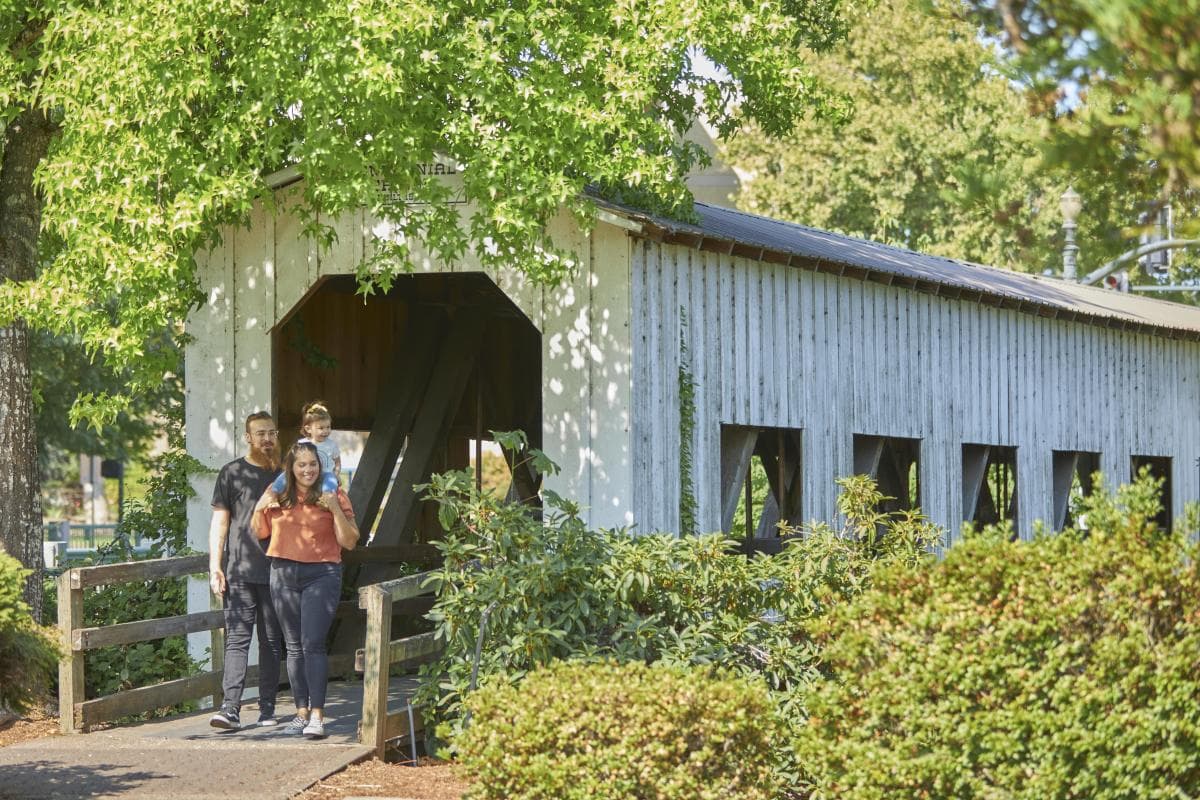
Cottage Grove and southern Lane County advertise an unusually dense cluster of historic covered bridges, the city markets itself as the “Covered Bridge Capital of Oregon,” and Lane County holds more covered bridges than any other county west of the Mississippi River. That concentration powers tourism, shapes local road and trail design, and depends on a mix of volunteer labor, county maintenance and periodic federal preservation grants; when bridges close for repair, the effects are immediate for commuters, cyclists and small businesses such as Stacy’s Covered Bridge Restaurant in downtown Cottage Grove.
The seven bridges and crossings frequently listed in local guides are below. Each entry gives construction or restoration facts, access status, location details and why the span matters to recreation and local policy.
1. Centennial Bridge
This pedestrian bridge sits in Veterans Park at East Main Street and North River Road in downtown Cottage Grove, placing it within walking distance of shops and restaurants. Sources agree it was built from parts of dismantled Lane County bridges and rests on abutments of the old Main Street Bridge, but the construction year is inconsistent across municipal and regional guides, one source says it was “constructed in 1997 by volunteer labor to celebrate Cottage Grove’s centennial,” while other accounts list 1987. The bridge is explicitly pedestrian‑only, making it a downtown landmark and an example of community volunteerism tied to heritage promotion.
2. Swinging Bridge
Located about a half‑mile upstream from Centennial Bridge, Swinging Bridge is a foot‑and‑bicycle bridge, not a covered bridge, and it historically served schoolchildren crossing the Coast Fork to reach classes. The current structure is at least the fourth on the site; earlier versions could swing side‑to‑side, giving the span its name. Though not covered, Swinging Bridge is often included on walking and biking tours and functions as an accessible riverside crossing close to downtown amenities.
3. Chambers Railroad Covered Bridge (Chambers Bridge)
Built in 1925 by lumberman J.E. Chambers to carry rail traffic across the Coast Fork Willamette River, this long timber railroad span is repeatedly singled out as a unique structure, one local source calls it “the only remaining covered railroad bridge in Oregon,” while another claims it is “the only remaining covered railroad bridge west of the Mississippi.” The bridge is listed at 1231 S. River Road in Cottage Grove and measures about 78 feet long according to a first‑hand account; it was restored in 2006 with funding from the National Historic Covered Bridge Preservation Program. Sources differ on current access: some describe it as closed to traffic and pedestrians while other accounts describe it as restored and serving a neighborhood south of downtown, that conflict matters for visitors and for county decisions about maintenance and liability.
4. Mosby Creek Covered Bridge (Layng Bridge)
Constructed in 1920 and named for pioneer David Mosby, Mosby Creek (Layng) Bridge is identified across sources as the oldest covered bridge in Lane County and the only Cottage Grove‑area covered bridge that remains open to vehicular traffic. It is an historic Howe truss span crossing Mosby Creek, a Row River tributary; one account confirms a 1990 restoration. Its single‑lane traffic status makes Mosby Creek a critical piece of local transportation infrastructure as well as a tourist draw, which raises routine maintenance and safety considerations for Lane County road planners.
5. Stewart Covered Bridge
Stewart Bridge is a 60‑foot Howe truss span built in 1930 near Walden and crosses Mosby Creek. It is listed on the National Register of Historic Places (1979) and has survived serious weather events, accounts note a flood that cracked lower chords and a heavy snowfall that collapsed its roof in the past. Today public access is restricted: the bridge is visible from a parking area and from a trail that descends to Mosby Creek beneath it (addressed at 34201 Garoutte Road). Restricted access preserves the structure but reduces direct visitor footfall and concentrates viewing in managed roadside locations.
6. Dorena Covered Bridge
Dorena Bridge was built in 1949 as part of the Dorena Reservoir project that followed engineering work in 1946; the reservoir’s filling required relocation of the town of Dorena and demolition or movement of about 100 homes and the railroad. Construction of the bridge cost $16,547 under the supervision of Lane County foreman Miller Sorenson, and it provided roadway access between Star Ranch and Cottage Grove. The Dorena area is included on the driving and biking loops around the reservoir; scenic picnic sites and seasonal display of foliage make the route a year‑round recreational asset but also create a maintenance footprint for county agencies managing roads and shoreline access.
7. Currin Covered Bridge (Currin Bridge)
Currin Bridge crosses the Row River and traces its lineage to an original 1883 span; the current structure replaced that earlier bridge in 1925, with reconstruction credited to local bridge builder Nels Roney. It was closed to vehicle traffic in 1979 and reopened as a pedestrian crossing in 1995; sources describe its “quirky” appearance with red sides, white portals and a corrugated metal roof. Currin’s pedestrian reopening demonstrates how adaptive reuse balances preservation with road‑safety policy and recreational planning.
How to see them: touring options and distances Multiple touring options exist, and reported distances vary because sources describe different routes and modes. That variation matters for logistics and public safety planning:
- Driving loop: The city’s official tour guide lists a 20‑mile driving route with a minimum driving time of 1–2 hours; regional travel guides describe an approximately 30‑mile scenic byway that loops through town and around Dorena Reservoir and notes that you can drive through two of the bridges. Use the shorter city loop for compact visits and the longer loop if you plan to stop for picnics and photography.
- Bike loop: Cycling guides promote a Covered Bridges Scenic Bikeway described alternately as a 36‑ to 38‑mile loop with a 2.5–4 hour riding time; guides emphasize the route is “mostly flat, easy, and scenic” and suitable for almost all ages though some road sections may not be ideal for very young children. One author endorses the ride: “This is a bike ride I’d recommend to anyone who loves to get out and explore new countryside.”
- Practical notes: A complete visit typically requires motorized transport to move among all sites; some sections of the Row River Trail and parts of downtown are wheelchair‑accessible. Rainy Peak in Cottage Grove offers a small fleet of bike rentals for the trail and loop riders.
Policy, preservation and civic engagement, what to watch Preservation depends on a patchwork of volunteer labor, municipal action and federal grants. Centennial’s construction from salvaged bridge materials is an example of volunteer‑led heritage work; Chambers received federal restoration funds in 2006 via the National Historic Covered Bridge Preservation Program. That mixed funding model raises recurring questions:
- Maintenance responsibility and budgets: Which county or city budgets cover recurring structural inspections, traffic control around single‑lane spans, and insurance/liability for pedestrian access? When bridges close, local businesses and trail users feel it quickly.
- Public oversight of federal grants: Grants such as the one used for Chambers carry reporting and stewardship obligations; residents and elected officials should track project timelines and post‑grant maintenance plans.
- Volunteer engagement: The Centennial project and other local efforts show volunteer labor remains a resource, organizeable through civic groups, historic societies or Friends of the Bridges initiatives.
- Check access: some spans are pedestrian only (Centennial), some remain open to cars (Mosby Creek), and others are currently off‑limits or reported inconsistently between sources (Chambers, Stewart). Verify current closures with Lane County Public Works or the City of Cottage Grove.
Before you go, safety and verification checklist
- Pick the right loop: decide whether you want the compact 20‑mile city drive, a roughly 30‑mile scenic byway, or the longer 36–38 mile bike loop and plan stops accordingly.
- Rent thoughtful gear: Rainy Peak offers a small fleet of bikes in Cottage Grove; confirm availability in advance.
Final note for local accountability Cottage Grove’s covered bridges are cultural assets that support recreation and local commerce. But preserving them requires clear, public plans for maintenance funding, transparent reporting on restoration grants, and accessible information about closures and safety. Prioritize confirming three items flagged in local guides before publishing or organizing group visits: the Centennial Bridge construction year, the precise scope of Chambers Bridge’s “only remaining covered railroad bridge” claim, and Chambers’ current public‑access status. Those verifications matter to residents, taxpayers and the officials charged with keeping these wooden spans standing for another century.
This article was produced by Prism’s automated news system from verified source data, official records, and press releases, then run through automated quality and moderation checks before publishing. The system is built and supervised by the people who set the standards it runs under. Read our full AI policy.
Did this article answer your question?


