Ludlow Tent Colony Site marks a defining moment in labor history
A 40-acre field north of Trinidad still anchors one of labor history's darkest chapters. Its future now depends on how UMWA, the National Park Service, and state stewards preserve it.
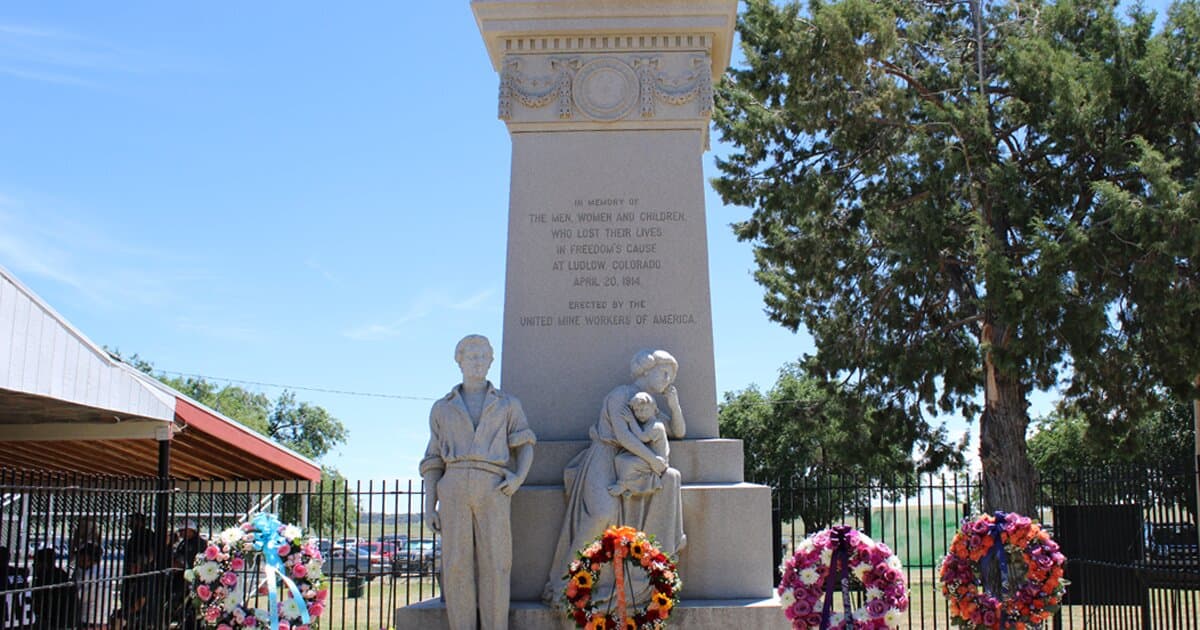
A 40-acre field east of the Colorado and Southern Railroad tracks, just off Interstate 25 in western Las Animas County, still carries the weight of one of the bloodiest episodes in American labor history. The Ludlow Tent Colony Site sits about 15 miles north of Trinidad and 24 miles south of Walsenburg, a location that makes it easy to find on a map and impossible to separate from the violence that happened there. The land is mostly open ground, and that emptiness is part of the story: it has remained largely undeveloped since the 1913-1914 confrontation, with a single monument standing where a tent colony once held thousands of people.
A landscape marked by conflict
History Colorado identifies the parcel as the site of the Ludlow tent colony and says it meets National Historic Landmark criteria because of its association with the Ludlow Massacre. The National Register nomination adds that the only structure breaking the landscape is the monument erected in 1918 by the United Mine Workers of America. Even the site’s setting tells readers where power sat in the coalfields: north of Trinidad, south of Walsenburg, and just west of the Ludlow exit from Interstate 25, near the dirt road that leads toward Del Agua Canyon.
That geography matters because Ludlow was never just a battlefield. It was a company-town eviction site, a labor camp, a family neighborhood, and later a memorial landscape. The 40-acre parcel now holds all of those meanings at once, which is why decisions about access, maintenance, and interpretation matter to Las Animas County as much as to historians.
What happened in the tent colony
The colony took shape in September 1913, when coal miners and their families, after being evicted from company housing during a strike, moved into a tent settlement organized by the United Mine Workers of America. By the winter of 1913-1914, the colony had several hundred tents and about 1,500 residents. Families dug cellars under the tents for protection from stray bullets, a detail that makes plain how quickly a labor dispute became a survival crisis for women and children as well as miners.
The worst violence came on April 20, 1914. History Colorado says the attack killed two women and eleven children, while other accounts place the broader death toll at roughly two dozen to 25 people. The day-long battle involved strikers, company guards, and the Colorado National Guard, and it set off another ten days of heightened violence across the Colorado Coalfield War before federal troops restored order. The strike ended in failure in December 1914, but the conflict did not disappear from public memory. It entered labor history as a stark example of what happens when workers, company power, and state force collide.

The miners were fighting for the eight-hour workday and for enforcement of Colorado’s existing mine safety rules. That makes Ludlow more than a tragedy site. It is a place where the struggle over working hours, safety, and the right to organize became visible in the lives of immigrant workers and their families.
Why the site still matters
The Ludlow Tent Colony Site was listed in the National Register of Historic Places in June 1985 and designated a National Historic Landmark in 2009. History Colorado also says the site has high potential to yield information relevant to American labor history and to the archaeology of ethnicity and class interaction. That matters in a county where coal, migration, family settlement, and corporate control shaped daily life for generations.
The memorial landscape itself is part of the historical record. The United Mine Workers of America erected the monument in 1918, and the site later became one of the clearest examples of union-led commemoration after industrial violence. Colorado Preservation has described Ludlow as one of the few places of tragedy immediately commemorated by a union with a substantial memorial. That early act of remembrance helped turn the site from a massacre ground into a place of public accountability.
The landscape also continues to yield information. Archaeological testing at Ludlow began in 1997, and the University of Denver’s Colorado Coalfield War Archaeological Project returned for intensive field seasons in 1998, 1999, 2000, 2001, and 2002. A 2024 study found that stabilization work at the site revealed new insights into memorialization over time, reinforcing that Ludlow is still an active research site rather than a fixed relic.
Who is responsible for Ludlow now
Preservation at Ludlow is not passive. The National Park Service says the United Mine Workers of America is using preservation planning support to create a master plan for the site, with the goal of sustainable and ethically responsible interpretation and wider stakeholder input. The NPS also places Ludlow among several sites of armed conflict receiving preservation money, a sign that federal support now treats the site as part of a broader national conversation about violence, memory, and public history.
That mix of stewardship raises a practical question for Las Animas County: who carries the work if attention and funding weaken? History Colorado, the National Park Service, the United Mine Workers of America, and local and regional preservation advocates all have a role, but the site itself cannot explain Ludlow on its own. It needs maintenance, interpretation, and access that match its importance. Without that, the county risks losing one of the clearest places where visitors, students, descendants, and researchers can see how labor conflict, immigrant family life, and state violence shaped southern Colorado.
A civic asset, not just a memorial
The site’s value is not limited to the past. It sits close enough to Trinidad and Walsenburg to anchor school trips, heritage tourism, and public education, yet it remains grounded in the working landscape that produced the conflict in the first place. The centennial in 2014 drew public attention through an exhibit at the El Pueblo History Museum and related historical work, showing that Ludlow still speaks to questions of power, memory, and responsibility.
For Las Animas County, the Ludlow Tent Colony Site is more than a marker of grief. It is a preserved civic asset, a place where the county’s history connects to national labor , and a reminder that stewardship is itself part of the story.
This article was produced by Prism’s automated news system from verified source data, official records, and press releases, then run through automated quality and moderation checks before publishing. The system is built and supervised by the people who set the standards it runs under. Read our full AI policy.
Did this article answer your question?