Magnitude 4.0 quake rattles Trinidad, shaking felt across southern Colorado
No injuries or damage were reported after a 4.0 quake near Weston, but the Trinidad-area shaking fit a clustered sequence that residents should keep watching.
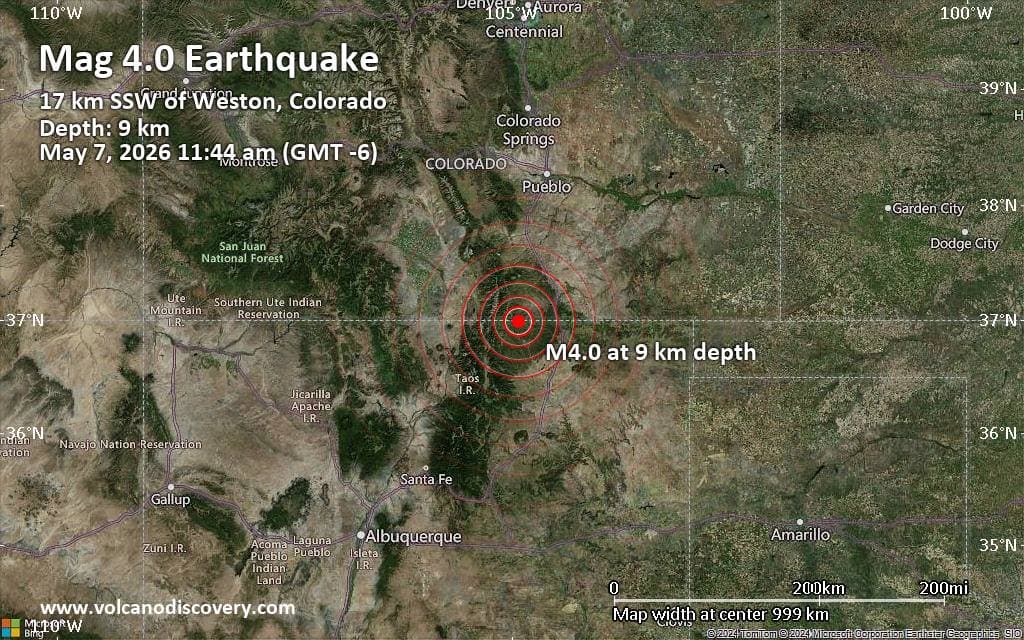
The 4.0 earthquake that rattled the Trinidad area did not bring reports of injuries or structural damage, but it did remind Las Animas County that the ground there is still active and worth monitoring. People from Raton to Walsenburg felt the shaking, and the U.S. Geological Survey’s event page placed the quake 17 kilometers south-southwest of Weston, Colorado, at a depth of 8.7 kilometers.
The quake struck at 11:44 a.m. on May 7, or 17:44:24 UTC, and the USGS “Did You Feel It?” page showed four felt-report responses in its snapshot. That is not a large number, but it gives officials and residents a quick picture of how widely the tremor was noticed across southern Colorado and into northern New Mexico. The page was last updated May 8.

For Trinidad and nearby communities, the bigger question is not whether this single jolt caused damage, but whether it fits a wider pattern. USGS earthquake catalog results for southern Colorado show a similar cluster in 2023, when a magnitude 4.3 quake near Segundo was followed later that same day by several nearby events, including quakes around magnitude 3.6, 3.5, 3.2 and 3.0. That kind of clustering is why scientists continue to pay attention to this stretch near the Colorado-New Mexico state line.
The pattern suggests the quakes may be moving through a narrow zone, possibly along one fault or a linked set of fractures. That does not mean a larger disaster is imminent, but it does mean residents in older buildings should keep an eye out for fresh cracks, shifted chimneys, loose plaster, and other small signs of damage that can follow even a moderate quake. Schools and emergency managers should also keep checking communication plans, exit routes, and reunification procedures in case a stronger aftershock ever follows.
The U.S. Geological Survey says its Latest Earthquakes tool is built to show real-time and near-real-time seismic activity, including magnitude 2.5 and higher quakes in the United States. The agency’s Earthquake Hazards Program, part of the National Earthquake Hazards Reduction Program, is designed to track earthquakes, assess hazards, and study what causes them. For Las Animas County, that means the May 7 tremor is not just a passing scare; it is another data point in a region that has seen repeated shaking and should stay prepared for more.
This article was produced by Prism’s automated news system from verified source data, official records, and press releases, then run through automated quality and moderation checks before publishing. The system is built and supervised by the people who set the standards it runs under. Read our full AI policy.
Did this article answer your question?