East Helena residents weigh growth, preserving the city’s character
East Helena’s growth review drew 489 survey responses and 109 listening-session participants as residents pressed to protect neighborhood character, schools and traffic flow.
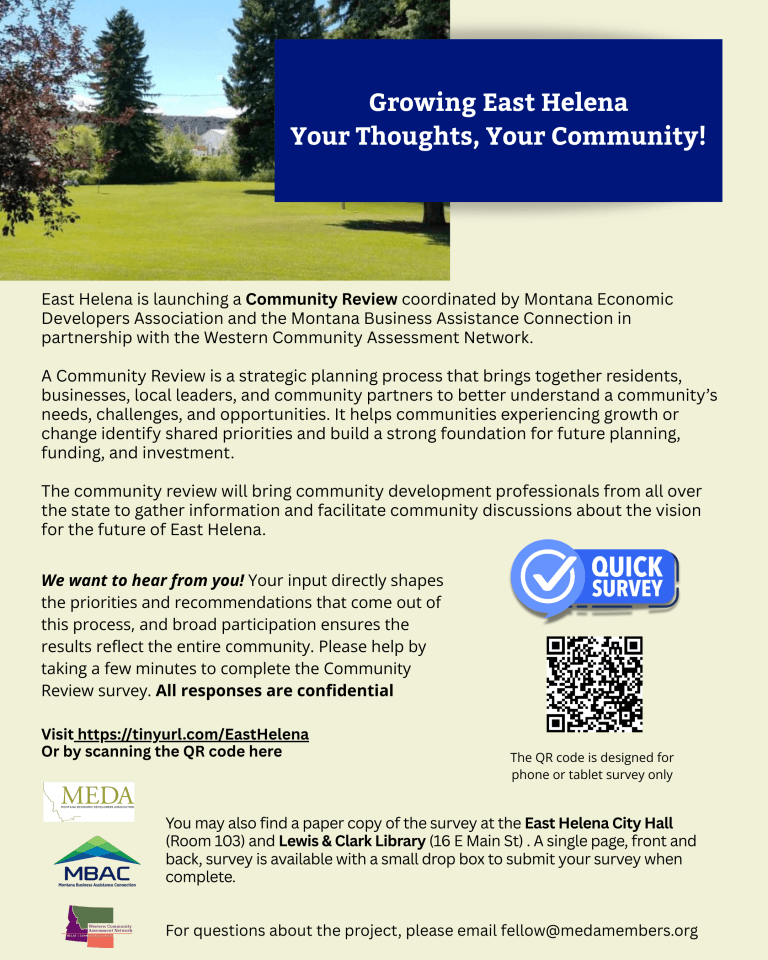
East Helena is asking residents to help decide how much growth the city can absorb before new housing, traffic and infrastructure strain its small-town feel. The community review now underway drew 489 survey responses, 109 listening-session participants across eight sessions, and 60 residents who signed up to stay involved, showing strong interest in how the city should change.
The review is being led by a partnership that includes the Montana Business Assistance Connection, the Montana Economic Developers Association, the Western Community Assessment Network and the Western Rural Development Center. Its first phase focused on public input, and a town hall identified three priority focus areas for the next round of work. Phase 2 is planned for summer 2026, with Phase 3 expected to move into coaching, technical assistance or mini-grants.
Keeping East Helena’s identity and character came through as a major priority, a telling result in a city of roughly 1,700 to 2,000 people just six miles from Helena. That scale matters. Even modest development can ripple through East Helena Public Schools, local roads, water and sewer systems, and the day-to-day feel of neighborhoods that have long been shaped by a tighter community layout than nearby Helena.
Small-business owners are pushing to be part of that conversation. Galaxy Roasting owner Kevin Schulte got involved because he believes local businesses need a seat at the table when major changes are coming. Schulte said he wants a thriving downtown that still feels like East Helena and preserves the family-oriented quality he values in the city.
The planning discussion is unfolding against a longer history of land-use decisions. East Helena first adopted a growth policy in 2009, updated it in 2014 and went through another public update process in 2020 and early 2021. Lewis and Clark County approved an updated county growth policy in July 2025 after a two-year public process, but East Helena is excluded from that countywide policy, leaving the city to chart much of its own course.
That local planning work also sits beside a heavy environmental legacy at the former ASARCO lead smelter site. The smelter operated from 1888 to 2001, and the East Helena Superfund site was added to the National Priorities List in 1984. The U.S. Environmental Protection Agency lowered the residential soil-lead cleanup level from 500 parts per million to 400 parts per million in January 2024 and announced $40 million in additional funding in February 2024 for yard cleanup, with hundreds of properties, alleyways and road aprons already cleaned up. As East Helena weighs growth, it is doing so while redevelopment, remediation and the city’s identity all pull on the same landscape.
This article was produced by Prism’s automated news system from verified source data, official records, and press releases, then run through automated quality and moderation checks before publishing. The system is built and supervised by the people who set the standards it runs under. Read our full AI policy.
Did this article answer your question?