Montana State Capitol offers tours, history and family-friendly visits
Free tours, kids’ scavenger hunts and a 43-minute video make the Montana State Capitol an easy Helena stop, even during summer 2026 construction.
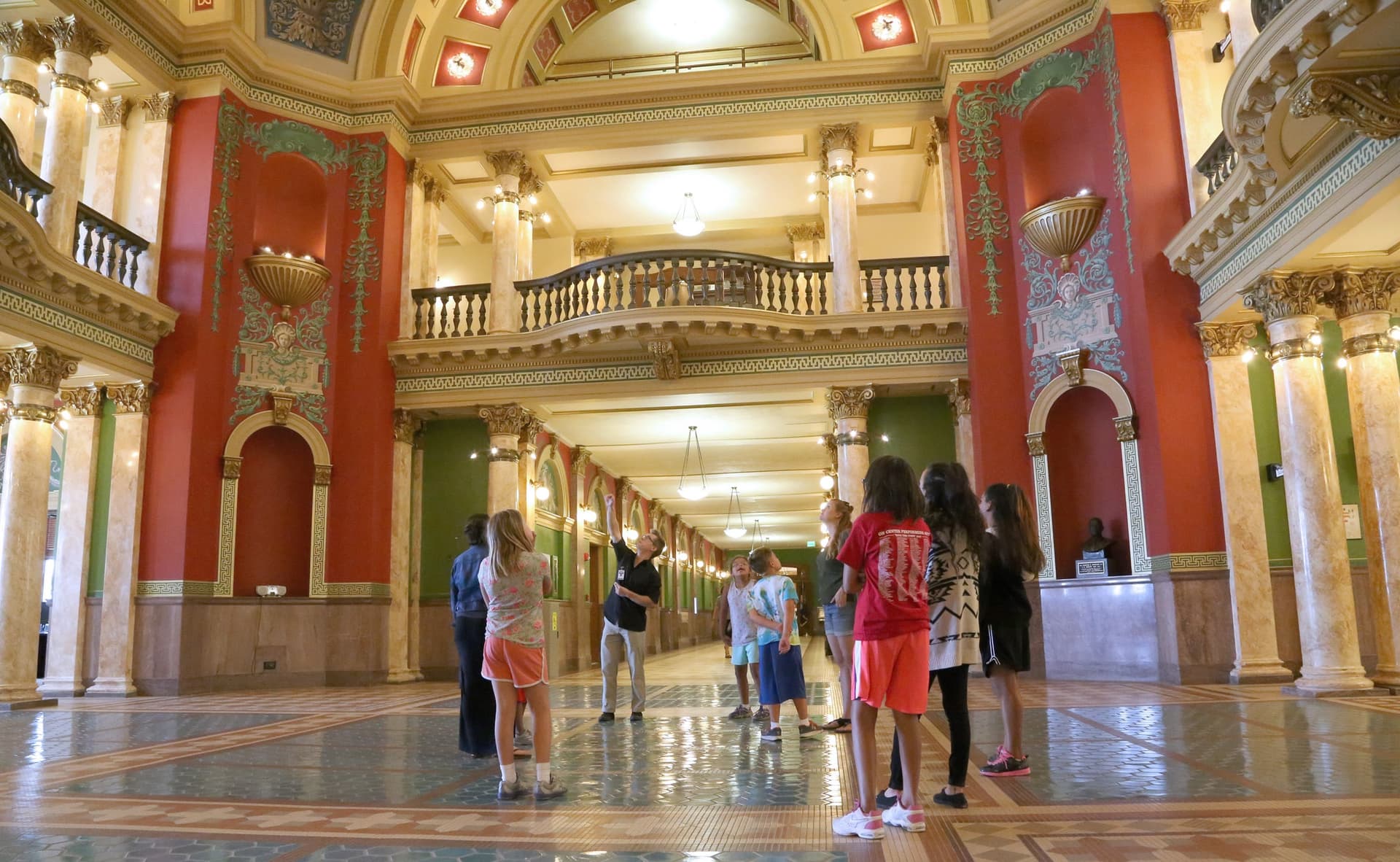
The easiest way to miss the Montana State Capitol is to walk in for the architecture and leave with a scavenger hunt in hand. At 1301 East 6th Ave. in Helena, the statehouse is open for self-guided visits during business hours, and the first-floor information desk is where guided tours begin, along with booklets and a family-friendly search led by Seaman, Lewis and Clark’s Newfoundland.
Start at the first-floor desk
The Capitol works well as a drop-in stop because the Montana Historical Society keeps the experience simple: visitors can arrive during business hours, pick up a self-guiding tour booklet, and follow the building at their own pace. Families with children have a second option right at the same desk, where the scavenger hunt turns the visit into a way to spot details instead of just walking past them.
That same front-door access matters for people planning around a full day in Helena. The building remains open to the public even with scheduled summer 2026 construction, so a visit does not depend on waiting for a quieter season or a special event. For anyone who cannot make it to downtown Helena, the Historical Society also offers a 43-minute video tour and a virtual tour, which makes the Capitol one of the easiest civic landmarks in Montana to see in person or from home.
What the building rewards you for noticing
The Capitol’s biggest surprise is how much of its story is built into the structure itself. The building is listed in the National Register of Historic Places and was built in two phases, with the main Capitol completed in 1902 and east and west wings finished in 1912. Those additions were designed by Helena architects John Link and Charles Haire, and the finished building reflects the late-19th-century American Renaissance movement, with a neoclassical look that gives the statehouse its formal presence on the Helena skyline.
Look up and the details become even more specific. The dome is faced with copper and rises 165 feet, and the figure at the top is named Montana, sculpted by Edward VanLandeghem. Inside, the design is identified as French Renaissance work by F. Pedretti’s Sons of Cincinnati, Ohio, a reminder that the Capitol was meant to project national style as well as state pride.
The art program adds another layer that is easy to miss if you only pass through the rotunda. Murals by Charles M. Russell, Edgar S. Paxson and Ralph E. DeCamp anchor the building’s original art legacy in the spaces created by the later additions. In the Capitol campus context, the modern tribal flag plaza recognized in 2019 adds a newer public expression to a building that has always been about who Montana includes, not just where lawmakers meet.
Why Helena ended up here
The Capitol makes more sense when you follow the chronology that led to it. Lewis and Clark passed through the area in 1805, gold was discovered at Last Chance Gulch in 1864, Helena became territorial capital in 1875 and Montana achieved statehood in 1889. Voters then had to settle the permanent-capital question, and Helena won that fight in 1894 after a contest that the Montana Historical Society describes as one of the ugliest and most corrupt in the state’s history.
That 1894 battle narrowed to Helena and Anaconda, and it was tangled up in the Copper King era, when economic power and political influence often moved together. The Capitol’s construction also reflects that world. Mining magnate Thomas Cruse bought the bonds that financed the building, a detail that shows how the statehouse rose not just from civic ambition but from the financial realities of late-19th-century Montana.
Construction began in 1899, the main building was dedicated on July 4, 1902, and the completed wings later gave the structure its larger footprint. The result is a building that still explains Helena’s place in Montana life better than any plaque can: the statehouse is where the capital decision hardened into stone, copper, murals and public space.
How to use the Capitol as a local stop
For Helena residents and anyone passing through Lewis and Clark County, the Capitol functions as more than a government building. It is one of the city’s easiest free attractions, and it works for quick visits as well as slower walks through state history. Because the Historical Society keeps the building open during the week and on weekends, it fits around errands, school-day outings and out-of-town guests without much planning.
A practical visit usually looks like this:
- Start at the first-floor information desk for guided-tour details.
- Pick up the self-guiding booklet if you want to move at your own pace.
- Ask for the kids’ scavenger hunt if you are visiting with family.
- Plan extra time to look up at the dome, the murals and the interior finishes.
- Use the virtual tour or 43-minute video if you are comparing what you see on site with what the building contains.
The Capitol still works because it is both a working seat of government and a public room Helena can use every day. Its history reaches back to statehood fights, railroad-era ambition and Copper King politics, but its present-day value is simpler: it remains open, free to enter and easy to share with visitors who want one stop that combines art, architecture and the story of how Montana chose its capital.
This article was produced by Prism’s automated news system from verified source data, official records, and press releases, then run through automated quality and moderation checks before publishing. The system is built and supervised by the people who set the standards it runs under. Read our full AI policy.
Did this article answer your question?