Federal Rule Changes Would Loosen Radiation Protections at LANL, Nationwide
The DOE dropped its 'as low as reasonably achievable' radiation standard in January, and an NNSA official has since confirmed LANL will allow workers higher annual doses as pit production expands.

The Department of Energy's radiation protection framework changed fundamentally on January 12, when Energy Secretary Chris Wright announced the agency was eliminating "as low as reasonably achievable," the ALARA principle that for decades had required DOE sites, including Los Alamos National Laboratory, to drive worker and public radiation exposures toward the lowest levels practical, not merely below the statutory ceiling. An NNSA official has since confirmed that LANL will allow workers to receive additional annual dose, a change that arrives as the laboratory expands its plutonium pit production mission and its contractor workforce.
ALARA was not a fixed number; it was an ongoing obligation to reduce dose through engineering controls, respiratory protection, and work restrictions whenever doing so was reasonably achievable. At LANL, where technicians and tradespeople work alongside scientists at the Plutonium Processing and Handling Facility and related radiological areas, that obligation determined when additional protective measures were required. Without it, the 5 rem statutory ceiling becomes the only operative limit.
The gap between where workers have actually been and where they could legally go is wide. In 2024, the DOE monitored close to 85,000 workers across its complex for radiation exposure. Of the roughly one in five who received any detectable dose, the average measured exposure was 1 percent of the 5 rem statutory limit. Across all DOE sites in a five-year span, just one worker received a dose exceeding 2 rem, and that single incident occurred at LANL's Plutonium Processing and Handling Facility. The watchdog Los Alamos Study Group has reported that LANL's internal administrative control levels have been loosened fivefold under the new directives, narrowing the buffer between daily practice and the statutory ceiling.
The Nuclear Regulatory Commission is moving in the same direction. Under an executive order requiring wholesale revision of its regulations, the NRC has said it is considering eliminating ALARA from Part 20, the half-century-old standard governing occupational and public exposure. A proposed rule is expected for public comment by April 30.
The shift traces directly to the White House. President Trump signed four executive orders last May aimed at what he called an industry "atrophied" by regulation, and Executive Order 14300 specifically criticized ALARA as lacking sound scientific basis. Researchers at Idaho National Laboratory followed with a report recommending the 5,000 millirem annual limit be kept with no ALARA requirements below it; DOE moved quickly to align.
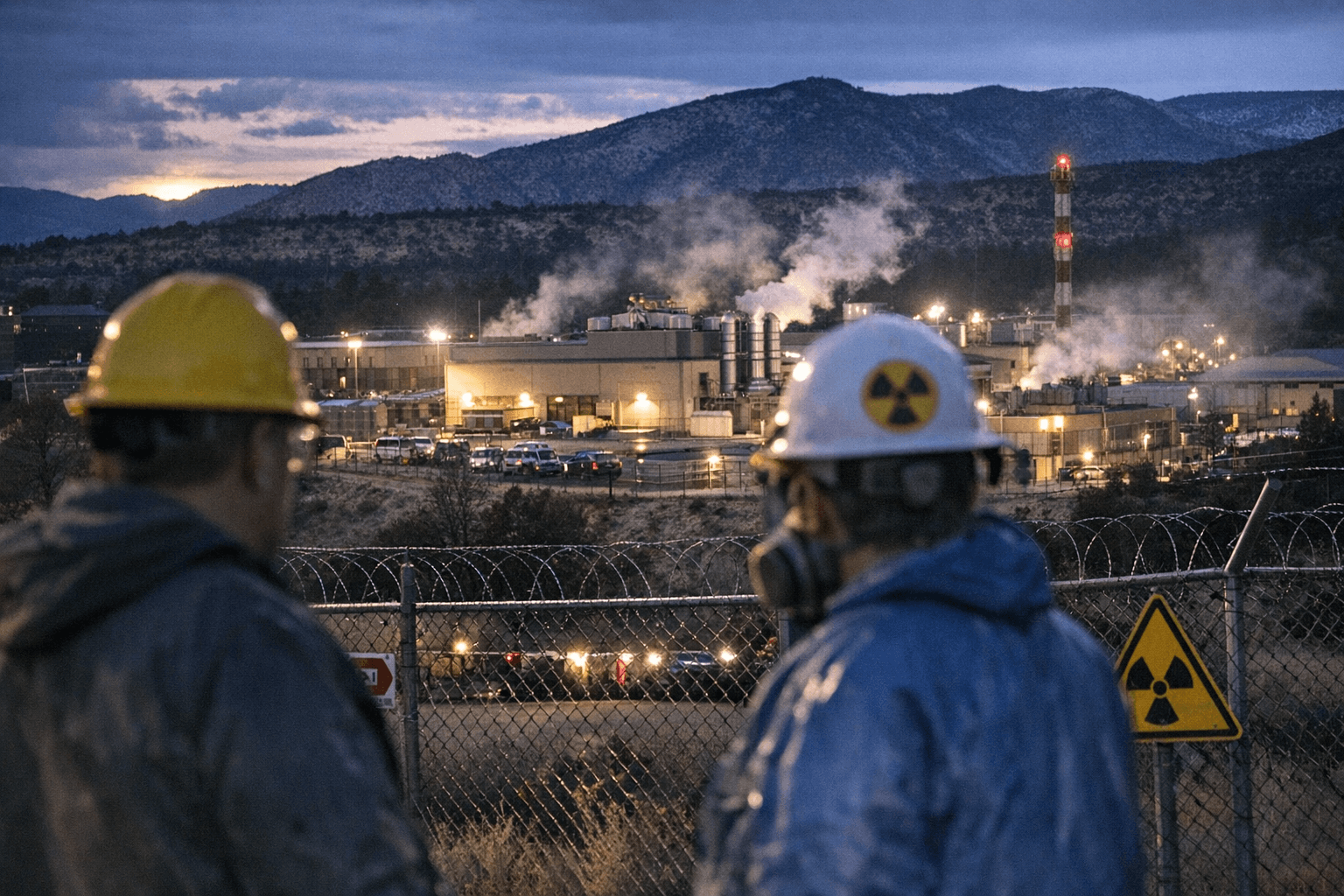
Worker advocates have pushed back sharply. Bradley Clawson, a retired nuclear worker who serves on the Centers for Disease Control advisory board on radiation and workers, said the rollback targets the practices that kept his occupational dose manageable. "They're pulling away from what's kept us safe all these years," Clawson said, speaking in a personal capacity. A coalition of scientists, physicians and community advocates filed a joint letter calling the changes an unacceptable sidelining of scientific standards in favor of industry priorities. The United Steelworkers union separately said it is committed to standards it described as "Gold Standard Science."
Those stakes fall hardest on workers with the least institutional protection. LANL is adding craft trades workers, subcontractors, and support personnel as its mission expands, and those workers' radiological monitoring resources typically lag behind those of cleared laboratory staff. For nearby Pueblos and county residents who have pressed for transparency in LANL's radiological footprint, the loss of ALARA also removes a concrete public benchmark: it required demonstrable effort toward minimization, not just a number declared technically not exceeded.
What independent monitoring or dose-reporting requirements will replace that obligation is the question county emergency management, tribal governments, and labor representatives have not yet received an answer to.
This article was produced by Prism’s automated news system from verified source data, official records, and press releases, then run through automated quality and moderation checks before publishing. The system is built and supervised by the people who set the standards it runs under. Read our full AI policy.
Did this article answer your question?