How Los Alamos residents can access public records, meetings and services
This guide explains where to start and what to expect when seeking Los Alamos County records, attending county meetings, or contacting municipal services, and which county facts still need verification.
1. Purpose of this guide
This guide follows the stated aim that “This evergreen guide explains how Los Alamos County residents and local journalists can find public records, watch or attend county meetings, access municipal services, and contact key offices.” The original overview notes the guide “synthesizes county web resources, meeting calendars, and public‑records portals,” but the supplied Los Alamos County text is truncated and lacks the operational details needed to complete those steps.
2. Jurisdictional difference: why Evergreen (Washington) examples do not equal Los Alamos policy
The materials supplied include classroom‑style public‑records guidance from The Evergreen State College, which explicitly references Washington law: “The Washington State Public Records Act, enacted in 1972, guarantees citizens of our state transparency and complete access to government records.” Those Evergreen procedures illustrate a standard public‑institution approach under Washington State law but are not Los Alamos County policy unless the county independently confirms the same timelines, forms, or fees.
3. What counts as a public record (Evergreen’s definition you can use as a model)
As an example from Evergreen: “Public Records include any writing, electronic media, email, video recording and/or other recording and must be an existing and identifiable record.” Evergreen also states that “Any record created by an employee or representative of the state as part of their official duties or using state resources is a potential public record.” Use these definitions as a model to frame requests, but verify New Mexico/Los Alamos definitions against the New Mexico Inspection of Public Records Act or county code before relying on them.
4. How to request public records (Evergreen’s procedural model you can follow, pending Los Alamos verification)
Evergreen’s guidance reads: “Public records may be requested by contacting the Public Records Officer using the contact information at the top of this page or by submitting a records request via our Records Request Form.” The Evergreen pages reference a “Public Records Request Form” and a public‑records workflow. Evergreen states: “Within five business day of receipt of the request, you will either receive the record or will be contacted in writing.” Written responses, per Evergreen, will either acknowledge the request and provide an availability date, deny with explanation, or ask for clarification; confirm whether Los Alamos County uses the same approach and whether its timeline is identical.
5. What to expect after you submit a request (timing, responses and large requests, Evergreen sample)
Evergreen outlines three possible written responses: acknowledgement with a date, denial with explanation, or a request for clarification: “Written responses will be to acknowledge the request and provide a date the records will be available, to deny the request with an explanation of the denial, or to ask for further clarification.” Evergreen further warns: “Please keep in mind the College's response time will depend on the number of public record requests being processed by the College, how many records are responsive to the request, how old the records being requested are, and how specific the request is.” For very large requests, “the College may provide documents to citizens on an installment basis.” Treat these as a useful template; obtain Los Alamos County’s actual timelines and installment policy before planning large productions.
6. How to watch or attend Los Alamos County meetings (what’s missing and what to verify)
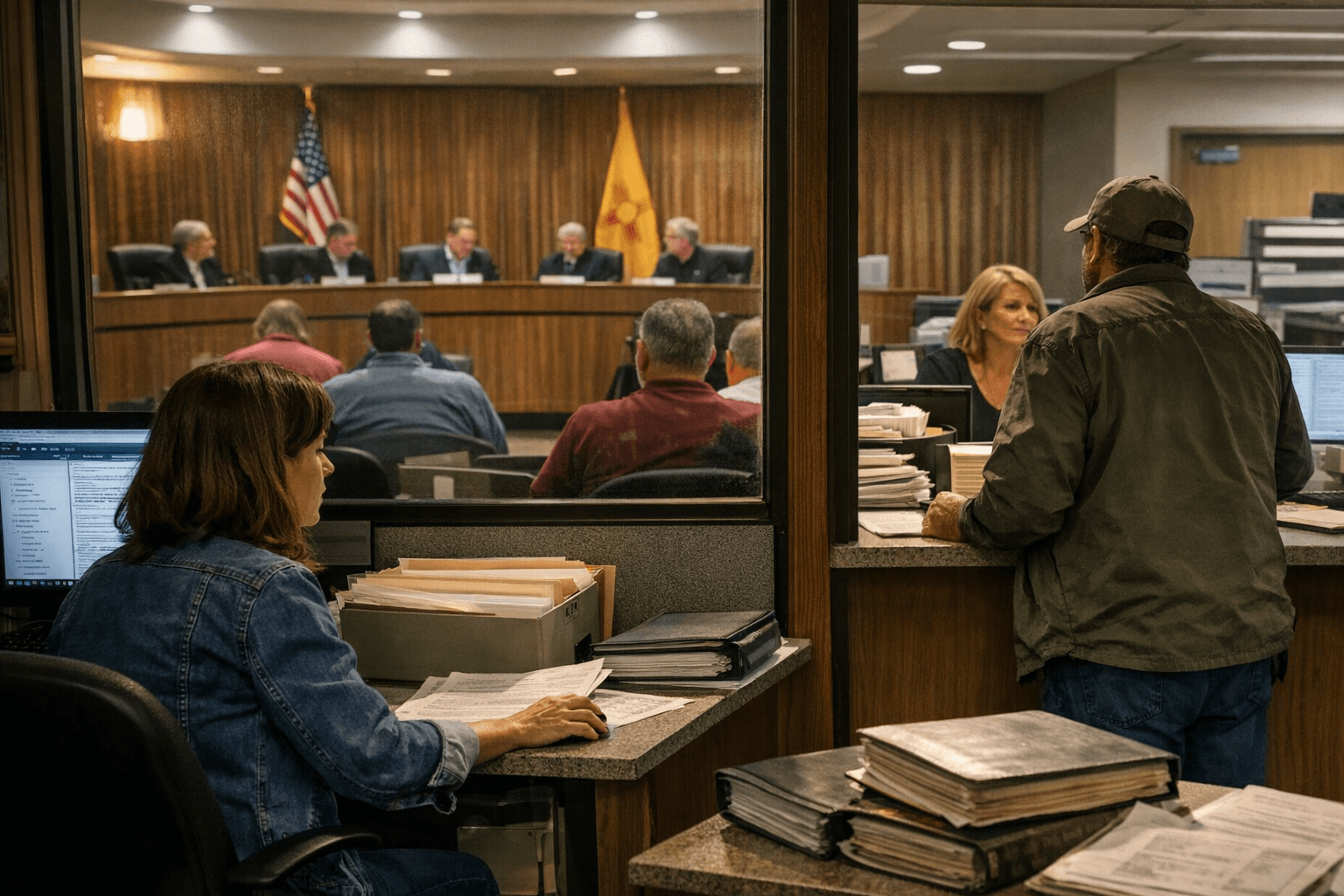
The Los Alamos overview affirms the guide will show how to “watch or attend county meetings,” but the supplied material contains no schedule, streaming links, meeting locations, or public‑comment rules. Before publishing definitive instructions, obtain the county meeting calendar, the list of meeting venues (for example council chambers or library meeting rooms), whether meetings are streamed or posted as recordings, how agenda packets are distributed, and the county’s public‑comment procedures and time limits.
7. How to access municipal services and contact key offices (missing contact and process details)
The overview promises to explain how to “access municipal services, and contact key offices,” yet no names, phone numbers, office hours, or forms are present in the supplied excerpt. Reporters and residents should request from the county: the Public Records Officer’s name and contact information, County Clerk/Manager contact, legal counsel contact for records questions, and municipal services office locations and hours. Do not publish procedural steps or contact details until the county provides these specifics.
- Be precise about what you want: evergreen guidance emphasizes specificity because response time “will depend on … how specific the request is.”
- Expect an initial written acknowledgement or a denial: Evergreen’s model guarantees one of three written responses “Within five business day of receipt of the request.” Note the supplied Evergreen phrase uses “day” singular; confirm the county’s exact statutory language and number of days.
- Break large requests into narrower batches: Evergreen notes “the College may provide documents to citizens on an installment basis,” a useful strategy to accelerate early deliveries.
- Ask the county what fees and formats it uses, paper copies, electronic delivery, or vendor portals, before assuming cost or turnaround.
8. Practical tips for making effective records and meeting requests (checklist and short tactics)
- Los Alamos overview fragment: “This evergreen guide explains how Los Alamos County residents and local journalists can find public records, watch or attend county meetings, access municipal services, and contact key offices. It synthesizes county web resources, meeting calendars, and public‑records portals to create a p”, note this sentence is truncated in the supplied material and must be confirmed before printing as complete.
- Evergreen State College quotes you may use exactly: “The Washington State Public Records Act, enacted in 1972, guarantees citizens of our state transparency and complete access to government records.” “Public Records include any writing, electronic media, email, video recording and/or other recording and must be an existing and identifiable record.” “Any record created by an employee or representative of the state as part of their official duties or using state resources is a potential public record. Read the full text of the act.” “Public records may be requested by contacting the Public Records Officer using the contact information at the top of this page or by submitting a records request via our Records Request Form.” “Within five business day of receipt of the request, you will either receive the record or will be contacted in writing. Written responses will be to acknowledge the request and provide a date the records will be available, to deny the request with an explanation of the denial, or to ask for further clarification.” “Please keep in mind the College's response time will depend on the number of public record requests being processed by the College, how many records are responsive to the request, how old the records being requested are, and how specific the request is.” “For large requests, the College may provide documents to citizens on an installment basis.”
9. Exact quotes available to reuse (preserve wording and truncation)
The research supplies specific language you may use verbatim:
- The Los Alamos County Public Records Officer’s name, title, email, phone and mailing address.
- The county’s official public‑records policy or ordinance and any downloadable “Public Records Request Form.”
- The statutory authority that governs county records requests (for example the New Mexico Inspection of Public Records Act) and the county’s stated response timelines and fee schedule.
- Meeting calendars, agenda distribution policy, streaming or location details, and public‑comment rules.
- The county’s policy on large requests, installment delivery, and accepted formats (electronic vs. paper).
10. Items a reporter (or an enterprising resident) must obtain from Los Alamos County before publishing verified procedures
11. Next steps and final guidance
Treat the Evergreen materials as a clear and serviceable model for how a public institution manages requests under Washington law, but confirm every timeline, contact, and form with Los Alamos County before telling residents to act. Obtain the checklist items above from county officials or published county pages, then replace placeholders with verified names, links, and statutory citations to produce a fully operational local guide residents and local journalists can rely on.
This article was produced by Prism’s automated news system from verified source data, official records, and press releases, then run through automated quality and moderation checks before publishing. The system is built and supervised by the people who set the standards it runs under. Read our full AI policy.
Did this article answer your question?