LANL Researchers Set New Limits on Neutrino Mass in Underground Experiment
Los Alamos researchers helped set a record sensitivity in the hunt for a decay so rare its half-life exceeds the age of the universe by nearly 14 quadrillion times.
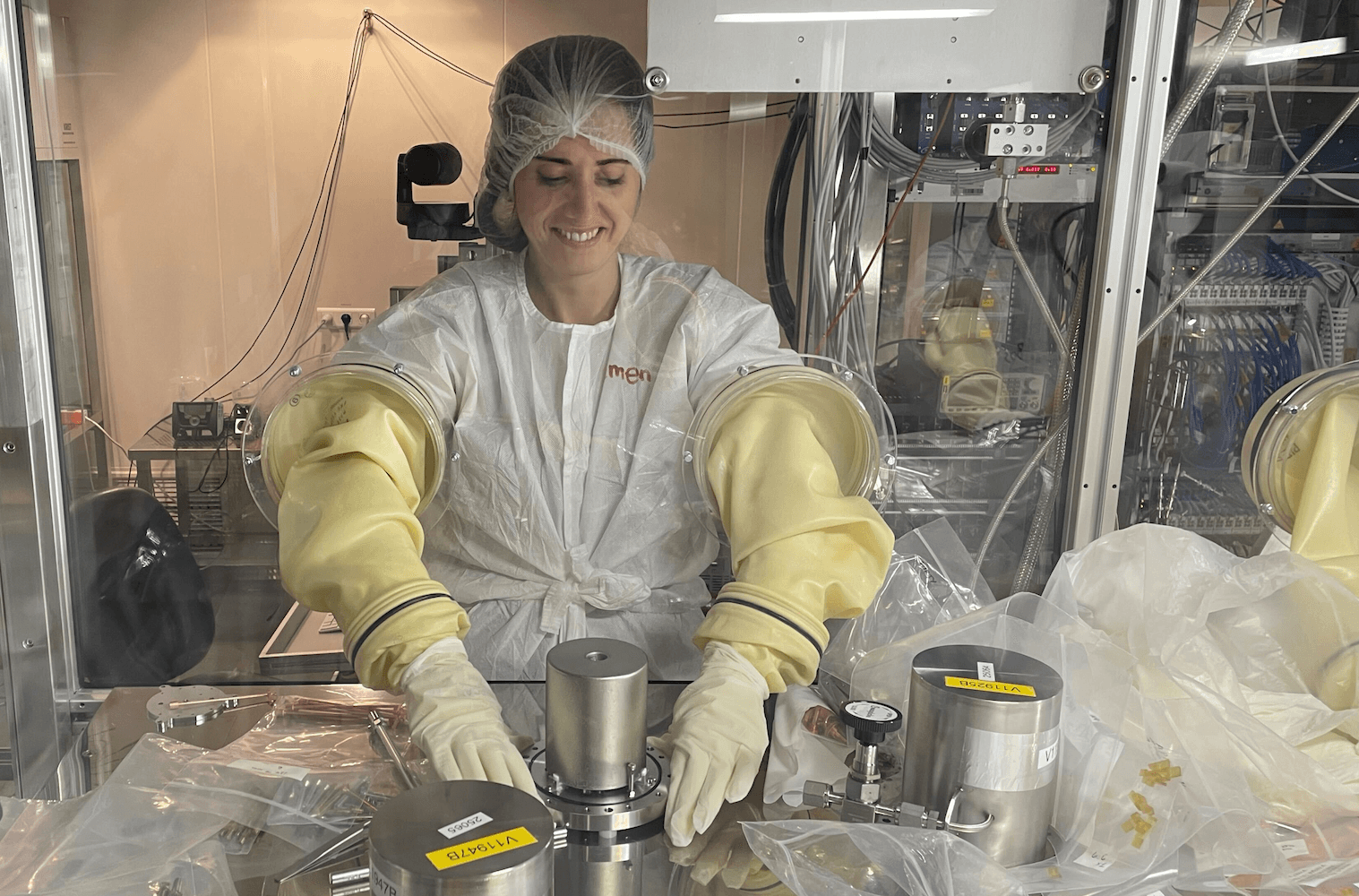
Scientists at Los Alamos National Laboratory contributed to a landmark underground physics experiment that placed the tightest-ever constraints on a hypothetical nuclear decay, advancing the case for a far larger detector that is now the only ton-scale project in the United States cleared to pursue formal DOE funding.
The result came from LEGEND-200, the first stage of the international Large Enriched Germanium Experiment for Neutrinoless Double-Beta Decay collaboration. The findings were published in Physical Review Letters on January 16, with LANL's Science, Technology, and Engineering Highlights newsletter highlighting the local contribution on March 27. LANL physicist S.R. Elliott, whose group works in the laboratory's Neutron Science and Technology division, was among the named authors.
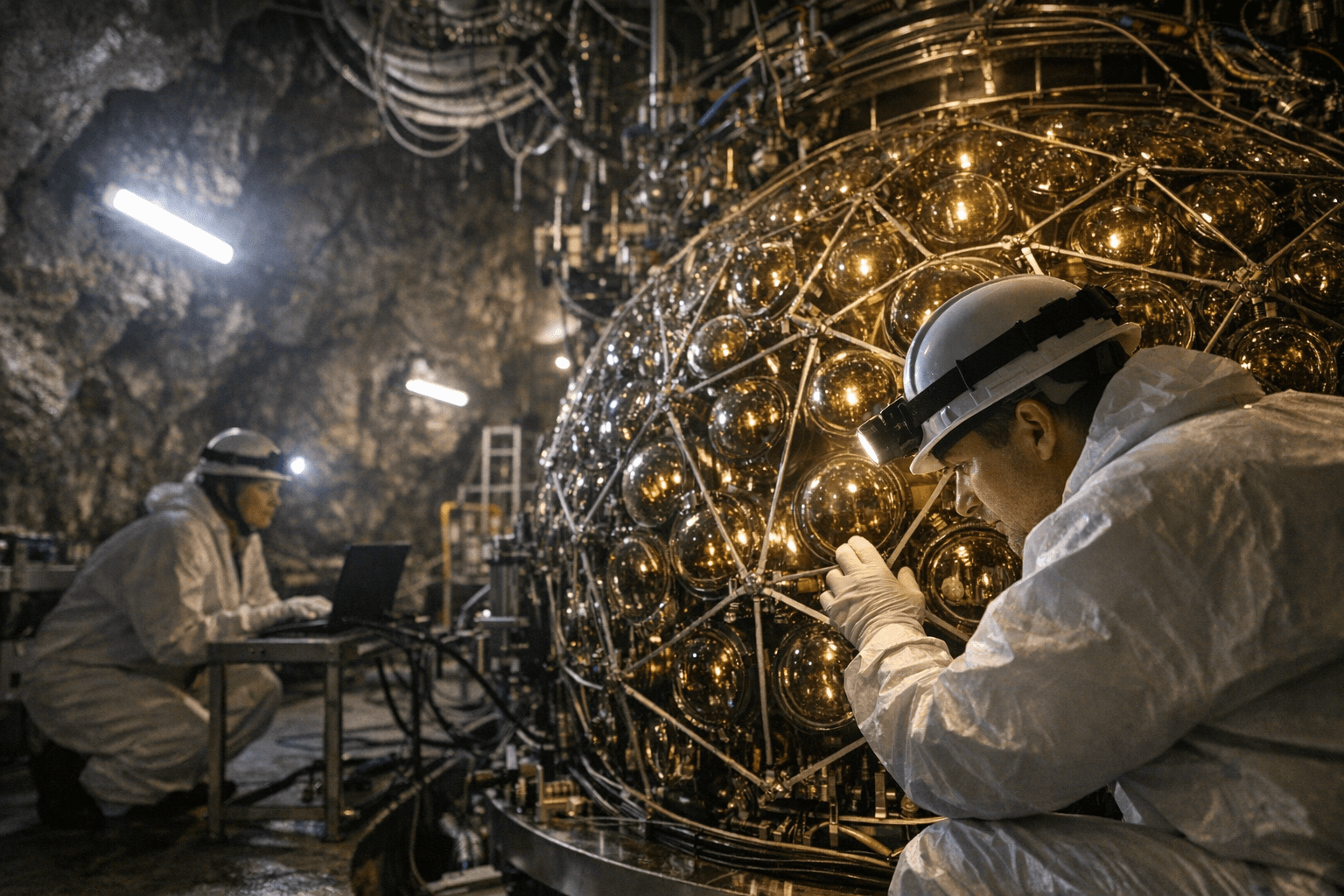
Working roughly 1,400 meters beneath Italy's Gran Sasso mountains at the INFN Gran Sasso National Laboratory, the collaboration deployed 142.5 kilograms of high-purity germanium detectors enriched in germanium-76 and submerged in liquid argon. The mountain overburden strips away the cosmic-ray background that would otherwise flood any signal. LANL's contribution spanned detector installation, operation, and data analysis during approximately one year of physics-quality data-taking that began in 2023.
The experiment searched for neutrinoless double-beta decay, a process in which two neutrons inside a germanium-76 nucleus convert simultaneously into protons, emitting two electrons but absolutely no neutrinos. Standard physics permits a related process that produces two neutrinos; the neutrinoless version has never been observed. Detecting it would prove that neutrinos are Majorana particles, each serving as its own antiparticle, and could illuminate why the observable universe contains matter rather than equal parts matter and antimatter.
LEGEND-200 found no evidence of the decay in its first-year dataset. That absence is itself a scientific achievement: it constrains the half-life of the process, if it occurs at all, to more than 0.5 times 10 to the 26th years at 90 percent confidence. Combined with legacy data from the GERDA and Majorana Demonstrator experiments, the limit strengthens to 1.9 times 10 to the 26th years, the world's best. For perspective, the universe itself is roughly 13.8 billion years old; that combined half-life floor is nearly 14 quadrillion times longer.
LANL noted the sensitivity was reached in a fraction of the time comparable predecessor experiments required, a metric that directly supports the proposal for LEGEND-1000. That successor would field approximately 1,000 kilograms of detectors for a decade, targeting a half-life sensitivity exceeding 10 to the 28th years. It is currently the only ton-scale neutrinoless double-beta decay project approved to apply for DOE Critical Decision-1 status, the formal gateway to project planning and potential construction authorization.
The background-reduction methods and analysis pipelines developed for LEGEND have broader utility, LANL stressed, including applications to nuclear forensics and other safeguards work central to the laboratory's national security mission. Funding for LANL's participation came from the DOE Office of Science's Office of Nuclear Physics and from the laboratory's own Laboratory Directed Research and Development program, a pairing that positions the work squarely at the intersection of frontier physics and applied detector technology Los Alamos has long leveraged for both science and security.
This article was produced by Prism’s automated news system from verified source data, official records, and press releases, then run through automated quality and moderation checks before publishing. The system is built and supervised by the people who set the standards it runs under. Read our full AI policy.
Did this article answer your question?