LANL Researchers Test Fiber-Optic Cables as Moonquake Detection Tools
LANL scientist Carly Donahue tested fiber-optic cables in simulated moon dirt to detect quakes, potentially replacing costly seismometers for future lunar missions.
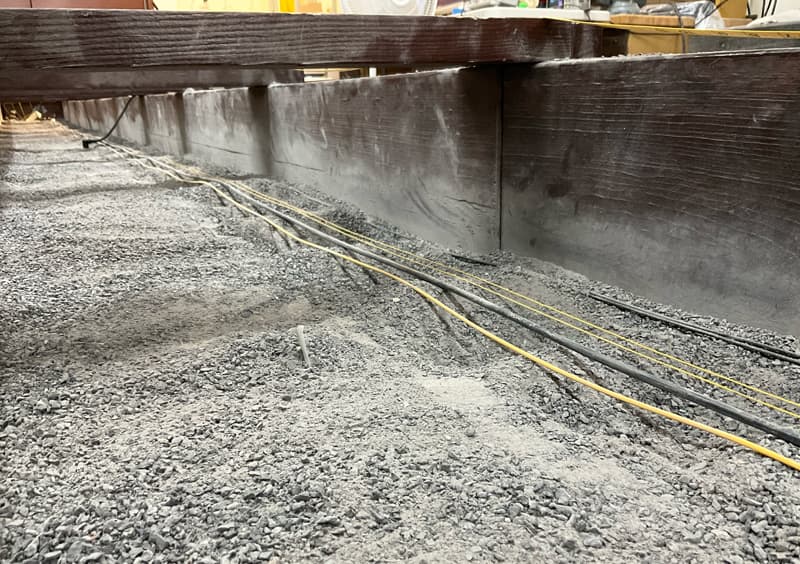
Carly Donahue wanted to know if something as mundane as a fiber-optic cable could solve one of lunar science's persistent headaches: getting seismic data from a place where deploying traditional instruments is ruinously expensive.
"The moon has a lot of seismic activity, but deploying traditional seismic sensors like seismometers is extremely difficult and costly," said Donahue, a scientist at Los Alamos National Laboratory and corresponding author on two new studies examining the question. "Fiber-optic cables are lightweight, robust and inexpensive, so we wondered: Could they be used on the surface of the moon to detect seismic activity there?"
The two studies, published in the journals Icarus and Earth and Space Science and described in a March 17 LANL research feature, suggest that fiber-optic cables laid directly on the lunar surface could potentially detect moonquakes. The Icarus paper, titled "Earthquake detection in a simulated lunar regolith using distributed acoustic sensing," describes laboratory experiments using simulated lunar soil as the test medium. The second paper, "Controlled Source DAS Coupling Tests: Implications for Unburied Deployment on the Moon and Earth," examined how well the fiber-optic technique performs when cables are laid on a surface rather than buried, with direct implications for any eventual lunar deployment.
Both studies apply a technique called Distributed Acoustic Sensing, or DAS. Rather than relying on a single seismometer at a fixed point, DAS turns an entire length of fiber-optic cable into a continuous chain of sensors. A device called an interrogator fires laser pulses down the cable; when those pulses strike microscopic imperfections in the fiber, they scatter and return to the source through a process known as Rayleigh backscattering. Even faint seismic waves can shift the cable's geometry, altering which imperfections the pulses hit. Researchers then analyze changes in the reflected signals' amplitude, frequency, and arrival time to identify seismic events.
LANL scientists have already demonstrated the technique on Earth. A team led by Loïc Viens used a 50-kilometer stretch of fiber-optic cable owned by Cordova Telecom Cooperative, running underwater between Cordova and Valdez, Alaska, to detect controlled demolitions carried out onshore in Cordova to clear ground for an oil spill response facility and a new road. Brent Delbridge presented that work at the Seismological Society of America's annual meeting in Baltimore, April 14 through 18, 2024.
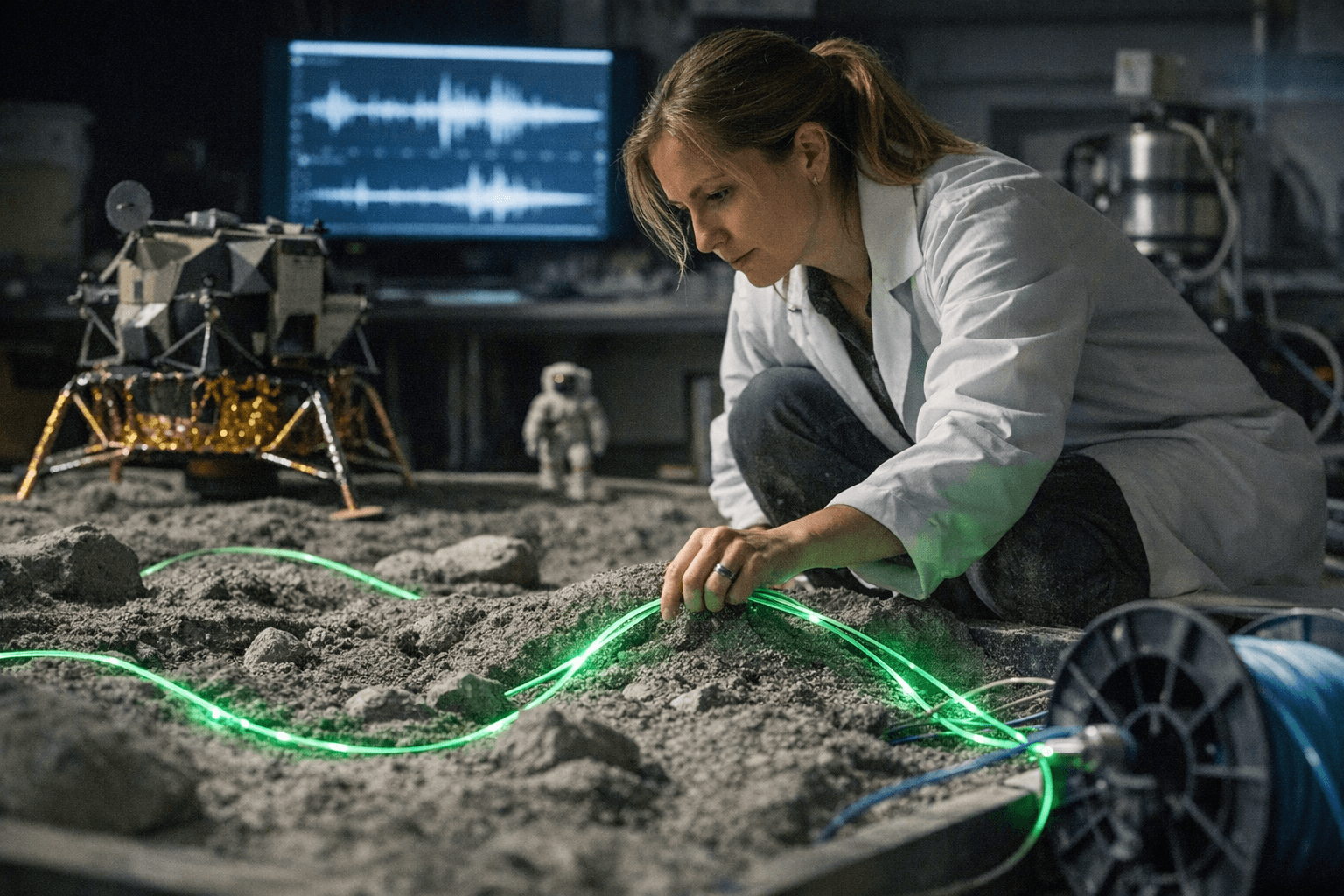
That Earth-based proof of concept helps motivate the lunar application. Traditional seismic sensors cover only single points and require dedicated infrastructure; DAS repurposes existing cables to enable wide-area, continuous monitoring at a fraction of the cost. On the Moon, where no telecommunications grid exists to borrow from, cables would need to be laid fresh, but Donahue's point about weight and cost still holds: a spool of fiber-optic cable is far simpler cargo than a network of seismometers.
The research was funded by LANL's Center for Space and Earth Science and the Laboratory Directed Research and Development fund. Neither paper claims that DAS has detected moonquakes on the actual lunar surface; the studies use hedged language throughout, describing what fiber-optic cables "could potentially" do. The next step, unaddressed in the current publications, would be testing whether the cables and their interrogator hardware can survive the Moon's thermal cycling, vacuum conditions, and radiation environment.
Questions about the research can be directed to LANL Media Relations at media_relations@lanl.gov.
This article was produced by Prism’s automated news system from verified source data, official records, and press releases, then run through automated quality and moderation checks before publishing. The system is built and supervised by the people who set the standards it runs under. Read our full AI policy.
Did this article answer your question?