LANL Scientists Reshape Quantum Arrow of Time, Advancing Quantum Technologies
A Los Alamos physicist and collaborators engineered quantum processes that run backward in time, opening paths to energy harvested from quantum measurements and new quantum state controls.
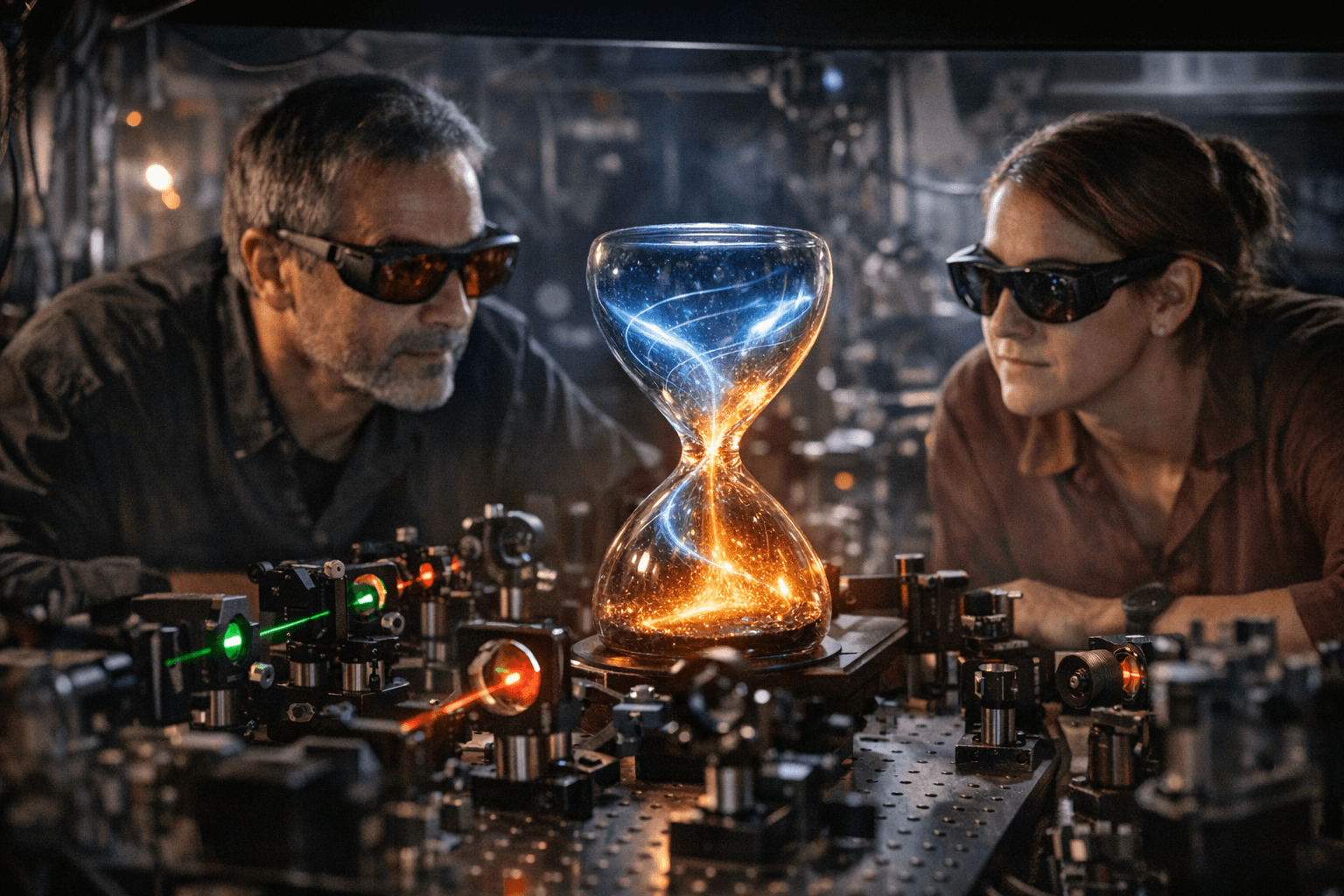
Luis Pedro García-Pintos, a physicist in the Quantum and Condensed Matter Physics Group of the Theoretical Division at Los Alamos National Laboratory, led a team that published a study in *Physical Review X* demonstrating quantum control protocols capable of making quantum systems behave as if time flows in reverse. The paper, co-authored with Yi-Kai Liu of the National Institute of Standards and Technology and the University of Maryland and Alexey V. Gorshkov of the Joint Quantum Institute at NIST and the University of Maryland, carries direct implications for energy extraction, quantum state preparation, and national security applications of quantum technology.
While the microscopic laws of physics are often symmetric under time reversal, most natural processes that we observe are not. The emergent asymmetry between typical and time-reversed processes is what physicists call the arrow of time. In quantum physics, that arrow of time emerges when a sequence of measurements is performed on a system. García-Pintos and his collaborators found a way to engineer around it.
"Unlike phenomena we observe around us, at the microscopic level, most fundamental laws of physics see forward and backward movement in time as physically possible," García-Pintos said. "In other words, those laws of physics are symmetrical under time reversal; the equations work just as well if you reverse time. For quantum systems, which operate at that microscopic level, the tools we've constructed can manipulate the perceived arrow of time, leading to surprising, novel ways to control quantum systems."
The mechanism at the heart of the research is a purpose-built control Hamiltonian. The researchers created a control Hamiltonian, a series of fields and pulses, to simulate the impact of measurements. Using that Hamiltonian in a feedback mechanism, they could cancel, magnify, or overcompensate for measurement imperfections, resulting in new trajectories more consistent with time flowing backward than forward. In this study, the researchers used measurements combined with feedback to generate time-reversed stochastic trajectories, causing quantum systems to behave as though they are evolving backward in time.
As an application of their research, the team leveraged their control protocols to design a measurement engine that extracts energy from quantum measurements performed on the system. That extracted energy, according to the research, could power other quantum processes or be stored in a quantum battery. The work also opens up possibilities for quantum state preparation.
The protocols echo a famous 19th-century thought experiment. Maxwell considered a being that, by a careful monitoring-and-feedback process, decreases the total entropy of two gases at different temperatures. Maxwell's "intelligent demon" instigates a process that, while allowed by the laws of physics, is overwhelmingly unlikely to be observed in nature. The reverse of such a process is the one we typically observe. That is, Maxwell's demon exploits measurement and feedback to generate a process consistent with a backward arrow of time. The LANL team's protocols formalize and extend that logic into the quantum domain.
The paper was published February 19, 2026, in *Physical Review X*, under DOI 10.1103/l18s-9vmh. The LANL report number is LA-UR-26-21382. The protocols were designed to generate processes more consistent with time flowing backward than forward.
Experimental verification is the immediate next objective. The team identified superconducting qubits as the preferred platform because the technology allows for rapid feedback and high detection efficiencies, and quantum versions of Maxwell's demon have already been demonstrated there. Next steps will include experimentally demonstrating the use of Hamiltonian measurement processes for quantum feedback control in that setting, with follow-up work aimed at designing quantum state preparation protocols using the new techniques.
The work was funded by the U.S. Department of Energy's Office of Science through its Advanced Scientific Computing Research program, the Beyond Moore's Law project of the Advanced Simulation and Computing Program at Los Alamos, and the National Science Foundation.
This article was produced by Prism’s automated news system from verified source data, official records, and press releases, then run through automated quality and moderation checks before publishing. The system is built and supervised by the people who set the standards it runs under. Read our full AI policy.
Did this article answer your question?