LANL Study Finds Some Quantum Learning Models Can Run on Classical Computers
A LANL study in Nature Communications found that quantum models engineered to sidestep a key training obstacle are often no harder to run than classical computers, reshaping where the lab bets its quantum resources.

A Los Alamos National Laboratory team has delivered an uncomfortable result for the quantum machine-learning field: many of the architectural fixes researchers designed to rescue variational quantum algorithms from a notorious training failure turn out to make those same algorithms trivially runnable on an ordinary classical computer.
The finding, published in Nature Communications by a team led by LANL physicists Marco Cerezo of the Information Sciences group and Martin Larocca of the Theoretical Division, centers on what quantum computing researchers call the barren plateau problem. As variational quantum circuits grow larger, their optimization landscapes go flat: gradients vanish exponentially with the number of qubits, and training stalls completely. The field has invested heavily in workarounds, including layered circuit designs, specialized parameter initialization schemes, and local cost functions engineered to guarantee a trainable landscape.
The LANL team's analysis showed that the same structural constraints that provably eliminate barren plateaus also tend to confine computation to low-dimensional subspaces that a classical algorithm can efficiently navigate. In other words, the cure and the classical simulability share the same root. "We can't continue to copy and paste methods from classical computing into the quantum world," Cerezo said. Larocca, whose Center for Nonlinear Studies appointment reflects the depth of LANL's theoretical investment in the problem, had put it plainly in related work: "Barren plateaus are not the only issue facing variational quantum computing, but it is the main issue at the moment."
The paper stops short of declaring variational quantum computing a dead end. Instead, it calls for a harder reckoning with where quantum hardware genuinely outperforms classical alternatives. The authors recommend rigorous theoretical benchmarks and hybrid classical-quantum workflows that make quantum advantage explicit and verifiable, problem by problem, rather than assumed by architecture.
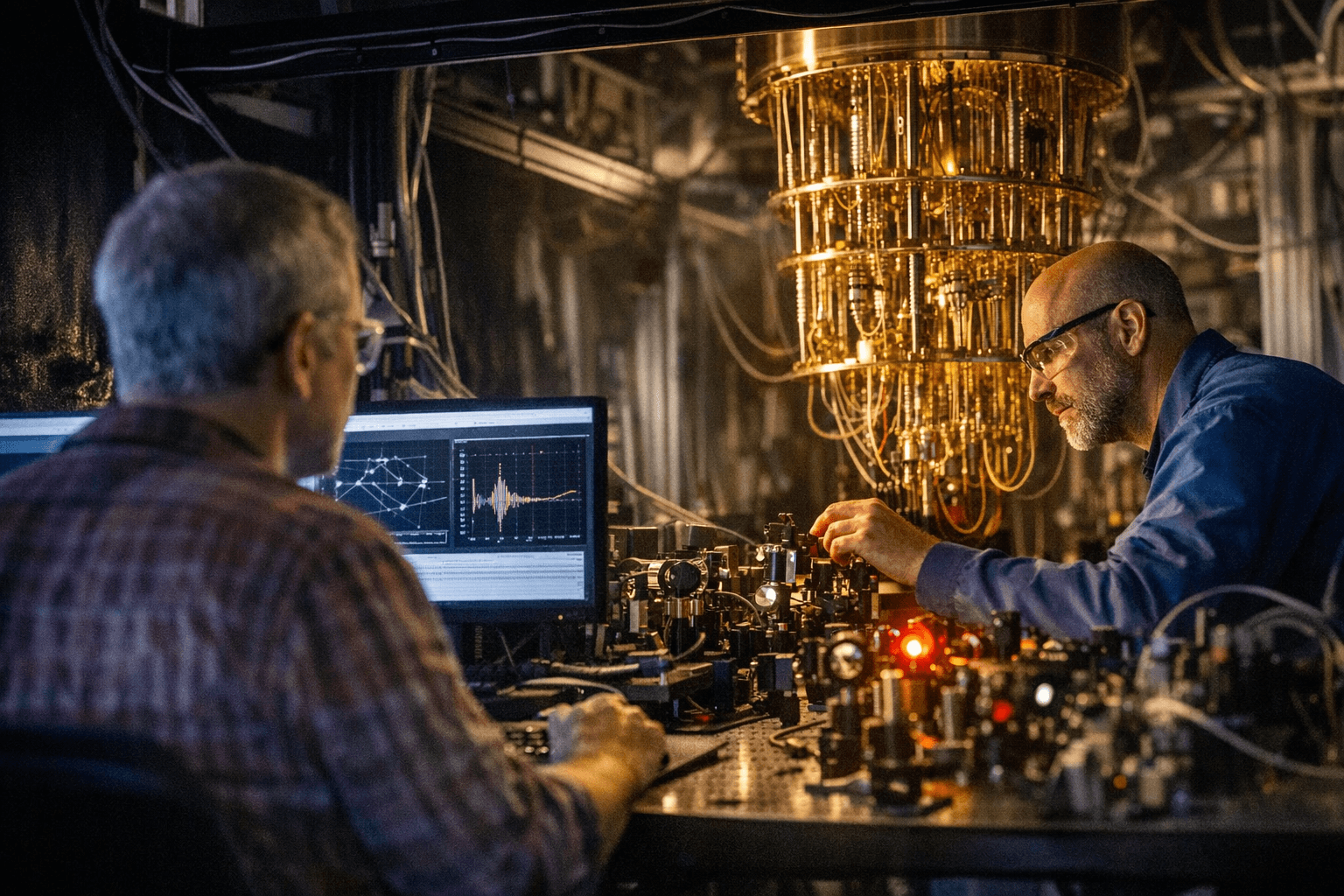
For LANL, which operates within the Quantum Science Center based at Oak Ridge and runs collaborations across government agencies and industry partners, the practical upshot is a sharper filter for resource allocation. Costly quantum hardware time and workforce capacity should flow toward problems where the classical-simulation shortcut demonstrably does not apply, including certain materials science calculations and optimization tasks with no exploitable low-dimensional structure. The laboratory's near-term quantum roadmap will likely shift emphasis away from variational approaches that check the barren-plateau-free box but fail the classical-simulability test.
For companies, university programs, and federal contractors working alongside LANL in northern New Mexico's expanding quantum ecosystem, the study reframes workforce priorities. Talent fluent in both quantum information theory and classical simulation methods will be better positioned to identify where genuine quantum speedups exist than those trained solely on circuit design. The research makes clear that distinguishing true quantum advantage from well-packaged classical computation is itself a core technical skill the region's quantum workforce will need to develop.
Sources:
Know something we missed? Have a correction or additional information?
Submit a Tip