LANL study rethinks powerful gamma-ray bursts as star collapses
LANL scientists say two record-setting gamma-ray bursts fit a star-collapse model, renewing Los Alamos’ role in the field that began with the 1973 Vela detections.
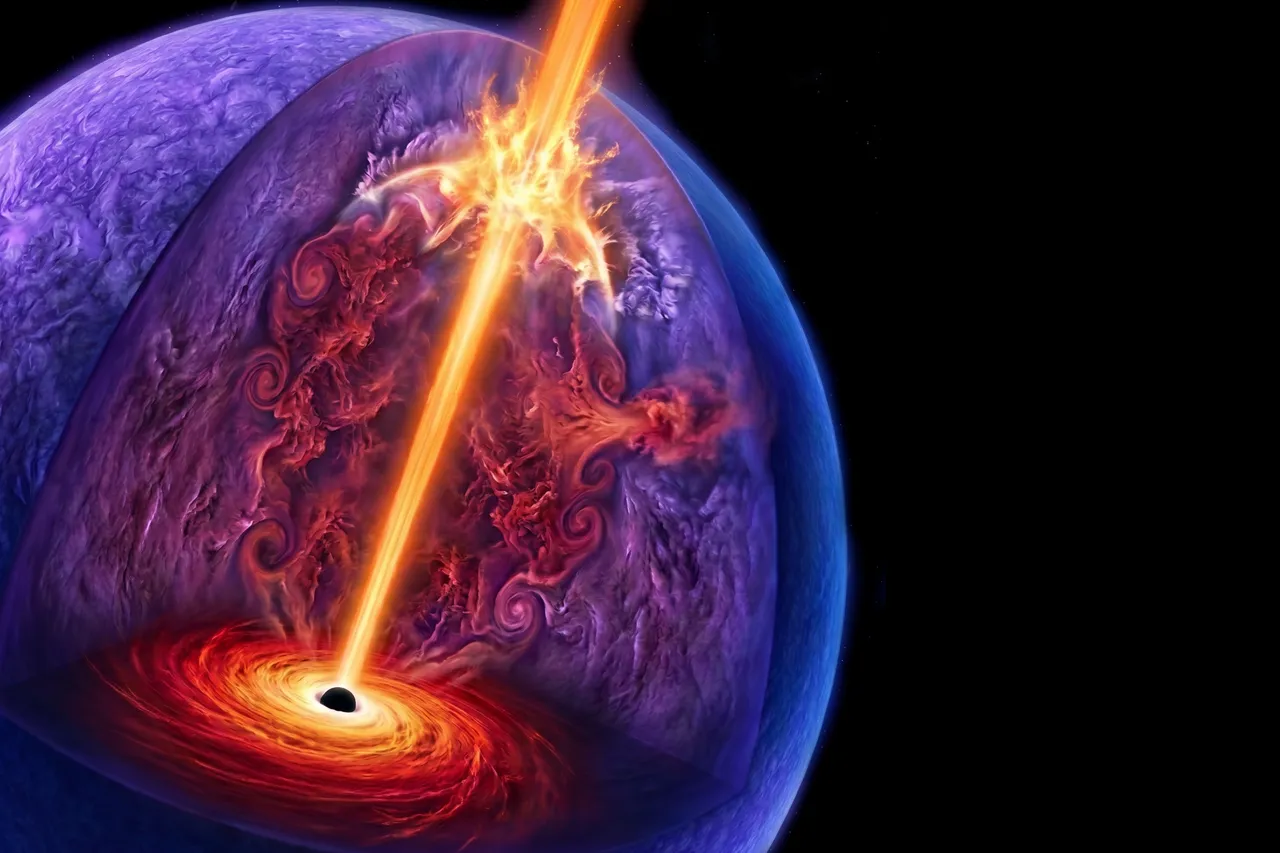
Los Alamos National Laboratory scientists have published a new paper in The Astrophysical Journal Letters arguing that two long gamma-ray bursts, GRB 211211A and GRB 230307A, are consistent with a collapsar explanation rather than a neutron-star merger.
That matters in Los Alamos County because the work ties a current debate in astrophysics directly back to the lab that helped launch the field more than 50 years ago. LANL says Ray Klebesadel’s 1973 paper reported 16 Vela events, and a laboratory retrospective notes that the Vela satellites were built to watch for nuclear detonations in space before they revealed gamma-ray bursts from deep space.

In the new analysis, the team says the bursts fit a scenario in which a massive, fast-spinning star collapses inward, forms a black hole and drives the gamma-ray blast. That reading challenges earlier interpretations that pointed to a compact-object merger, especially after GRB 211211A was linked to a kilonova in follow-up observations and other 2023 work described the pair as a possible new class of long bursts with compact-merger origins.
The two events were anything but ordinary. Fermi’s Gamma-ray Burst Monitor detected GRB 211211A on Dec. 11, 2021, at 13:09:59 UTC, and GRB 230307A on March 7, 2023, at 15:44:06.67 UTC. NASA-related reporting described GRB 211211A as lasting about a minute. GRB 230307A was even more extreme: Fermi-GBM literature calls it the second-highest-fluence gamma-ray burst ever measured, with a fluence of about 6.02 x 10^-3 erg cm^-2 and a duration beyond 100 seconds.
LANL’s new interpretation reaches beyond burst classification. The laboratory says elements heavier than iron, including gold, lead and uranium, are forged through rapid neutron capture in cosmic events, and its scientists said last year that collapsars may offer a new mechanism for that element creation. Postdoctoral fellow Marko Ristić said the extreme densities, temperatures, relativistic effects and time scales make gamma-ray bursts a uniquely difficult problem, which is why a fresh model matters.
The lab’s role does not stop at theory. Its RAPTOR robotic optical telescope system at Fenton Hill near Los Alamos has been used to track cosmic transients, showing that LANL’s gamma-ray burst work spans discovery, follow-up observation and simulation. For Los Alamos, that keeps one of the county’s signature institutions in the center of a high-stakes scientific argument with national and international reach.
This article was produced by Prism’s automated news system from verified source data, official records, and press releases, then run through automated quality and moderation checks before publishing. The system is built and supervised by the people who set the standards it runs under. Read our full AI policy.
Did this article answer your question?