Los Alamos team uncovers how RNA shapes gene activity
A Los Alamos team mapped a rare RNA switch that can shut down genes under stress, a finding that could shape future biotech and medical tools.

A Los Alamos National Laboratory team has mapped a rare RNA switch that can shut down genes under stress, a finding that strengthens the lab’s bioscience profile and could help keep Los Alamos County on the map for federally funded research.
The work, published in Communications Biology and highlighted by the lab on May 6, focused on B2 RNA, a POL-III-derived transcript that rises sharply during cellular stress. The paper says B2 RNA can directly bind and repress RNA polymerase II, lowering transcript levels when cells are under strain. For a lab long known for national security science, that kind of RNA biology matters because it opens a path toward therapeutics, biomedical tools, and a deeper understanding of how genes behave in living systems.
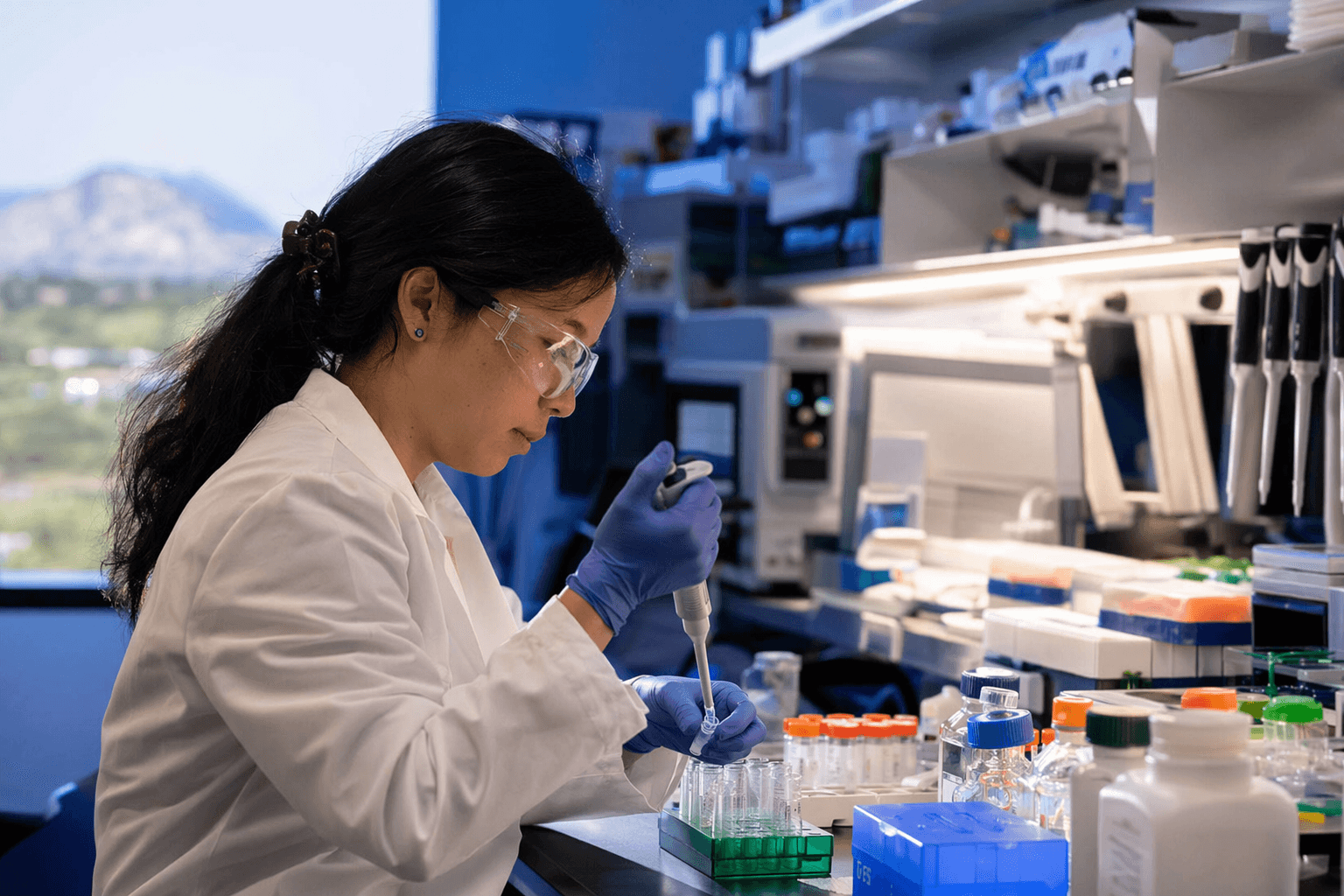
Karissa Y. Sanbonmatsu, one of the Los Alamos scientists on the project, said the challenge is that RNA data are still limited and RNA is often more variable and floppier than proteins, which means researchers must account for many possible structures rather than one fixed form. That is exactly what made the finding stand out: the team showed that structure and function are tightly linked in this ribozyme, and that the cleavage region acts as an architectural organizer.
The study, titled Cleavage region organizes the structural architecture of the SINE-derived B2 repressive ribozyme, included Ankush Singhal, Tyler Mrozowich, Carlos Rivera, Susmit Narayan Chaudhury, Lilei Xu, Rodrigo Aguilar, Maulik Badmalia, Jeannie T. Lee, Trushar R. Patel, and Sanbonmatsu. The researchers used RNA chemical probing, small-angle X-ray scattering, and 3D motif modeling, along with point mutations and deletions of the cleavage site, to see how the RNA ensemble shifted and how those shifts changed biological behavior.
The paper adds another wrinkle: the self-cleaving activity can be induced by chromatin-modifying factors through non-canonical epigenetic mechanisms. That is rare in mammals and makes the SINE B2 system especially useful for studying gene regulation. In practical terms, it gives Los Alamos researchers a new model for how RNA can act as a molecular switch without proteins.
The study also fits into a broader scientific push around ribozymes and RNA-based regulation, areas that point toward an ancient RNA world and modern applications in gene control. For Los Alamos, the payoff is not just scientific prestige. It reinforces the lab’s bioscience and genomics programs as a driver of outside collaboration, future funding, and advanced research tied to medicine and biotechnology. The team’s data are now publicly trackable through SASDB under accession numbers SASDV63, SASDV93, SASDV83 and SASDV73, and its SHAPE-processing scripts were released through Zenodo, widening the impact beyond one experiment and into the next round of RNA research.
This article was produced by Prism’s automated news system from verified source data, official records, and press releases, then run through automated quality and moderation checks before publishing. The system is built and supervised by the people who set the standards it runs under. Read our full AI policy.
Did this article answer your question?