Manhattan Project National Historical Park Marks 10th Anniversary at Fuller Lodge
A park that drove 25,538 visits and $1.8 million in local spending in 2024 marks 10 years April 8 at Fuller Lodge, where staff will preview the next decade.
When Secretary of the Interior Sally Jewell and Secretary of Energy Ernest Moniz co-signed the founding memorandum for Manhattan Project National Historical Park on November 10, 2015, Los Alamos became the anchor of a three-city federal park stretching from New Mexico to Washington state. In 2024, that anchor drew 25,538 visitors and delivered $1.8 million in direct spending to local businesses. On April 8, park staff will gather in Fuller Lodge's Pajarito Room to present that record and lay out the interpretive programs and preservation work the park is carrying into its second decade.
The anniversary event runs 5:30 to 7:00 p.m. at 2132 Central Ave. A formal program reviewing ten years of site preservation, educational outreach, and community partnerships wraps around 6:15 p.m., after which staff and partner organizations will be stationed throughout the room to discuss upcoming interpretive programs, volunteer opportunities, and educational resources for students and adults. A reception with cake follows.
Set against the park's other two units, the Los Alamos numbers make a case for the Hill's standing as a national destination. The Hanford, Washington site drew 19,644 visits and generated $773,000 in local spending in 2024; Oak Ridge, Tennessee, led the park system with 29,511 visits and $2.8 million. All three units combined pushed approximately $5.4 million into surrounding communities, nearly 10 percent more than 2023. The joint NPS-Department of Energy structure funds interpretive work through federal investment while DOE retains ownership of the underlying sites, a model in place since the park's founding.
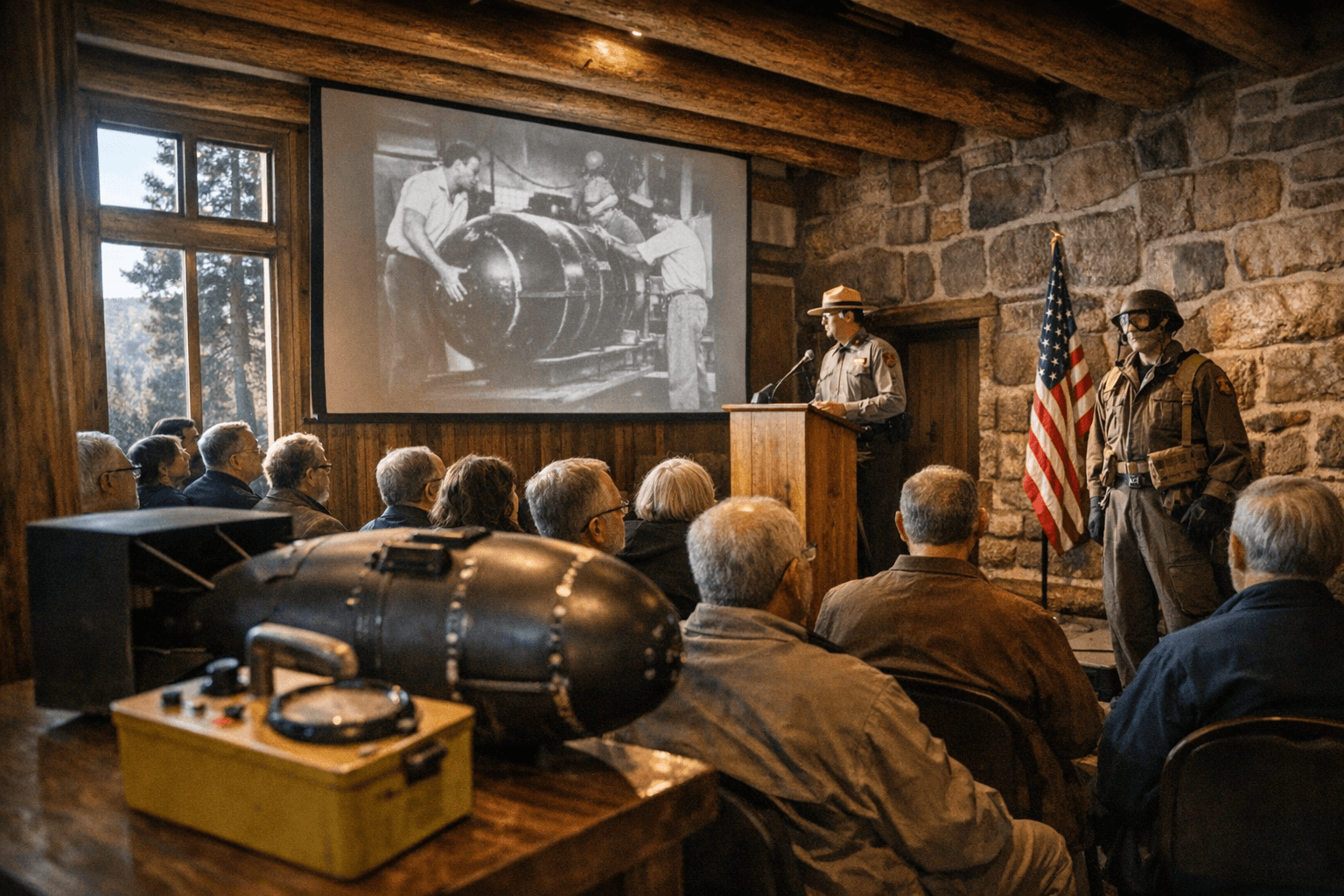
Fuller Lodge itself is a fitting backdrop for this accounting. The log structure at 2132 Central Ave. served as the Ranch School's dining hall before the Army commandeered the mesa in 1943, then became the social center where scientists and workers gathered through the Manhattan Project years. For more than 80 years it has sat at the center of community life in Los Alamos, and it now serves as the park's primary community-facing venue for interpretive programs and public events.
The park's first decade was built on a question Jewell and Moniz could answer only in theory in November 2015: whether a federal institution could steward the contested, morally complex history of the weapon that ended World War II in a way that serves both scholarship and public understanding. The April 8 program will review how the park addressed that question through preserved structures, ranger-led tours, school programming, and local partnerships. What staff present that evening about the next ten years will carry weight for a community whose identity has never been fully separable from what happened here eight decades ago.
This article was produced by Prism’s automated news system from verified source data, official records, and press releases, then run through automated quality and moderation checks before publishing. The system is built and supervised by the people who set the standards it runs under. Read our full AI policy.
Did this article answer your question?