SpaceX Falcon 9 Launch Visible from Los Alamos, Booster Lands Successfully
A SpaceX Falcon 9 rocket launched from Vandenberg Space Force Base on the night of Jan. 2, 2026, carrying an Italian Earth-observing satellite, and the ascent was visible from Los Alamos and White Rock. The mission, reported locally as SpaceX's first launch of 2026, featured a planned booster landing about 8.5 minutes after liftoff and generated strong local interest and community photos.
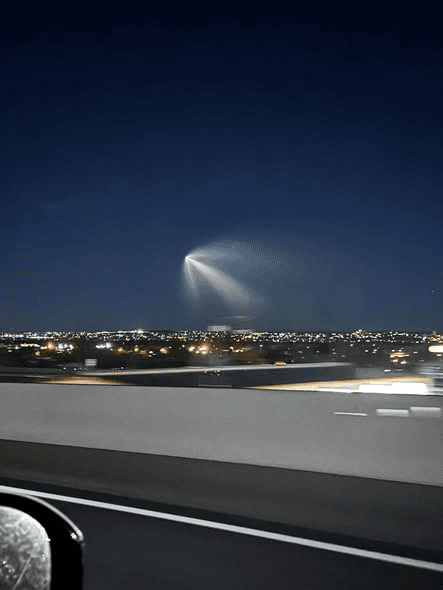
Residents across Los Alamos County watched the night sky on Jan. 2 as a SpaceX Falcon 9 rose from Vandenberg Space Force Base carrying an Italian Earth-observing satellite. The liftoff, noted locally as SpaceX's first mission of 2026, was visible from neighborhoods in Los Alamos and White Rock and prompted numerous reports and photographs from area residents.
The rocket's first-stage booster performed as planned, touching down approximately 8.5 minutes after liftoff. The successful recovery is consistent with SpaceX's focus on reusability, which has helped reduce launch costs and increase flight cadence for commercial and government payloads. That cadence is one reason residents across wide geographic areas can sometimes see launches, as rockets climb through illuminated exhaust plumes against night skies.
For local viewers, the event was primarily a community moment. People reported seeing the rocket's bright ascent and the expanding trail in the sky, and several local contributors submitted photos documenting the sight from different vantage points. Those images captured both the initial streak of the launch and the changing sky as the vehicle climbed, giving a tangible sense of how high-altitude launches can be visible even from several states away.
Beyond the immediate spectacle, the mission underscores a broader trend in space activity that has implications for Los Alamos County and the region. Increasingly routine commercial launches expand access to Earth-observation data that can inform climate monitoring, natural resource management, and emergency response planning. An Italian Earth-observing satellite aboard this Falcon 9 adds to the growing fleet of international instruments that collect imagery and measurements used by researchers and local planners.

There are also practical community considerations. Nighttime launches can prompt curiosity and questions about air and noise impacts, and the visibility of launches can foster public interest in science, technology, engineering and math careers. Local schools, civic groups and amateur astronomy observers may find opportunities to use such events as teaching moments about orbital mechanics, satellite data and the modern launch economy.
The Jan. 2 sighting is one in a pattern of more frequent, visible launches that residents may encounter in coming years. For now, the successful Falcon 9 mission and booster landing provide a clear example of modern rocket operations and a memorable skywatching moment for Los Alamos County, captured in photographs submitted by local contributors.
Know something we missed? Have a correction or additional information?
Submit a Tip