Gallup depot becomes cultural center for community connection
Gallup’s former Santa Fe Depot now anchors downtown as a museum, Amtrak stop and cultural center. Its 1996 transfer shows how one building still serves passengers, visitors and local identity.
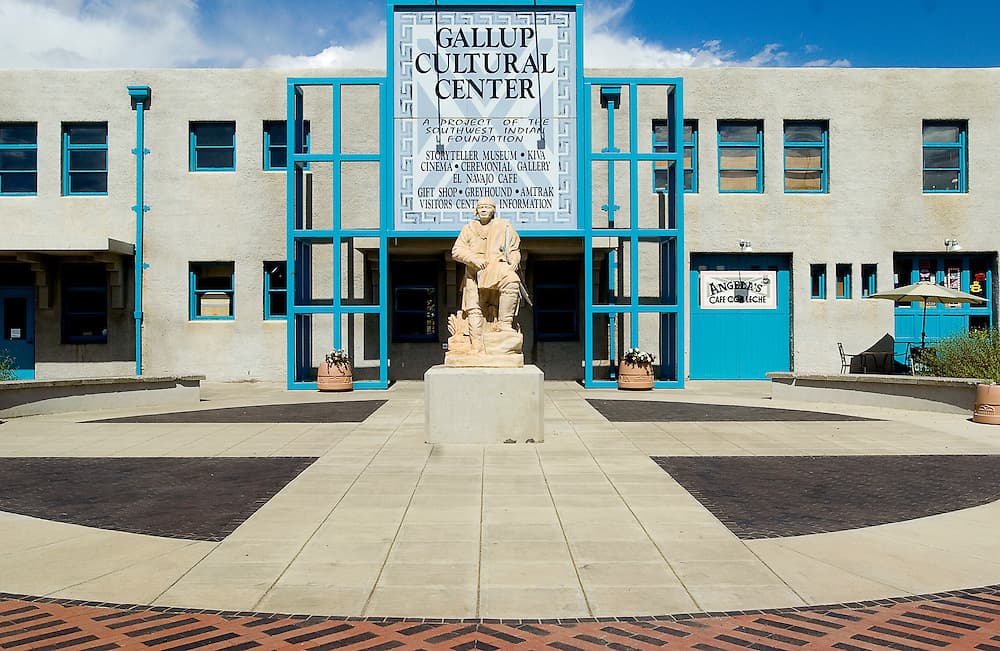
At 201 E. Route 66 in downtown Gallup, the old Santa Fe Depot still moves people, only now it does it as a cultural center, museum and Amtrak stop. The City of Gallup handed the newly renovated building to the Southwest Indian Foundation in 1996 and asked it to turn the depot into a cultural center for the larger community. That decision left Gallup with a building that preserves rail history while serving everyday civic life, from visitors arriving by train to residents looking for a downtown destination.
A depot still doing public work
The Gallup Cultural Center’s own message is simple: “CULTURE - COMMUNITY - CONNECTION.” That slogan fits the building’s current role because it is not just preserved architecture sitting behind a rope line. It is a working public space in a city built around rail travel, trade and the movement of people through northwestern New Mexico.
The center sits inside the historic depot at 201 E. Historic Highway 66 as well as 201 E. Route 66. It is also part of the current Amtrak station, which keeps the site tied to transportation even as it hosts cultural activity. Amtrak’s Gallup stop is listed as GLP, and the building’s dual use gives downtown a rare mix of transit access and community presence in one address.
What visitors find inside
The center’s museum is on the second floor, according to Route 66 heritage listings. Visitor summaries describe exhibits on area tribes and local history, and they note that the building once served railroad tourists in a different era. That makes the site useful in two directions at once: it helps tell Gallup’s story and gives travelers a reason to stay in downtown Gallup instead of passing through.
A visitor listing places museum hours at Monday through Friday, 10 a.m. to 4 p.m. Those hours matter because they show the center functions as a regular public-facing institution, not an occasional event space. For anyone planning a stop, the schedule is straightforward, and the setting inside the depot makes the visit part history lesson, part downtown errand, part travel stop.
Why this building matters in Gallup now
Gallup was founded in 1881 as a railhead for the Atlantic and Pacific Railroad, so the depot is not an accessory to the city’s identity. It sits at the point where the town’s rail origin, downtown commerce and regional mobility all meet. Visit Gallup also frames the city as a place where trade and commerce with surrounding Native American communities has been important since the late 1800s, which helps explain why a cultural center focused on Native art and community use belongs in this building.
The Southwest Indian Foundation says its mission is to lessen poverty and unemployment among Native Americans of the Southwest, specifically Navajo, Zuni, Hopi, Laguna, Acoma and Apache peoples, through self-help initiatives and charitable donations. In Gallup, that mission runs through the cultural center in partnership with the city. The result is a site that links heritage preservation with a broader civic purpose, especially in a county where Native communities shape the region’s economy, culture and daily life.
A downtown network, not an isolated stop
The cultural center is positioned as part of a wider downtown circuit rather than a standalone attraction. Its events page points visitors toward the Octavia Fellin Public Library, El Morro Theater, Art123 Gallery, the Rex Museum and transportation resources. That cluster matters because downtown foot traffic is not generated by a single building alone. It depends on connected destinations that give people reasons to walk, linger and spend time in the center of Gallup.
That broader network is one reason the depot still matters to the local economy and downtown identity. A restored station that functions as a museum and visitor stop can help reinforce the blocks around it, especially when it is linked to nearby cultural institutions. Great American Stations describes station restoration as a way for communities to unlock the economic value of train stations, and Gallup fits that model closely.
A BNSF Railway heritage piece dated Aug. 4, 2023, also underscores that Gallup’s rail story still carries civic weight. The city’s train history is not a closed chapter. It is part of how Gallup presents itself now, whether through Amtrak service, heritage storytelling or the cultural center’s presence on Route 66.
The history behind the walls
The building’s past is layered enough to demand careful naming. One preservation source says the Santa Fe Depot was built in 1899 and served as a passenger rail station until 1966. Another route history source identifies Gallup’s depot as the 1923 Santa Fe Depot. Both cannot describe the same structure in exactly the same way, which suggests Gallup’s station history needs clear labeling in official materials and local interpretation.
That matters because the depot’s story is one of the reasons the building still draws attention. If the city and its partners want the center to keep working as a public asset, they need the history to be legible, the name to be consistent and the building itself to be maintained. A site that serves both rail passengers and museum visitors cannot afford confusion about what it is called or how its history is presented.
What to watch next
There is also a naming wrinkle worth fixing. Visit Gallup refers to the attraction as the George Galanis Multicultural Center, while other official and project pages use Gallup Cultural Center. Whether that is an alternate name, a related designation or a leftover listing, the inconsistency can make the place harder to find and harder to explain. Clear naming is not cosmetic when a downtown institution depends on wayfinding, tourism and public recognition.
The bigger issue is upkeep. The center’s value comes from the fact that it is in use: a station, a museum, a community landmark and a bridge between Gallup’s rail past and its present-day civic life. If the city, the Southwest Indian Foundation and other partners let maintenance slide, Gallup would not just lose a preserved building. It would lose a rare downtown space that still carries passengers, tells local history and keeps a historic depot active in the middle of the city.
This article was produced by Prism’s automated news system from verified source data, official records, and press releases, then run through automated quality and moderation checks before publishing. The system is built and supervised by the people who set the standards it runs under. Read our full AI policy.
Did this article answer your question?