Gallup feature explains Memorial Day's meaning and Civil War origins
Gallup’s Memorial Day reminder starts with a family grave and ends at city memorials, tracing how a Civil War ritual became a local day of military remembrance.
A local act of remembrance anchors the holiday
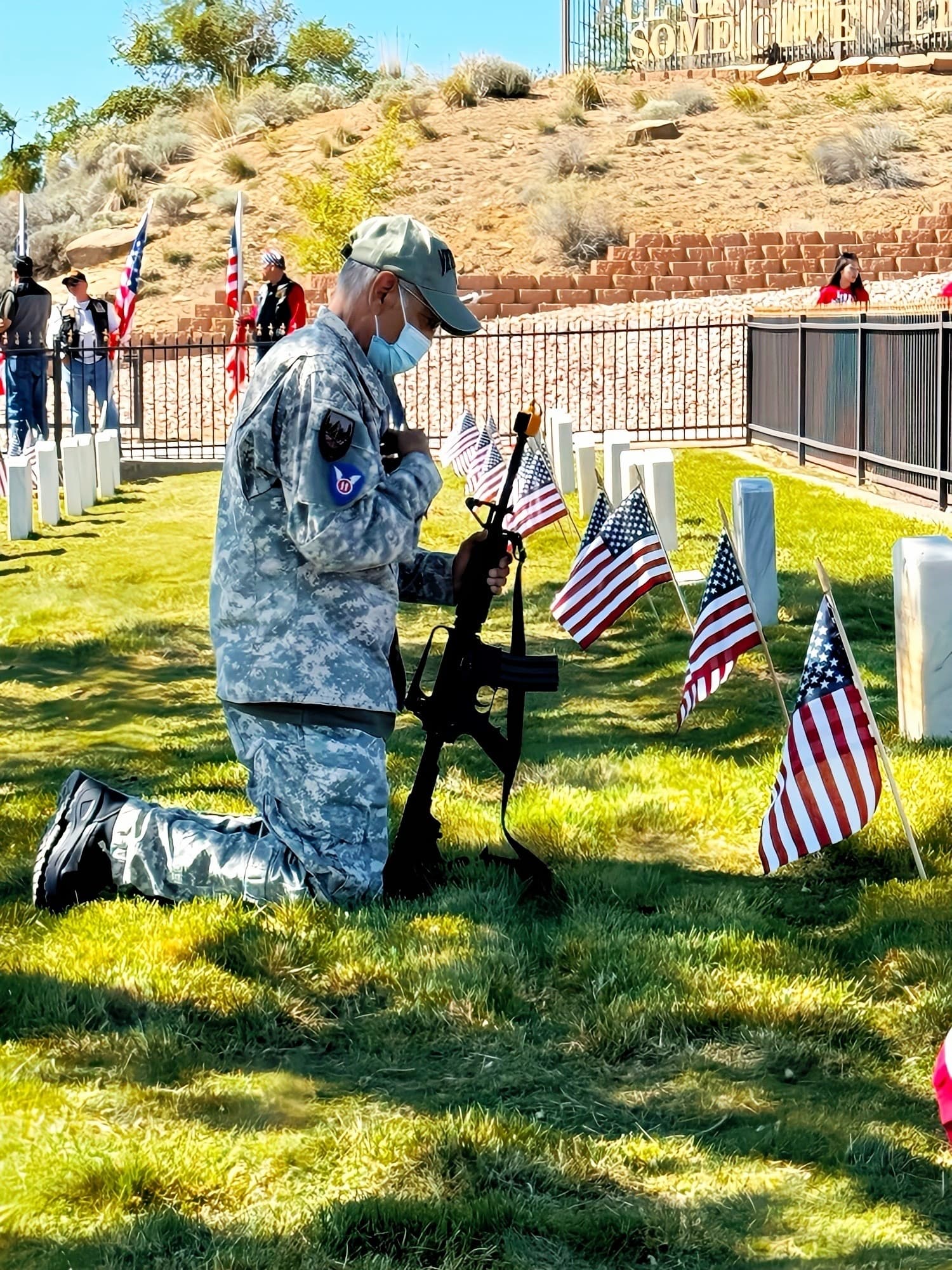
Anton Grieg kneeling before an ancestral grave is the image that gives Memorial Day its most immediate meaning in Gallup. The file photo used with the Gallup Sun’s holiday feature shows remembrance as something intimate and familial, not just ceremonial, and that matters in McKinley County, where military service is woven into many households’ histories.
That local frame fits the way Gallup publicly marks the day. Memorial Day here is not simply the unofficial start of summer. It is a time when families, veterans groups, and civic institutions pause over names, graves, and memorials that connect the county to service and sacrifice across generations.
How Decoration Day became Memorial Day
The holiday’s roots reach back to the Civil War, when communities began decorating the graves of the dead. What is now Memorial Day began as Decoration Day, a national act of mourning created to honor those who died in military service.
The turning point came on May 5, 1868, when the Grand Army of the Republic issued General Orders No. 11. Maj. Gen. John A. Logan then designated May 30 as the day of observance. The first official national Decoration Day event followed at Arlington National Cemetery on May 30, 1868, where more than 5,000 people gathered for the ceremonies.
That first observance was deeply tied to the nation’s postwar memory. National Park Service history notes that John A. Logan presided and James Garfield served as the principal speaker, giving the day both political weight and public solemnity. Congress later made Memorial Day a national holiday in 1971 and fixed it on the last Monday in May, a change that helped define the modern holiday calendar while preserving its original purpose.
Why the history still matters in Gallup
In a place like Gallup, the origin story is not just trivia. It shapes how people understand the day now, especially in a county with strong ties to veterans, tribal communities, and military families. The Gallup Sun’s feature works as a reminder that the holiday exists to honor the dead, not to celebrate the season.
That message lands locally because Gallup has built much of its civic identity around military remembrance. Visit Gallup describes the city as “America’s Most Patriotic Small Town,” and that claim is backed by a long list of names and histories tied to the region: WWII Navajo Code Talkers, Korean War Medal of Honor recipient Hiroshi “Hershey” Miyamura, surviving Bataan Death March veterans, and the 442nd. Those are not abstract symbols in McKinley County. They are part of the local story of who served, who returned, and who did not.
Memorials in downtown Gallup keep the names visible
The Veterans Memorial Pillars in downtown Gallup give the holiday a permanent public face. Located in front of the McKinley County Courthouse in historic downtown Gallup, the pillars honor service members from World War I through the Gulf Wars, along with the WWII Navajo Code Talkers.
That detail matters because it shows how remembrance is placed in the center of civic life, not pushed to the margins. Courthouse Square and the surrounding downtown streets make the memorial part of the everyday landscape, so the county’s military history stays visible whether people are there for legal business, shopping, or a holiday ceremony.
The message is reinforced by the broader geography of the county. McKinley County covers 5,451.1 square miles of land area and had an estimated population of 68,119 on July 1, 2025. Within that vast rural space, the U.S. Census Bureau reports 2,205 veterans for 2020-2024. Those numbers help explain why public remembrance remains so important here: the county is large, spread out, and home to many families with direct ties to military service.
Gallup’s observances turn remembrance into a civic ritual
The city’s annual veterans observances make Memorial Day part of a larger calendar of tribute. Visit Gallup lists wreath laying at Hillcrest Veterans Cemetery, a parade on Aztec Avenue, and tributes at the Veterans’ Memorial as recurring pieces of that public remembrance. Each one gives residents a different way to show respect, whether through silence at a cemetery, marching on a main street, or standing in front of a memorial.
That pattern matters because it ties the holiday to place. Hillcrest Veterans Cemetery gives families a setting for personal mourning. Aztec Avenue brings remembrance into public view. The Veterans’ Memorial turns memory into an established civic act. Together, those observances show that Gallup’s Memorial Day is not a single moment, but a set of shared customs that keep military loss present in the public square.
A regional duty, not just a holiday weekend
Rep. Patty Lundstrom has described Northwestern New Mexico as having “a special reverence” for fallen service members, and that fits the way Memorial Day is treated across the region. Her commentary also pointed readers toward the annual parade in Gallup and a Purple Heart City designation ceremony in Farmington, showing that remembrance stretches beyond one town and into neighboring communities.
Lundstrom’s reference to “the hundreds of New Mexicans lost in Vietnam” brings the scale of sacrifice into sharp focus. It is a reminder that Memorial Day is not about abstraction or ceremony alone. It is about specific lives, specific families, and specific losses that still shape communities across McKinley County and beyond.
The Gallup feature succeeds because it keeps that truth at the center. By pairing the Civil War origins of Memorial Day with a local image of Grieg at a family grave, it links national history to the everyday practice of honoring the dead. In Gallup, the holiday still asks for more than a day off. It asks for memory, and for the public discipline to keep that memory visible.
This article was produced by Prism’s automated news system from verified source data, official records, and press releases, then run through automated quality and moderation checks before publishing. The system is built and supervised by the people who set the standards it runs under. Read our full AI policy.
Know something we missed? Have a correction or additional information?
Submit a Tip